A proposal posted October 20, 2026 argues that technosignature searches should examine planetary landscapes, not only radio signals. Ana Henrique, Sofia Sheikh and Benjamin Fields suggest looking for persistent surface patterns that could result from technological activity.
What would actually be searched?
The authors propose applying anomaly-detection methods to existing lunar and Martian imagery. They also discuss follow-up with radar and spectroscopy, rather than treating an unusual shape alone as proof of construction.
They explicitly state that their plausibility arguments do not demonstrate any extraterrestrial surface technosignature. The proposal is a research agenda, not a report of ruins, artifacts or a detected civilization.
A known human example
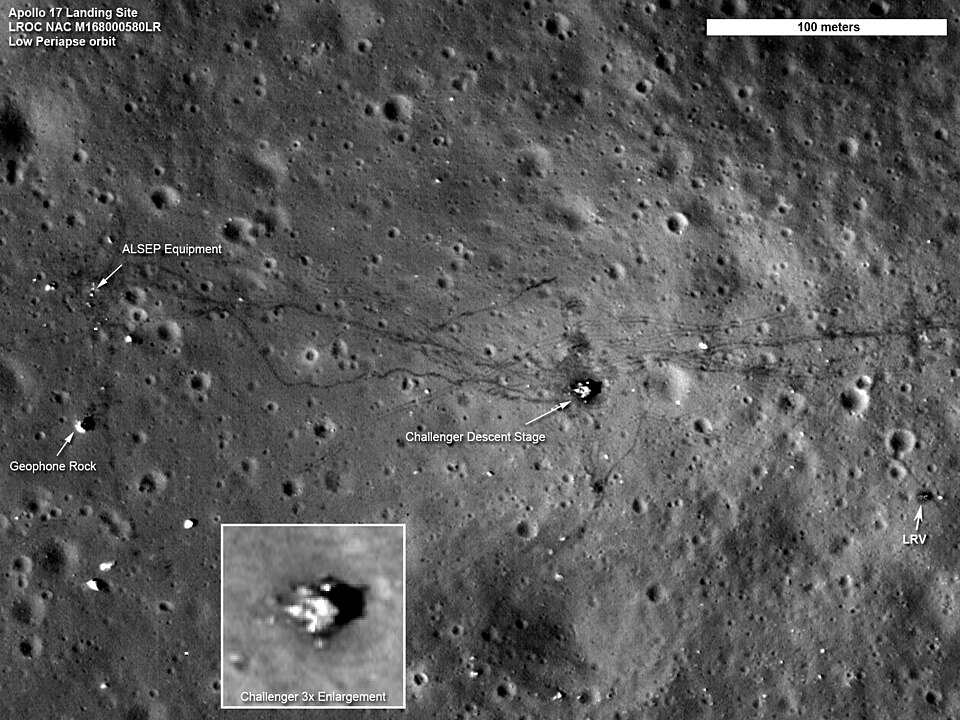
NASA’s Lunar Reconnaissance Orbiter imagery shows Apollo landing sites and traces of human exploration. These known objects demonstrate that some technological traces can be recorded from orbit. They do not establish that similar traces from another civilization exist.
For a future search, a useful result would include measured sensitivity: which sizes, contrasts and terrain types could the method detect, and which could it miss? Natural geology, lighting and image artifacts would need testing before any unusual pattern could become a credible technology claim.
Primary sources
Image: Labeled LRO image of the Apollo 17 landing site, released in 2011. Credit: NASA/GSFC/Arizona State University. Public-domain source copy. This is evidence of human exploration, not extraterrestrial technology.