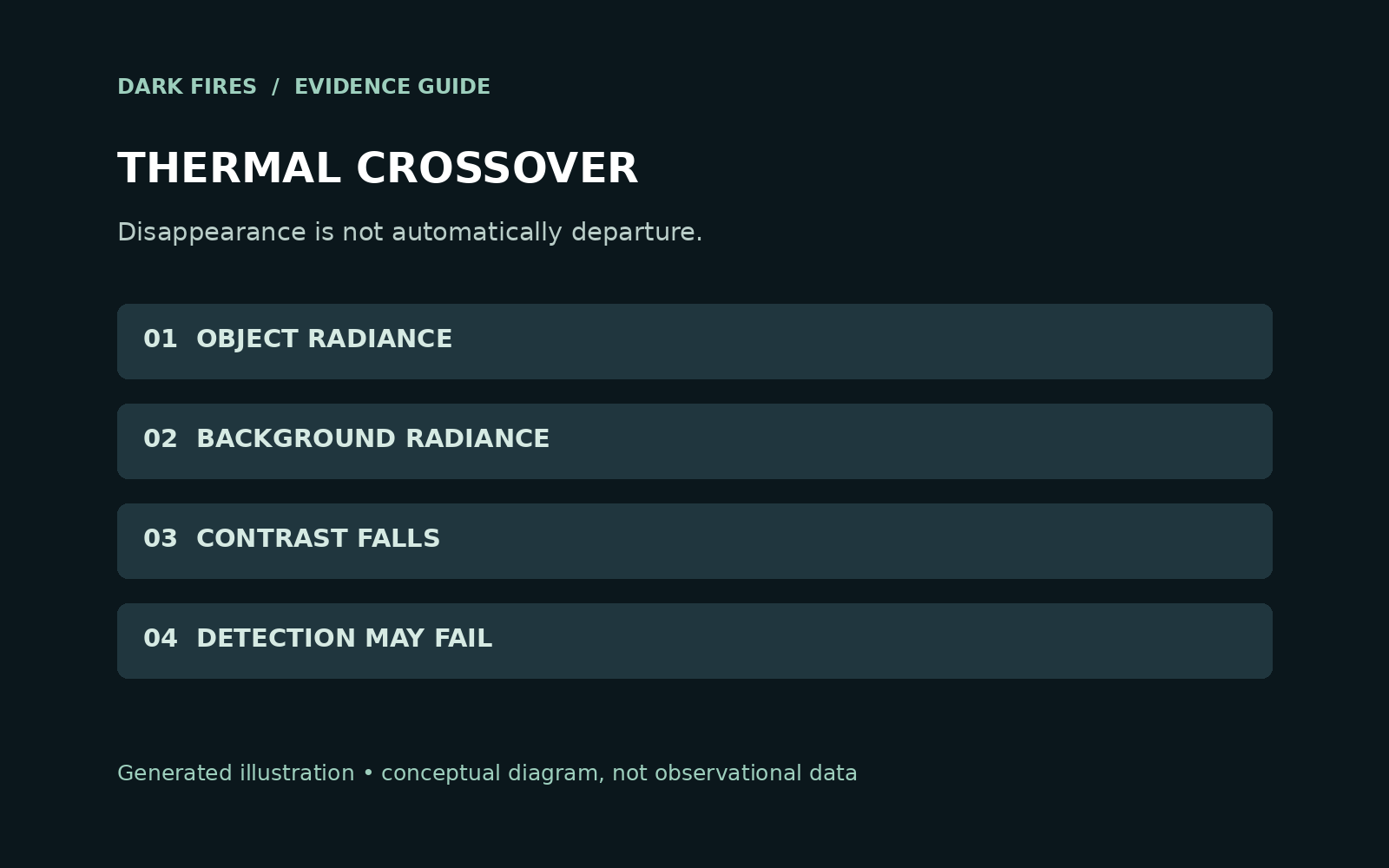
An object can become difficult to distinguish in a thermal image without leaving the scene. One reason is thermal crossover: conditions in which a target and its surroundings produce too little contrast for clear separation.
Infrared imagery is not simply an outline of everything present. A 2010 experimental study of conventional and polarimetric thermal imaging explains that effective temperatures depend on actual temperature and emissivity, the efficiency with which a surface emits radiation. As those signatures change, objects that were conspicuous can become less distinct.
The researchers compared mid-wave and long-wave infrared observations through crossover periods. Their results suggested that combining polarimetric information from those bands could improve conventional thermal imagery. That is an instrument-performance finding, not evidence that any particular unexplained sighting has been solved.
For UAP footage, the relevant question is therefore not just “Where did it go?” Ask whether contrast changed, whether the camera settings changed, and whether another sensor continued to detect the object. Preserve the unedited sequence before and after the apparent disappearance.
Thermal crossover is one possible mechanism among many. A clip alone may not establish that it occurred. Equally, losing a thermal signature does not by itself demonstrate acceleration, dematerialization or a transition into water.
Primary sources: Experimental paper; U.S. Army technical discussion of thermal imagery.
Generated illustration
Original Dark Fires conceptual diagram, not observational data or a reconstruction of a sighting.
Leave a Reply