DARK FIRESORIGINS UNKNOWN

Author: Dark Fires

  • GIMLI Will Test Whether a Lunar Pit Opens Into a Hidden Lava Tube

    GIMLI Will Test Whether a Lunar Pit Opens Into a Hidden Lava Tube

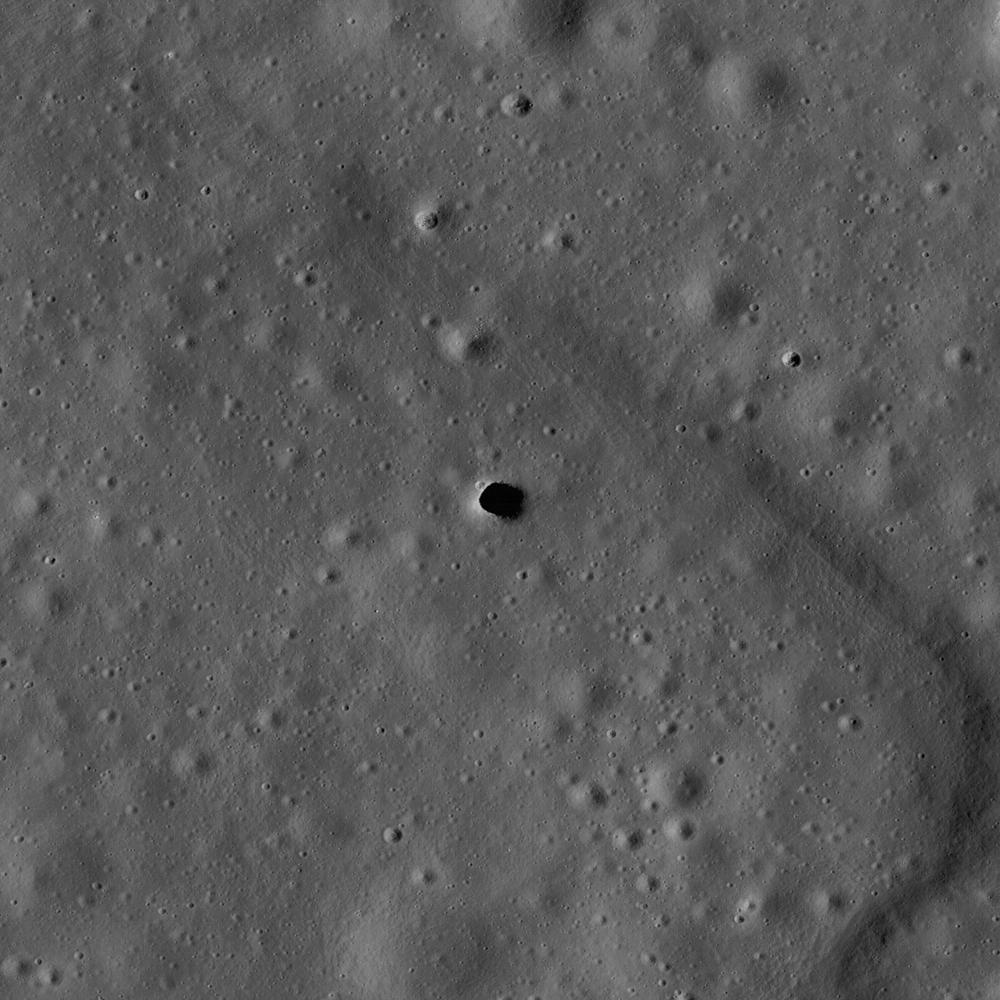
    Marius Hills Pit photographed from lunar orbit. Credit: NASA/GSFC/Arizona State University. Image source.

    A dark opening in the Moon’s volcanic landscape is getting a closer investigation. NASA selected GIMLI on September 30, 2026, to determine whether the Marius Hills Pit connects to a substantial underground lava tube. The Planetary Science Institute described the project on October 1. The announcement marks a new investigation, not the discovery of a habitable cave. NASA’s selection announcement identifies the payload as Geophysical Instruments for Marius Lunar pit Investigation.

    What the opening already reveals

    The Lunar Reconnaissance Orbiter Camera’s pit atlas describes an elliptical opening within a winding channel. Its inner dimensions are approximately 49 by 55 metres, with a depth of about 40 metres. The floor appears comparatively flat but is strewn with boulders, and slight overhangs occur near its base. The atlas cautions that debris may complicate access to any deeper void. That makes the difference between seeing an opening and mapping what lies beyond it especially important.

    Several ways to look underground

    Led by PSI’s Nathaniel “Than” Putzig, GIMLI will combine ground-penetrating radar, seismic measurements, a gravimeter and cameras. Radar and seismic observations will probe the subsurface, while gravity measurements provide another way to investigate its structure. Cameras will document the surface and exposed pit walls. The instruments are intended to establish whether an underground void exists and, if so, constrain its dimensions. PSI’s project description also identifies Honeybee Robotics as an equipment and integration partner and the Norwegian Space Agency as the radar provider.

    The geology matters even if the cave search comes up empty. Layers exposed in the walls could record separate lava flows and intervals between eruptions. Measurements around the opening could also help explain how the pit itself formed. Those are useful results regardless of whether the site eventually has practical value for exploration.

    From intriguing feature to measured environment

    NASA selected GIMLI alongside two other lunar investigations: LEMS-SP, designed to monitor environmental hazards and seismic activity, and DISCO, intended to investigate ice in small cold traps and surface conditions. The payloads are to reach the Moon through the Commercial Lunar Payload Services initiative. NASA’s announcement does not provide a launch date or name a delivery company for GIMLI.

    The appeal of a lunar cave is easy to understand: surrounding rock could provide shielding and a more stable thermal environment. But the immediate task is narrower and scientifically testable. Before anyone can assess a shelter, they need to know whether the cavity exists, how large it is and what its surroundings are like. GIMLI would turn a promising orbital target into a place whose subsurface can be measured directly.
  • Carbon Dioxide and Clouds Complicate the Search for Habitable Worlds

    Carbon Dioxide and Clouds Complicate the Search for Habitable Worlds

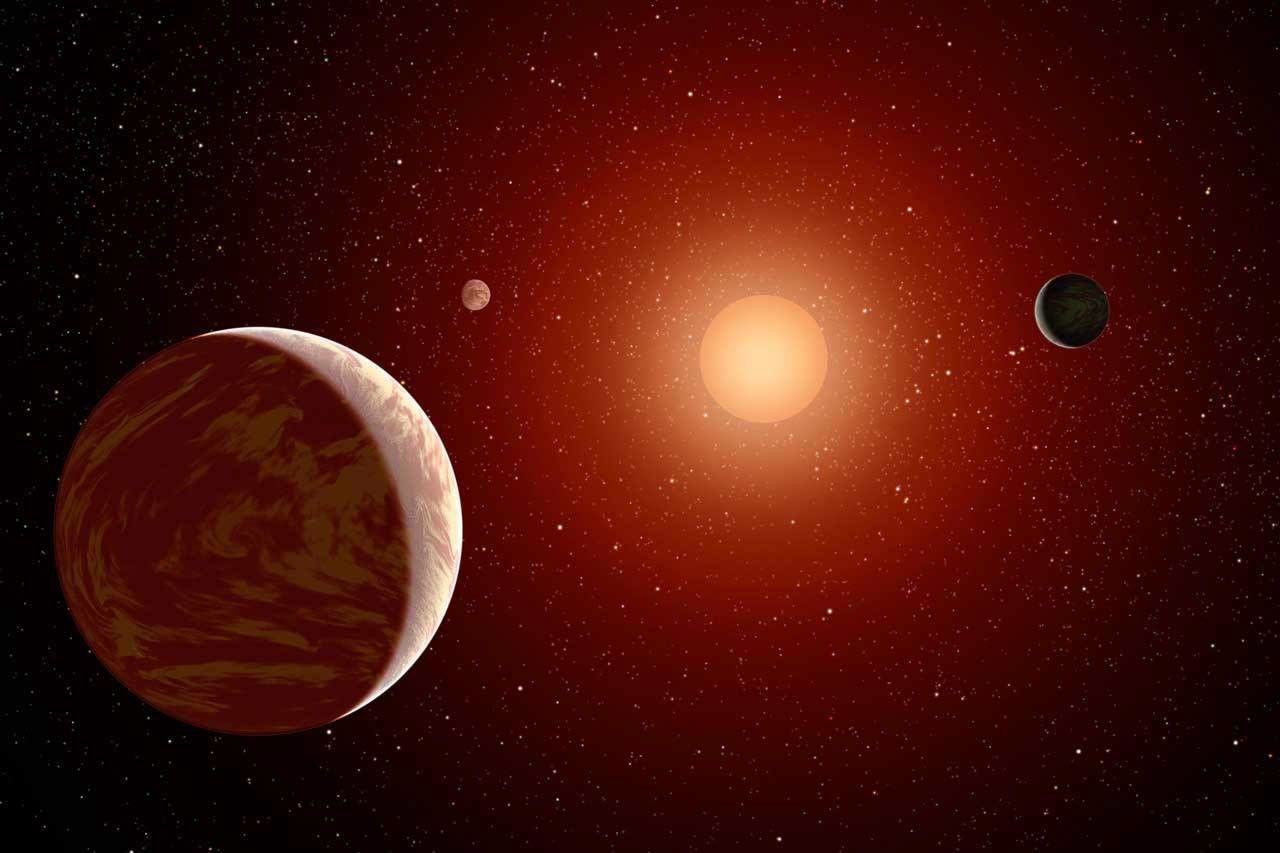
    Context illustration of planets orbiting a red dwarf star. The new research simulates atmospheric and climate possibilities rather than imaging these worlds. Credit: NASA/JPL-Caltech. Image source and credit.

    A new study explores outer-habitable-zone planets, where substantial carbon dioxide may be needed to keep surface water liquid. Daria Pidhorodetska and colleagues posted the research on September 29, 2026; it is also published in The Astrophysical Journal. Their simulations connect possible climates with the atmospheric signals future telescopes could seek.

    Distance alone leaves important questions unanswered

    The habitable zone describes where an appropriately equipped planet could maintain liquid surface water. As NASA’s overview explains, its location depends on the star: dim red dwarfs have close-in zones, while hotter stars illuminate broader, more distant regions. An orbital address is consequently only an initial clue. A rocky world also needs conditions that actually allow the water to persist. Stellar radiation, atmospheric survival and the planet’s physical characteristics all affect the interpretation.

    The new work uses the three-dimensional Generic Planetary Climate Model to examine high-carbon-dioxide climates. It finds broad agreement with earlier one-dimensional predictions while showing why carbon dioxide condensation and clouds deserve explicit treatment. The researchers also calculate spectra, predicting differences between habitable and nonhabitable versions of these carbon-dioxide-rich worlds. They consider direct imaging around Sun-like stars and transmission or emission measurements for planets around M dwarfs. These are modeled possibilities, not detections of new inhabited planets.

    The carbon cycle complicates the picture

    Earlier NASA-supported research on the outer habitable zone examined another difficulty: maintaining warmth over time. Volcanic carbon dioxide can help a frozen planet thaw, but weathering can subsequently remove that greenhouse gas. Under some modeled conditions, a planet cycles between warmer intervals and prolonged glaciation. The balance depends on uncertain properties such as outgassing and how efficiently exposed rocks react with water. A snapshot of possible warmth therefore leaves a separate question about how long it lasts.

    Potentially habitable for which organisms?

    Carbon dioxide also changes what habitability means biologically. A 2019 study by Edward Schwieterman and colleagues compared atmospheric models with physiological limits of complex aerobic life on Earth. It found that the gas concentrations required to warm some outer-zone planets could exceed the tolerances of such organisms. Its proposed zone for complex life was narrower than the conventional liquid-water zone. Those constraints concern known terrestrial biology; they do not establish a universal boundary for every conceivable form of life.

    Taken together, these studies suggest a careful sequence for interpretation: establish the atmosphere, assess its climate, and then ask what kinds of environments it might support. The latest simulations contribute to the first two steps by predicting observable consequences of thick carbon dioxide and clouds. Identifying those consequences would help astronomers decide which apparently promising worlds merit closer investigation.

  • Early Earth’s Cooling May Have Opened a Window for RNA-World Chemistry

    Early Earth’s Cooling May Have Opened a Window for RNA-World Chemistry

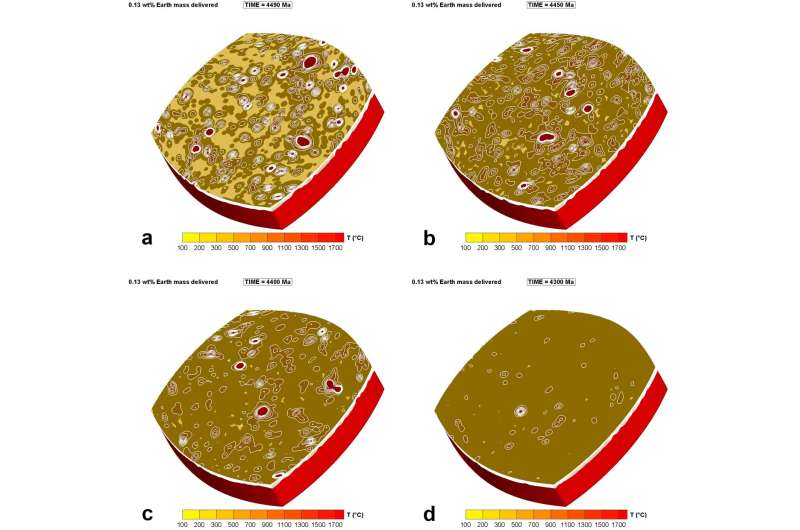
    Model snapshots show impact heating becoming less widespread as early bombardment declines. Colors represent modeled temperatures about 4 kilometers below the surface; circles mark craters. Credit: Abramov et al., Nature Communications, Figure 2, CC BY 4.0. Figure source. CC BY 4.0.

    Earth may have developed especially favorable conditions for the chemistry preceding life about 4.33 billion years ago, according to a study published on September 22, 2026, in Nature Communications. The estimate comes from a computer reconstruction of heating and cooling in the young planet’s crust. It identifies an environmental opportunity rather than a directly measured date for life’s origin.

    When a cool interval became lasting shelter

    Oleg Abramov and colleagues simulated impact heating from 4.5 billion to 3.5 billion years ago. The Planetary Science Institute’s research account emphasizes persistence: could a region cool enough for vulnerable molecules to survive, then remain cool through later bombardment? Another major impact could destroy chemistry accumulating during a temporarily favorable interval.

    In the model, regions of shallow crust that remained below the study’s temperature threshold began appearing after about 4.4 billion years ago. The paper also assessed cooler conditions appropriate to preserving molecular building blocks, including a conservative 60°C threshold for RNA-related chemistry. This distinction matters: an environment tolerable to an already evolved heat-loving microbe may still damage molecules involved in an earlier, more fragile chemical system.

    Impacts could also supply useful environments

    Bombardment also supplied useful heat. Water circulating through impact-heated rock can form hydrothermal systems with chemical-energy sources. The institute describes a period when globally destructive heating had declined while these systems remained widespread. That overlap helps explain the preferred window for persistent chemistry near 4.33 billion years ago.

    How the estimate fits life’s family tree

    A separate line of research works backward from organisms alive today. In a 2024 study led by the University of Bristol, researchers compared genes and used evolutionary models to estimate that the last universal common ancestor, or LUCA, lived about 4.2 billion years ago. LUCA represents an ancestor shared by modern cellular life. The reconstruction suggested an organism already possessing considerable biological complexity, rather than the first tentative step from chemistry into biology.

    These approaches address different parts of the problem. Molecular clocks infer evolutionary history; the new thermal calculations ask when suitable environments could endure. Agreement between their broad timelines is interesting, but it does not turn a model into a fossil record of an RNA world.

    The new work does not simulate a complete origin of life or demonstrate that RNA-based organisms actually occupied its modeled refuges. Its value is in narrowing physical conditions that proposed origin scenarios must satisfy. Future evidence about impact history, ancient crust and molecular stability can test how robust that opportunity window really was.

  • A Tiny Electrical Sensor Reads the Handedness of Life’s Building Blocks

    A Tiny Electrical Sensor Reads the Handedness of Life’s Building Blocks

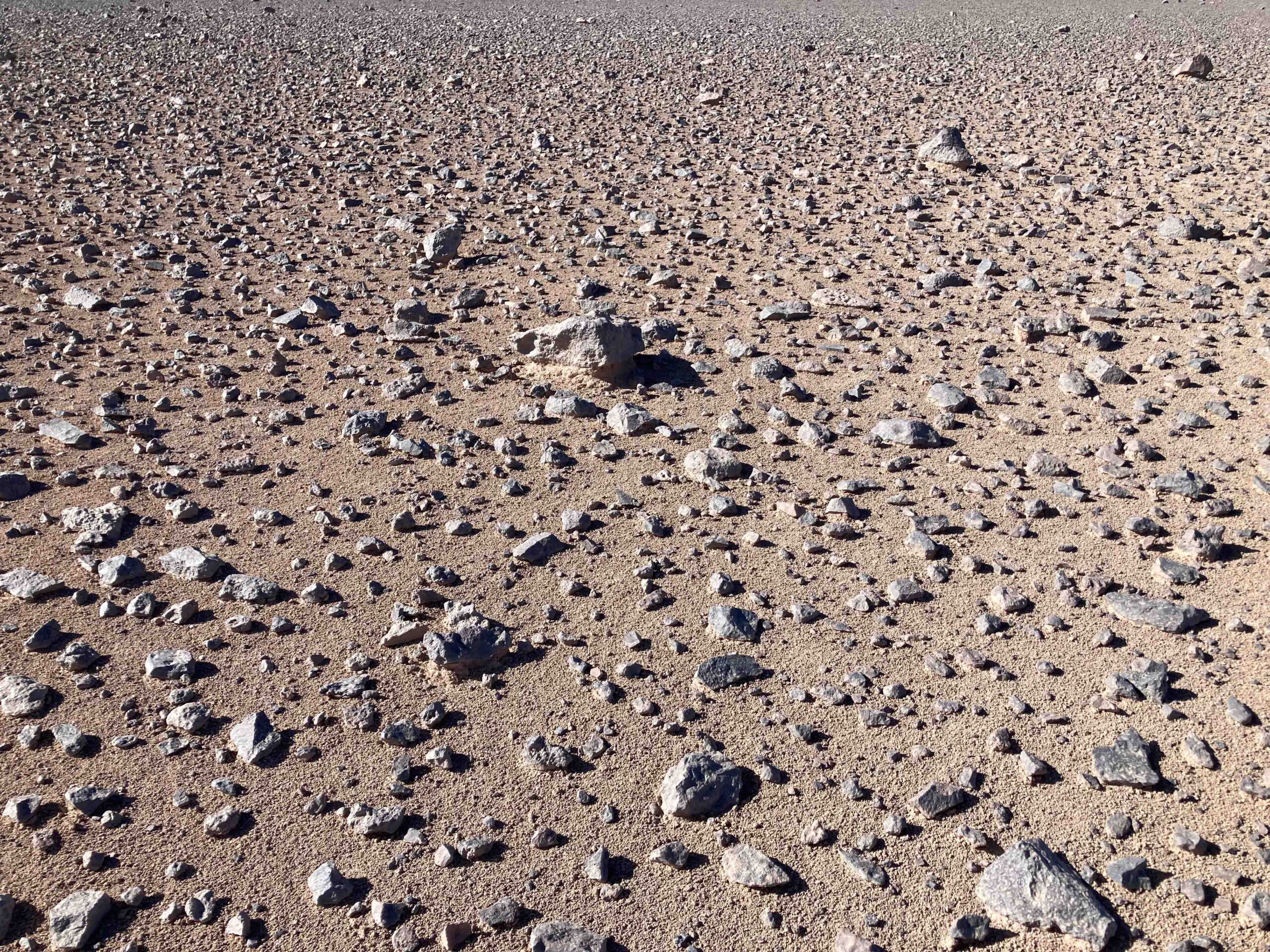
    The North of Antofagasta site in the Atacama Desert, where soil analyzed in the study was collected. Credit: Christopher E. Carr. The University of Osaka lists no usage restrictions. Image source and credit.

    A new laboratory technique can distinguish the mirror-image forms of individual amino acids by measuring tiny electrical currents. Published on October 5, 2026, in Nature Communications, the study by Takahito Ohshiro and colleagues advances a possible way to investigate the chemistry of future planetary samples. Its immediate achievement is a measurement method; no extraterrestrial organism was detected.

    Reading molecules through a nanogap

    The researchers place molecules between two gold nanowires separated by an extremely small gap. Electrical tunneling produces changing current patterns as individual molecules pass through. An artificial-intelligence classifier searches those patterns for differences between amino-acid forms. According to the University of Osaka’s research announcement, this approach could help make instruments smaller and less vulnerable to vibration than systems dependent on substantial optical equipment.

    The property being measured is chirality, often described as molecular handedness. Two forms can have the same chemical ingredients but arrangements that cannot be superimposed, like left and right hands. The distinction matters because terrestrial biology strongly favors one form when constructing proteins. However, handedness must be interpreted alongside other evidence. NASA’s analysis of returned Bennu material found both mirror-image forms in equal proportions, illustrating how life’s ingredients can exist without establishing that life exists.

    A promising result with important limits

    The new paper reports greater than 80 percent accuracy when distinguishing individual enantiomers. Harder tests were less accurate: a blind classification exercise involving 39 amino-acid forms exceeded 50 percent, while four-amino-acid mixtures exceeded 66 percent. Those are separate tests with different challenges, so the headline accuracy should not be applied to every sample. In extracts from the Murchison meteorite and Chile’s Atacama Desert, an 11-amino-acid target panel recovered major compositional features also seen with liquid chromatography–mass spectrometry. Background signals and scarce molecules remained complications.

    Those natural samples are important because a planetary sample will contain a chemical mixture rather than one conveniently isolated target. The university’s detailed announcement identifies several steps still needed before spaceflight: handling unknown substances, controlling contamination, improving quantitative accuracy and testing equipment under space conditions. The attraction is a future instrument able to identify molecules and their handedness electrically, while reducing the demands of a large optical system.

    One measurement in a larger investigation

    Bennu provides a useful reminder of the scientific stakes. NASA reported 14 of the 20 amino acids used in terrestrial proteins and all five nucleobases used in DNA and RNA in its samples. The mission’s findings concern chemical ingredients and environments that could support prebiotic reactions. Why Earth’s biology developed its strong handedness preference remains unresolved. A compact sensor could help investigate that question across more samples, provided its results are checked against contamination and nonbiological chemistry.

  • Webb’s Little Red Dots Put Early Black-Hole Measurements to the Test

    Webb’s Little Red Dots Put Early Black-Hole Measurements to the Test

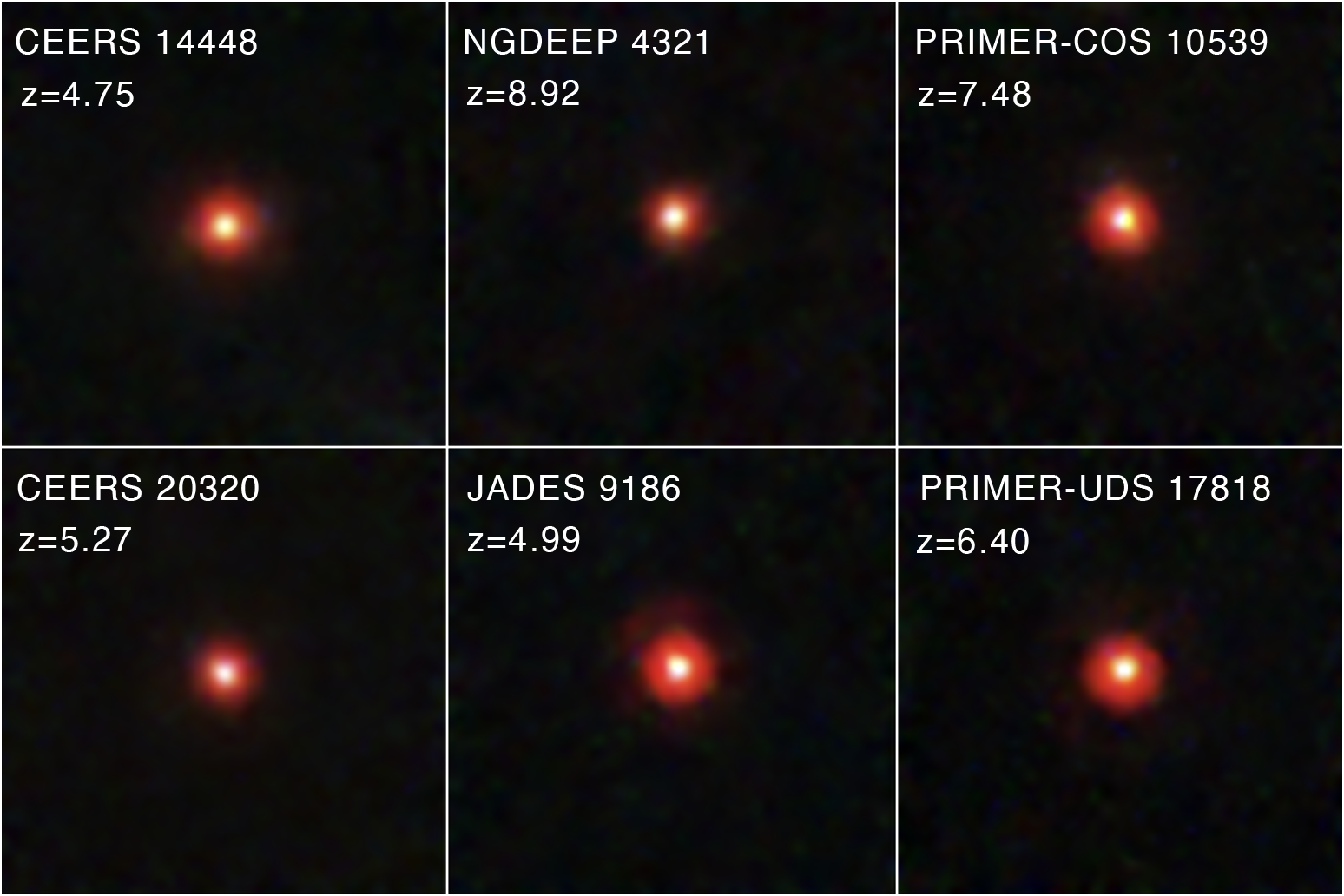
    Six examples of Webb’s little red dots, shown in a previously released survey mosaic reproduced in NASA’s October 2026 overview. These examples do not include Abell 2744-QSO1. Credit: NASA, ESA, CSA, STScI, Dale Kocevski (Colby College).

    The small red objects appearing in James Webb Space Telescope images have become a major test of ideas about the early universe. A NASA science overview released October 9, 2026 describes how these “little red dots” are reshaping research into black holes and their host galaxies.

    The new overview brings together an ongoing debate. These sources look compact and red, but appearances alone leave substantial questions about their central engines, surrounding material and evolutionary histories. Two research papers published earlier this year illustrate the different kinds of evidence needed to investigate them.

    How to weigh something hidden

    A black hole’s mass can be inferred from the motion of nearby material. For very distant objects, astronomers often examine spectral lines from glowing gas. Motion toward and away from us shifts the light, broadening those lines. Turning the width into a mass estimate requires a model of where the gas is and what drives its motion.

    That last step is particularly important for little red dots. Their unusual spectra make it necessary to check whether methods calibrated using more familiar active galaxies remain reliable.

    One object offers a dynamical check

    In a Nature paper published May 27, 2026, Ignas Juodžbalis and colleagues examined Abell 2744-QSO1, a little red dot at redshift 7.04. A foreground gravitational lens magnifies and distorts its appearance, giving Webb a valuable opportunity to investigate spatial detail.

    The team used spectroscopy to trace a gas rotation curve. Their analysis found motion consistent with a central point mass of about 50 million Suns and inconsistent with the nuclear-star-cluster explanation they tested. The result agreed with previous black-hole mass estimates derived from broad emission lines.

    This supplies a strong check for that particular source. It also shows why resolving motion is so useful: researchers can compare a dynamical estimate with a different, more indirect method. Extending such tests to a varied sample would help establish how broadly the agreement holds.

    Simulations explore how the sources could form

    A separate Nature study published September 16, 2026, led by Sunmyon Chon, investigated formation through radiation-hydrodynamic simulations. In the model, dense early environments produced large black-hole seeds that grew rapidly while surrounded by thick gas disks.

    The simulated gas scattered light strongly enough to broaden hydrogen emission into profiles resembling those observed in little red dots. That gives researchers a possible physical route connecting an obscured early growth phase with later massive black holes.

    A simulated match still needs observational tests. It depends on the model’s conditions and how faithfully the calculation captures gas flow and radiation. The authors note that their simulation does not yet resolve the full large-scale inflows needed to sustain growth over longer periods.

    Together, these results make the next questions concrete: which sources contain accreting black holes, how reliably can their masses be measured, and how much does surrounding gas alter the light we receive? Webb is providing observations with which to test each part of that picture.

  • A Heat-Loving Amoeba Raises the Temperature Limit for Complex Cells

    A Heat-Loving Amoeba Raises the Temperature Limit for Complex Cells

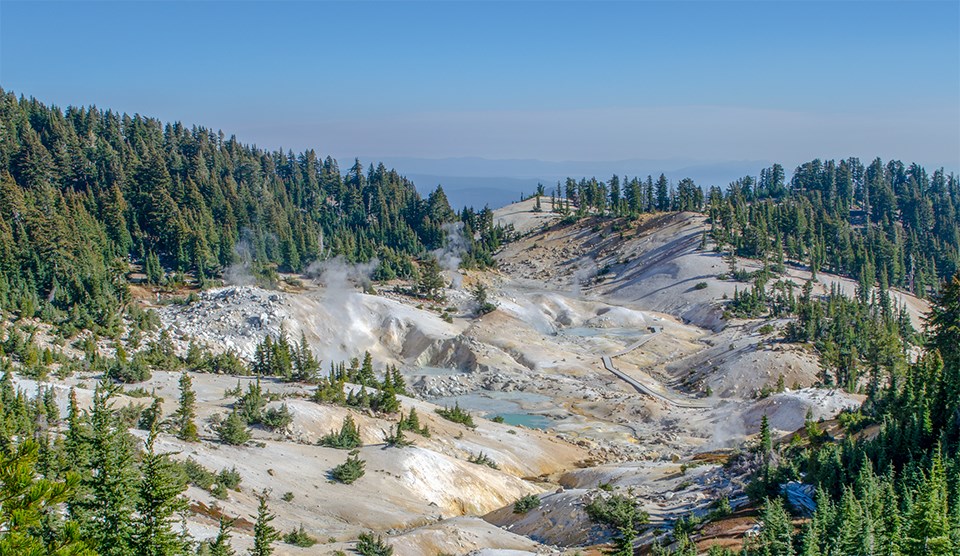
    Bumpass Hell basin in Lassen Volcanic National Park, photographed in 2018. This landscape provides regional geothermal context; the amoeba was sampled from a different stream in the park. Credit: NPS Photo/Amanda Sweeney.

    An amoeba from a California geothermal stream is extending the known operating range of complex cells. In a study published online in Cell on September 22, 2026, researchers describe Incendiamoeba cascadensis, which divides at 63 degrees Celsius, about 145 degrees Fahrenheit, and can move at 64 degrees Celsius.

    The result raises the documented growth ceiling for eukaryotes, organisms whose cells contain a nucleus. That group includes single-celled species as well as plants and animals. Here, “complex” describes cellular organization: the record belongs to a microscopic amoeba.

    The discovery began in an ordinary-looking stream

    Syracuse University’s account traces the fieldwork to Lassen Volcanic National Park. The researchers sampled diverse geothermal environments, eventually recovering the organism from a tributary rather than one of the conspicuous acidic pools.

    The setting demanded care around hot water and fragile ground. Long tools helped keep researchers at a distance; in the narrow stream, the team used barbecue tongs to collect material. Back in the laboratory, increasing incubation temperatures revealed how unusually well the amoeba handled heat.

    The university also identifies practical reasons to investigate those adaptations. Understanding heat-tolerant cellular components could eventually inform more durable enzymes, materials or industrial processes. Those are research possibilities, rather than products established by this study.

    Growth, movement and survival measure different things

    The research paper describes growth experiments across multiple temperatures, including repeat cultures and independent temperature checks. Growth was strongest around 55 to 57 degrees Celsius; reproduction at the upper limit of 63 degrees varied among replicates. No growth was observed at 64 degrees or above.

    Genetic analyses identified features associated with maintaining proteins, protecting DNA and handling environmental conditions. The authors also found distinctive predicted protein properties, including increased positive surface charge resembling adaptations in some heat-loving bacteria and archaea. These offer leads for explaining the amoeba’s resilience.

    NASA’s research summary adds an important distinction: the organism could recover after five minutes at 70 degrees Celsius. Brief exposure followed by recovery is a different result from reproducing continuously at that temperature. Describing both simply as a temperature limit would obscure the experimental achievement.

    A broader search still needs the whole environment

    For astrobiology, the discovery supplies a new example of what Earth’s cellular machinery can endure. NASA emphasizes that habitability also depends on water, acidity, pressure, oxygen and food. The amoeba belongs to an ecosystem and cannot support itself in isolation.

    The lesson is therefore more useful than assigning a new temperature cutoff to every planet. A promising environment must satisfy several requirements together, for long enough to support biological activity. A warmer range expands the conditions worth testing while leaving those other requirements in place.

    The research appeared first as a November 2025 preprint, before September’s peer-reviewed publication. Its lasting contribution is a measurable biological exception that can be investigated, repeated and compared with other organisms as researchers map life’s limits.

  • NASA Advances the Telescope That Will Link LISA’s Spacecraft

    NASA Advances the Telescope That Will Link LISA’s Spacecraft

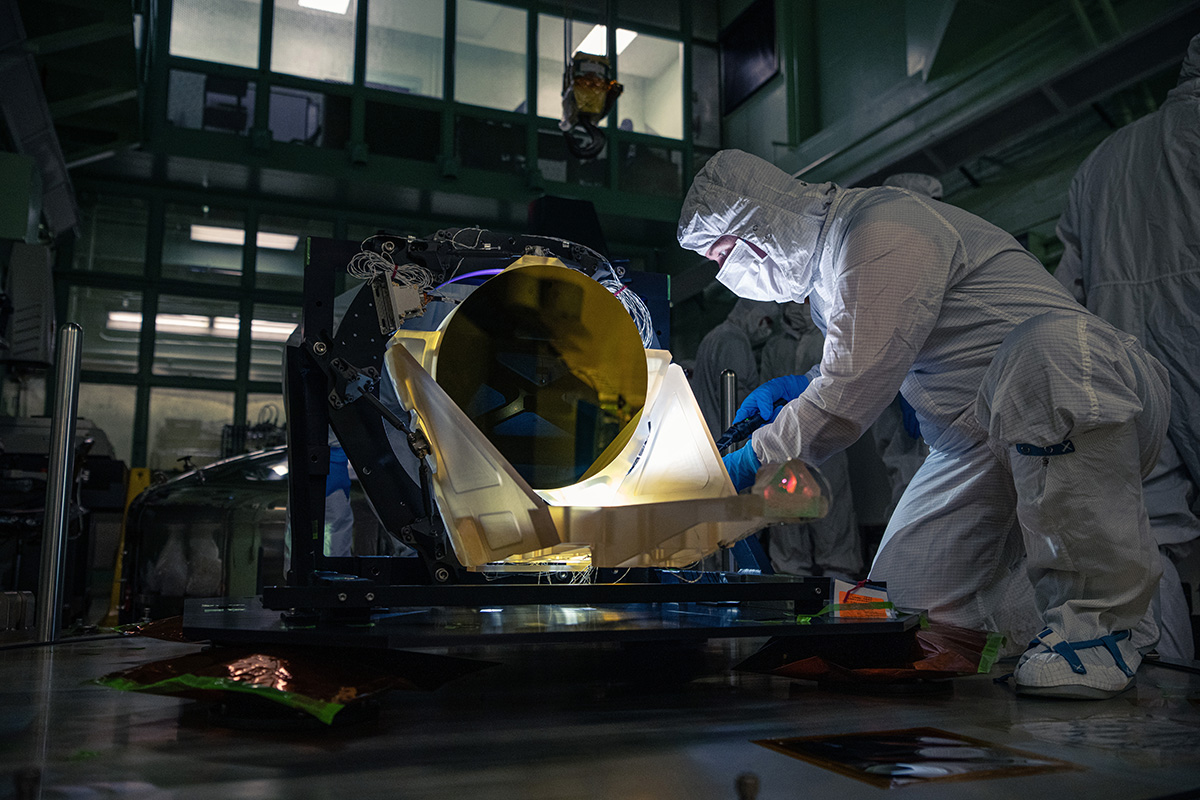
    A technician inspects LISA’s earlier prototype telescope at NASA Goddard in May 2024. The October 2026 announcement concerns the next engineering-test unit. Credit: NASA/Dennis Henry.

    NASA is moving ahead with the next test version of a telescope designed to connect spacecraft across millions of kilometres. The agency’s October 8, 2026 update says L3Harris Technologies will design, assemble and integrate an Engineering Test Unit for LISA, the planned space-based gravitational-wave observatory.

    The new unit will incorporate lessons from an earlier prototype. NASA describes it as the final pre-flight telescope unit and the first optical telescope it will deliver to the European Space Agency. A metal structural model was delivered in June 2026. The optical unit remains a development step toward eventual flight hardware.

    A telescope used as part of a ruler

    LISA, short for Laser Interferometer Space Antenna, is an ESA-led mission with NASA participation. Its three spacecraft are designed to form a triangle with sides approximately 2.5 million kilometres long, following Earth around the Sun. Each spacecraft will carry two telescopes that exchange infrared laser light with its companions.

    The purpose of that light is exceptionally precise measurement. Passing gravitational waves stretch and compress the distances between free-floating test masses protected inside the spacecraft. Comparing the laser signals lets researchers search for those tiny changes. The design calls for sensitivity to shifts smaller than the diameter of a helium atom across the vast separation.

    At that scale, the measuring equipment must be extraordinarily stable. A tiny unwanted change inside the instrument can complicate the effort to identify a real change in the distance being measured.

    Why the material matters

    NASA’s October 2024 prototype report explains the choice of Zerodur, an amber-coloured glass-ceramic whose shape changes very little as its temperature varies. The prototype arrived at Goddard Space Flight Center in May 2024. Its main mirror was coated in gold to reflect infrared light efficiently and help limit heat loss.

    The new telescope continues that approach. Its job fits into a much larger system in which optical stability, laser control and the behaviour of the test masses all matter.

    Other parts of that system are also progressing. In a January 27, 2026 update, NASA reported tests of a second early frequency-reference system, which helps control the lasers. The agency is also contributing devices to manage electrical charge on the test masses and the framework for processing the mission’s data.

    A different range of cosmic signals

    The enormous spacecraft separation will give LISA access to lower-frequency gravitational waves than ground-based observatories can measure. Its targets include mergers of massive black holes and compact stellar systems within the Milky Way. Those signals could help researchers reconstruct how black holes grow and test gravity in extreme environments.

    NASA continues to place launch in the mid-2030s, while ESA lists a planned 2035 launch. The October announcement marks progress on an essential component of that future observatory. The measurement itself will depend on the complete constellation working together, with six telescopes turning exchanged light into a record of changes in spacetime.

  • Could Life Remain Aloft? A Research Agenda for Habitable Skies

    Could Life Remain Aloft? A Research Agenda for Habitable Skies

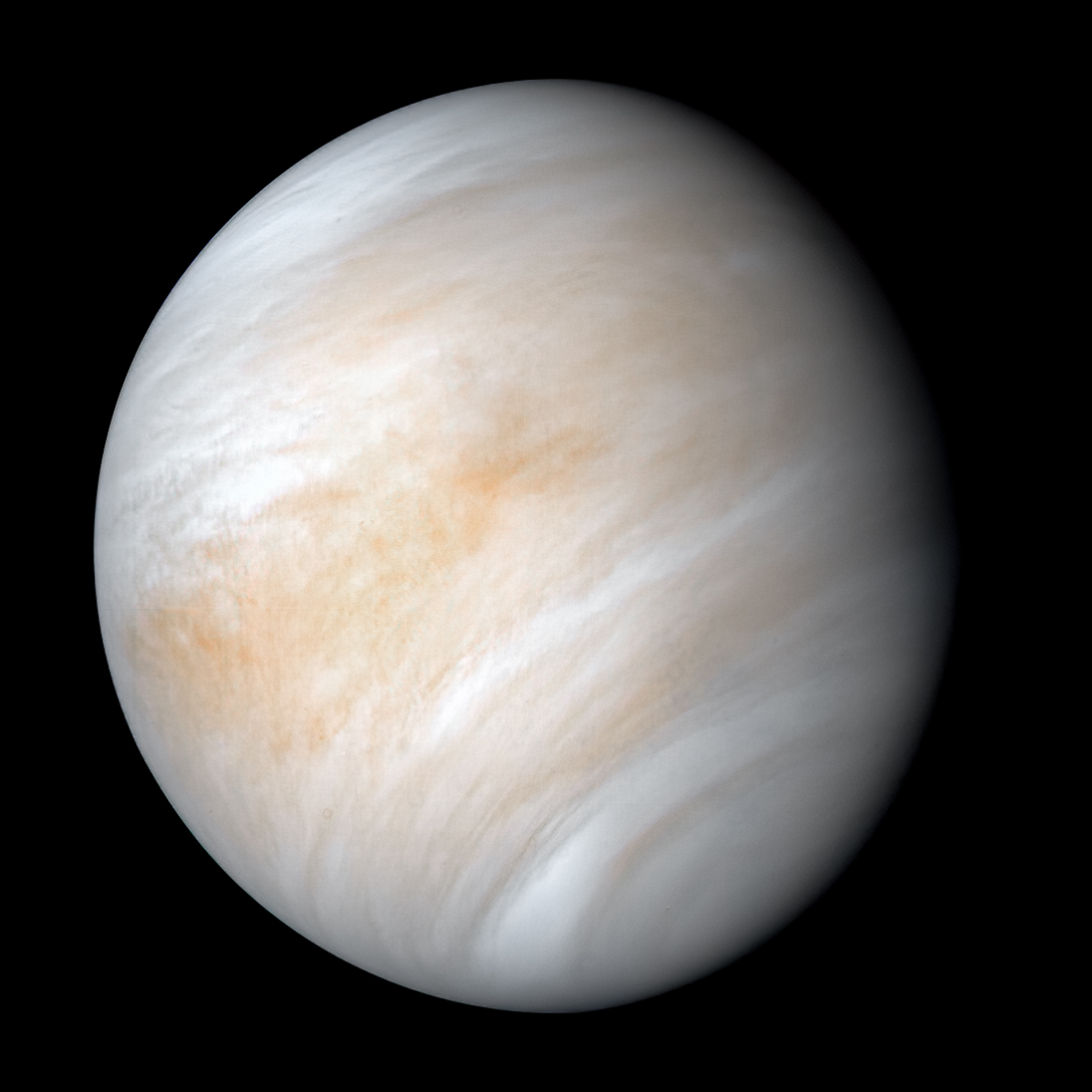
    Venus in a false-color composite assembled from Mariner 10 images taken in February 1974. Atmospheric observations help characterize possible habitats; they have not established an aerial biosphere. Credit: NASA/JPL-Caltech.

    Clouds can carry living microorganisms across great distances. Could an atmosphere also support a population that keeps reproducing without returning to the ground? A paper in the October 2026 issue of Astrobiology, “Atmospheres as Habitats,” organizes that question into a research program spanning Earth, laboratories and other planets.

    First published online on August 5, the study led by Noam Izenberg is a framework for investigation. It does not report an airborne ecosystem on another world. Its central uncertainty starts at home: sustained, multigenerational airborne life on Earth has yet to be established or excluded.

    What Earth’s clouds already tell us

    A useful foundation comes from a 2019 study of cloud water collected at France’s Puy de Dôme atmospheric station. Pierre Amato and colleagues examined both microbial genetic material and the RNA associated with gene activity, investigating what the organisms were doing within their cloudy surroundings.

    They found evidence of active microbial communities, largely bacteria, responding to cold, oxidizing chemicals and changes in their watery environment. Their results pointed to protective functions, membrane adjustments and exchanges between cells and cloud droplets. Clouds were chemically demanding surroundings in which biological activity could continue.

    The sampling location is important: this was research on terrestrial cloud water, with organisms that could have arrived from environments below. Activity during transport answers a different question from whether a population can replace itself indefinitely while remaining airborne. Both are interesting, and each requires its own measurements.

    Why Venus keeps the question alive

    NASA’s Venus overview explains the strong contrast between the planet’s surface and higher atmosphere. Around 50 kilometers above the ground, temperatures can be roughly 30 to 70 degrees Celsius, with pressures comparable to Earth’s surface. Those conditions have encouraged discussion of possible aerial habitats despite the planet’s punishing ground-level environment.

    Venus also has sulfuric-acid clouds. A tolerable temperature and pressure leave major chemical questions unresolved. NASA explicitly notes that the observations discussed in its overview provide no compelling evidence of life in those clouds.

    For a reader evaluating future Venus findings, this distinction is useful: a measurement may improve a model of where life could survive while leaving the question of whether anything lives there entirely open.

    Experiments that could move the question forward

    The new paper proposes studying whether microbes can persist and evolve in controlled airborne conditions, alongside better field observations. Time spent suspended, access to nutrients and repeated environmental stresses all enter the problem. The authors also call for atmospheric modeling and observations of worlds beyond the solar system.

    A decisive advance would connect several kinds of evidence: organisms present, activity measured, reproduction demonstrated and a credible account of how that population remains supplied. This is the attraction of the research agenda. It breaks an expansive idea about life in alien skies into questions that experiments on Earth can begin to answer.

  • Solar Orbiter Uses Particle Fingerprints to Trace a Magnetic Switchback

    Solar Orbiter Uses Particle Fingerprints to Trace a Magnetic Switchback

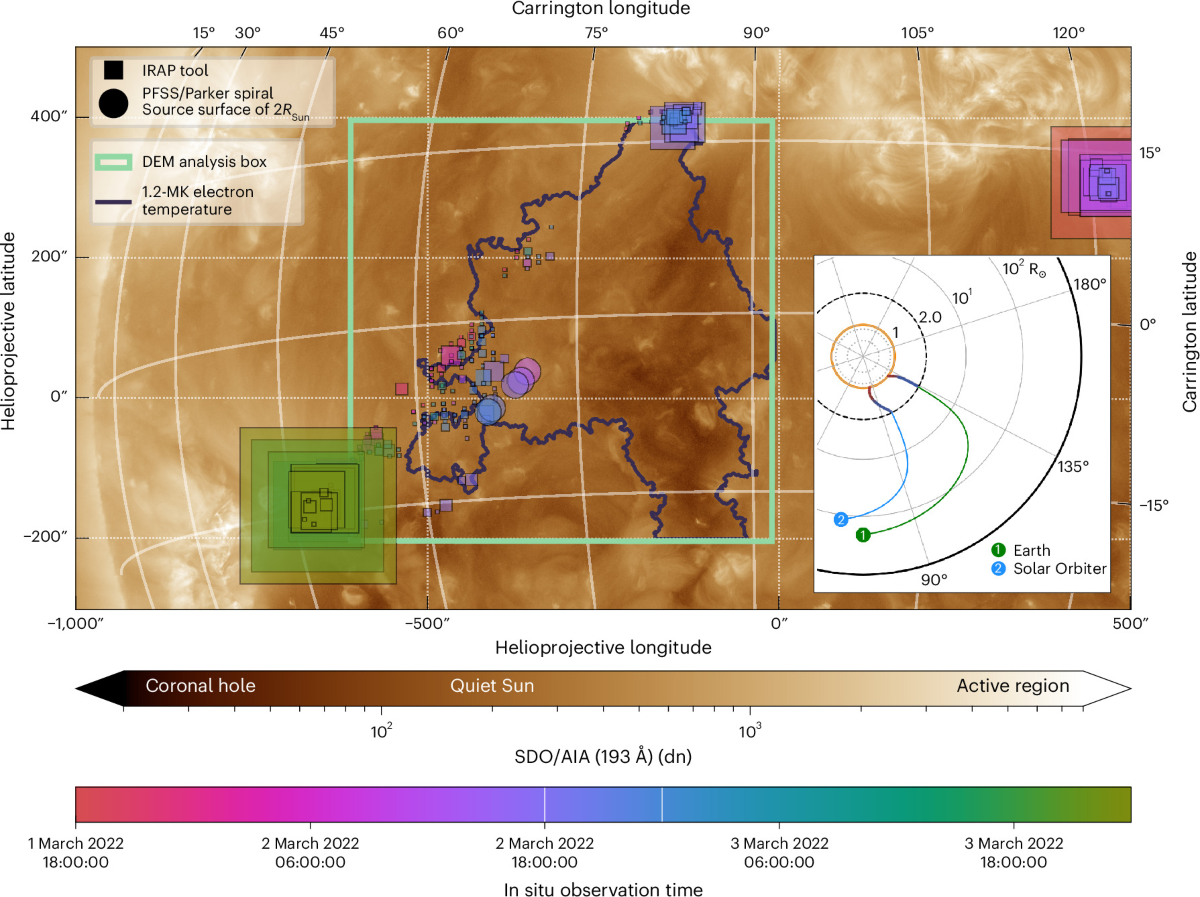
    Solar Dynamics Observatory imagery from February 28, 2022, overlaid with modelled magnetic connections for Solar Orbiter’s encounter. The coloured markers are model estimates, not direct photographs of field lines. Credit: J. T. Coburn et al., Nature Astronomy (2026), Fig. 1, CC BY 4.0. Reproduced without alteration.

    Particles caught inside a sharp bend in the solar wind have given researchers a way to investigate where that magnetic disturbance began. In an October 8, 2026 announcement, the European Space Agency described how Solar Orbiter used the composition of a magnetic “switchback” to connect it with conditions in the Sun’s atmosphere.

    The newly published analysis examines measurements collected on March 2, 2022, when the spacecraft was about 55 percent of Earth’s distance from the Sun. That distinction matters: the October development is the scientific interpretation of an earlier encounter.

    A sample with a history

    The Nature Astronomy study, led by Jesse T. Coburn, identifies unusual oxygen and carbon charge-state ratios, together with relatively little helium. The combination points to plasma that had occupied hot, closed magnetic loops in the corona, the Sun’s outer atmosphere.

    The proposed escape route is interchange reconnection. A closed loop interacts with magnetic field extending outward into space, changes its connections, and releases previously confined material. The researchers combined particle measurements with solar observations and magnetic-field modelling to investigate this route.

    The paper also describes an important limit: the models guide the search for the source region, rather than pinpointing an exact birthplace. The composition constrains the possible origin to structures associated with a coronal hole or its boundary.

    Different instruments answer different questions

    Switchbacks have a long observational history. ESA’s September 2022 account traces sudden, temporary field reversals back to the Helios probes in the 1970s. Parker Solar Probe later found them especially common near the Sun.

    A spacecraft passing through one samples the field at its own location. Reconstructing a whole structure from that single moving viewpoint can be difficult. Solar Orbiter’s Metis coronagraph supplied a complementary view on March 25, 2022, capturing an S-shaped feature in coronal plasma that researchers interpreted as a switchback.

    That imaging result and the newly analysed particle encounter are separate observations. Together they illustrate why the mission combines instruments that look at the Sun with instruments that sample its surroundings. An image helps reveal a disturbance’s shape; a particle sample can retain information about the environment from which the material escaped.

    Formation and travel can involve different physics

    The new study also finds particle-velocity and magnetic-field variations consistent with an outward-moving Alfvén wave. Such waves are disturbances carried through magnetized plasma. The authors therefore suggest that reconnection can explain the switchback’s origin while waves and turbulence help govern its subsequent propagation.

    This offers a way to connect explanations that are sometimes presented as competing alternatives. It also gives researchers a practical method to test: compare the composition of more switchbacks with their magnetic behaviour and likely source environments.

    The broader stakes concern how the Sun heats its atmosphere and drives its continuous outflow of charged particles. Those processes underlie the changing space environment around Earth. For now, this is a detailed reconstruction of one encounter, with a promising technique for learning from others.

  • LoFreq-SETI Prepares a Search for Technology in Low-Frequency Radio

    LoFreq-SETI Prepares a Search for Technology in Low-Frequency Radio

    Dark Fires editorial artwork of Earth from orbit. Illustration, not an observation from the LoFreq-SETI search.

    A new SETI project is preparing to examine a relatively neglected part of the radio spectrum. LoFreq-SETI, described in an October 2, 2026 preprint by Craig Taylor, Lillian Ekness and Chenoa Tremblay, adapts observations from the Long Wavelength Array for searches for possible technological signals below 100 megahertz.

    The work reports a processing demonstration rather than a discovery. Eight events appeared in the comparison between stations, but none survived visual inspection as a plausible technosignature. The authors plan to extend the approach to observations of exoplanet systems.

    An array built for long radio waves

    The University of New Mexico’s LWA overview describes three stations in central New Mexico, operating between 10 and 88 megahertz. Instead of a single enormous dish, the project uses collections of antennas. Its proposed Swarm expansion would distribute stations across universities and colleges in the United States, combining widely separated observations through a technique called very long baseline interferometry.

    That separation matters because an array’s ability to distinguish directions depends on how its measurements are combined. The observatory’s wider Swarm concept is therefore an instrumental development with uses extending beyond the search for extraterrestrial technology.

    Turning recordings into testable candidates

    LoFreq-SETI converts station recordings into a format accepted by the Breakthrough Listen Interesting Signal Search toolkit, or BLISS, then compares signals across observing locations. Its initial test used a limited selection of archival observations aimed at fast radio bursts. Those targets supplied a practical dataset for checking the machinery before a dedicated search.

    The BLISS project’s public documentation describes software designed to find narrowband signals whose frequency changes over time. It uses graphics-processor acceleration for tasks including flagging, estimating noise, combining measurements and identifying hits. Its worked example uses recordings of Voyager 1, giving developers a known human spacecraft signal with which to demonstrate the workflow.

    That example makes the terminology concrete: a search program can successfully detect technology without discovering anything extraterrestrial. A flagged hit is the beginning of an investigation into the transmitter and observing conditions.

    A useful lesson from an earlier false alarm

    The published investigation of the signal known as blc1 provides a cautionary precedent. It appeared in 2019 observations toward Proxima Centauri and initially had several interesting properties. Detailed analysis connected it to local, time-varying interference and to related signals at other frequencies.

    The lesson was methodological: an apparently promising frequency drift and observing pattern can emerge from ordinary electronics. Searching for related features across the data can be more informative than concentrating on the most striking trace alone.

    For LoFreq-SETI, the immediate achievement is a documented route from raw measurements to candidates that can be scrutinized. The next step is broader observing and validation. Its limited demonstration cannot establish how common technological transmitters are, but it makes a specific future search easier to carry out and evaluate.