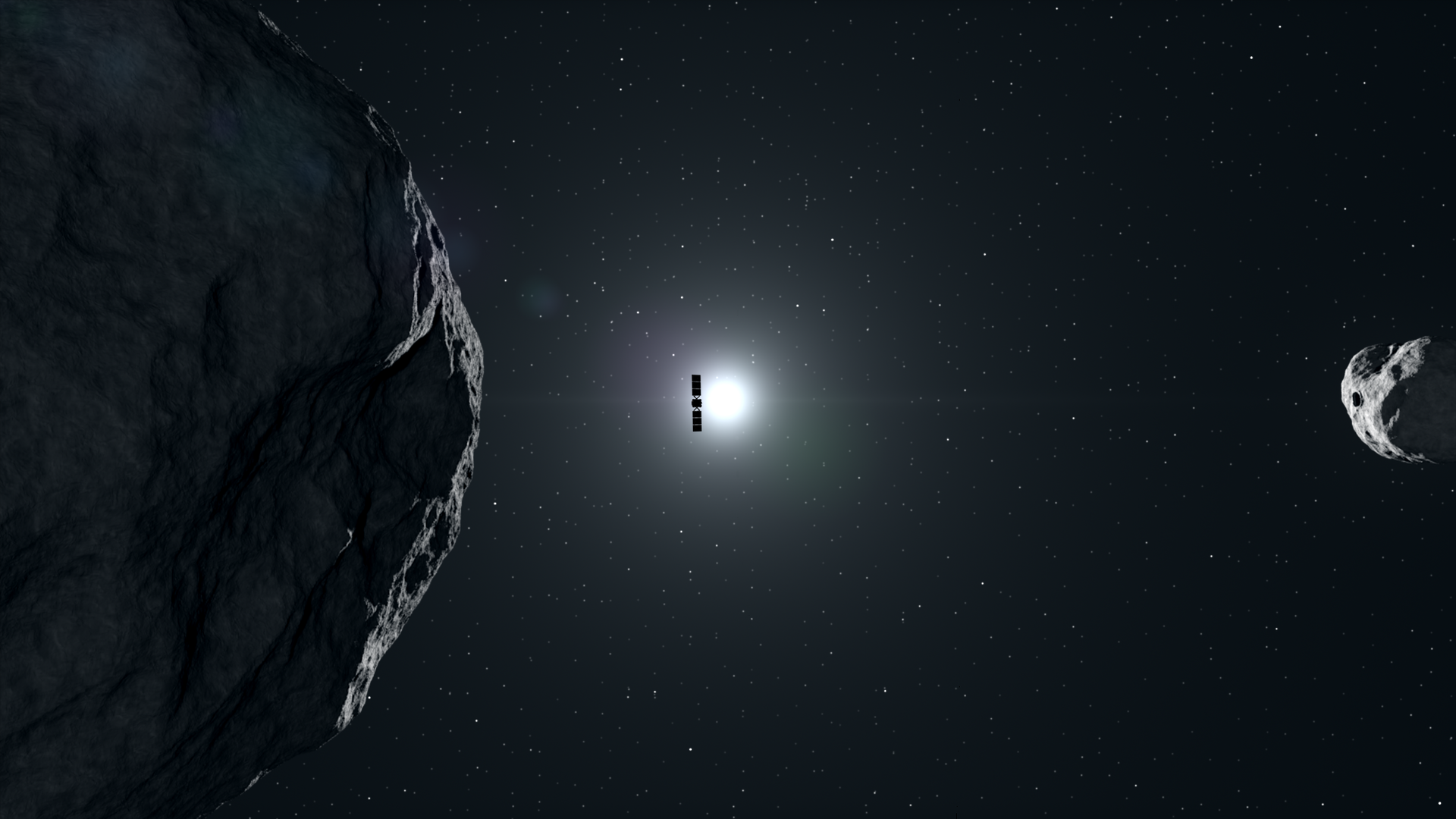
After two years of travel, ESA’s Hera spacecraft is preparing for a sustained braking campaign near its destination. The mission is headed for Didymos and its smaller companion, Dimorphos, where NASA’s DART spacecraft deliberately struck an asteroid in 2022.
In an October 7, 2026 mission update, ESA scheduled Hera’s first major braking burn for October 15. Three orbit-control thrusters are to fire together for 93 minutes, reducing the spacecraft’s speed relative to the asteroids by several hundred meters per second.
A second burn, planned for October 22 and lasting about 31 minutes, should provide further braking and correct deviations from the first maneuver. Smaller adjustments are planned afterward. These remain scheduled operations as of October 11; the spacecraft has not yet completed its asteroid rendezvous.
Navigation becomes part of the investigation
ESA’s flight-dynamics account explains how the team will check Hera’s progress. Radio-signal travel times help establish distance, while Doppler shifts reveal motion toward or away from Earth. Images from the spacecraft become increasingly valuable as the asteroids resolve into recognizable terrain.
The work also involves estimating the bodies’ motion, rotation and masses. During the early observing phase in November and December, Hera is expected to remain roughly 25 to 30 kilometers away. Later phases call for closer approaches, followed by deployment of two small companion spacecraft in early 2027.
The cautious progression matters because the state of Dimorphos after DART’s impact remains uncertain. Navigation models must allow for a target whose shape and rotation may have changed.
A return to the impact site
Didymos is about 780 meters across, while ESA’s September 23 guide to the system gives Dimorphos a diameter of about 151 meters. Before the collision, DART’s images showed the smaller body covered with large boulders. Hera will find out what that landscape looks like now.
That comparison has a practical purpose. As ESA’s mission overview accompanying its spacecraft illustration explains, a reliable measurement of Dimorphos’s mass is needed to understand the momentum transferred by DART. Surface mapping and measurements of the asteroid’s structure will help turn one successful deflection experiment into knowledge that can inform future planetary-defense missions.
Before those measurements can begin at close range, Hera must arrive with its motion carefully matched to the system. The coming burns are the transition between crossing interplanetary space and working beside two small, weakly gravitating worlds.
Featured image: Artist’s illustration of Hera approaching the Didymos–Dimorphos system. This is mission artwork, not an image returned from the rendezvous. Credit: ©ESA. Image source. Image usage terms.
Leave a Reply