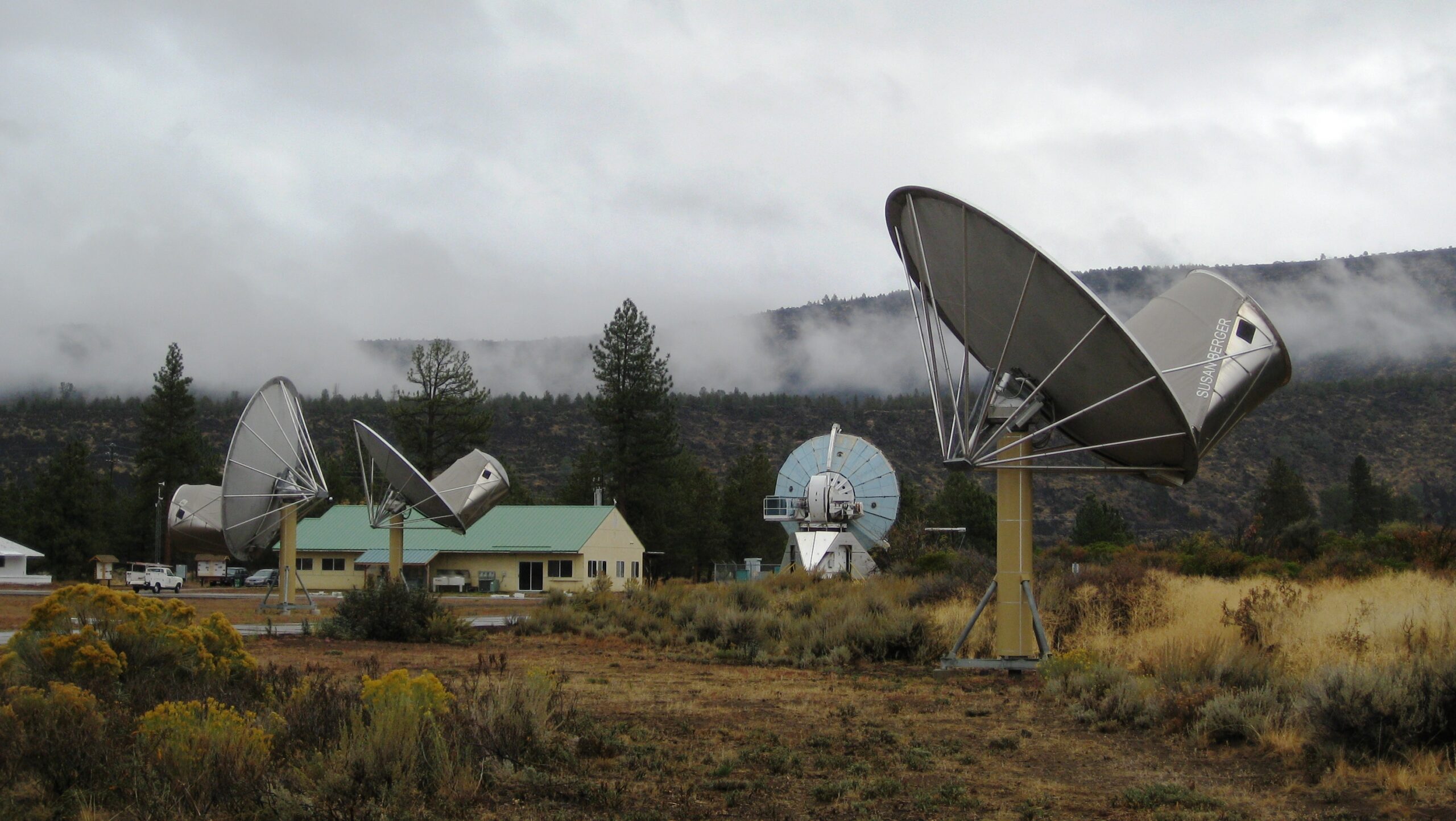
If another civilization wanted to attract our attention, where would it expect us to look? A new SETI progress report explores one answer: the point in our sky directly opposite the Sun. The idea turns the geometry of Earth’s orbit into a possible rendezvous for a signal.
Isabel Gerrard and Sofia Sheikh describe the Allen Telescope Array’s anti-solar-point campaign in a report posted on October 5, 2026. It is an ongoing search, with follow-up observations still needed. No extraterrestrial transmission has been established.
Seeing Earth from the other side
The geometry has a useful symmetry. From a suitably aligned distant system, Earth can pass in front of the Sun, producing the kind of transit astronomers use to discover exoplanets. The observer’s direction then appears opposite the Sun in our sky.
A 2021 study by Lisa Kaltenegger and Jackie Faherty showed that this viewing opportunity changes as stars move. Their reconstruction identified 1,715 stars within 100 parsecs that had occupied the right position during the preceding 5,000 years. That establishes an observable geometry. Whether anyone is there, has noticed Earth, or would choose that moment to transmit remains hypothetical.
The Allen Telescope Array at Hat Creek, California, combines signals from many small radio dishes. Its beamforming system can compare different directions, helping researchers investigate where a signal appears to originate. Dedicated observing time and flexible targeting make the facility useful for testing search strategies like this one.
A shortlist for more observing
The October report summarizes progress as of September 12, using observations from August 2024 through August 2026. About 12 percent of the planned coordinate coverage had been observed. The campaign listens between 2,356 and 3,700 megahertz and looks for narrow signals that drift in frequency.
Among the inspected material, 25 signal plots associated with 10 sky coordinates met the team’s follow-up criteria. Those are screening results. Re-observing the positions is part of working out what produced them.
That distinction matters in a crowded radio environment. As NRAO explains, human transmitters can overwhelm the faint emissions astronomers want to study. An interesting-looking trace needs careful checks before a distant technological origin becomes credible.
The appeal of the anti-solar strategy is its testability. It takes a specific assumption about how strangers might coordinate across space and gives telescopes a concrete place to listen.
Featured image: The Allen Telescope Array in an archival photograph taken October 23, 2010. Photo: brewbooks, CC BY-SA 2.0. Image displayed at reduced size; homepage thumbnails may be cropped. Original image and license record.
.jpg)
Leave a Reply