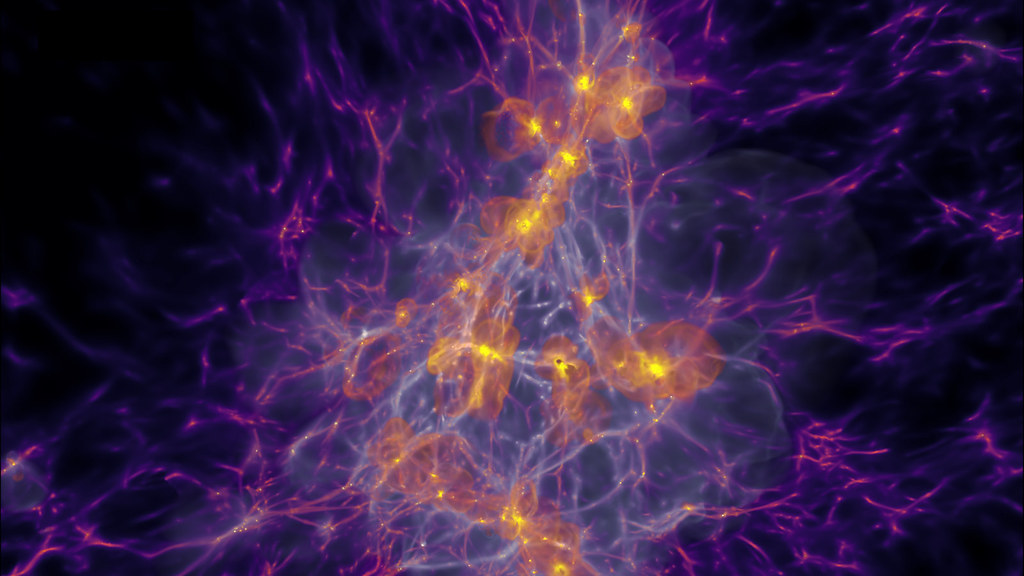
MEGATRON simulation of gas, oxygen and starlight in the first galaxies. Credit: Harley B. Katz, Martin P. Rey. Image source.
Astronomers study the early universe in two very different ways: by observing distant galaxies as they were long ago, and by examining chemical traces preserved in old stars closer to home. A group of MEGATRON simulation studies, highlighted by the University of Bath on September 30, 2026, aims to connect those approaches within one physical model. The goal is to test how the earliest stars changed their surroundings and left evidence that survives today. Bath’s research announcement describes the collaboration.
An iron clue in small galaxies
One of the newly published papers tackles a specific puzzle: the relationship between the stellar mass of a dwarf galaxy and its iron abundance. Among very small systems, the observed relationship levels into a plateau rather than simply continuing downward. MEGATRON reproduces this feature and links it to enrichment by extremely energetic explosions of the first generation of stars.
In the simulations, radiation influences where those early stars can form. Their explosions then occur in dark-matter haloes massive enough to retain the expelled material. That combination helps establish a characteristic iron abundance in later stellar populations. The model also predicts a minority population of more iron-deficient dwarf galaxies, offering an additional feature observers can investigate. This is a proposed physical explanation that matches important evidence, rather than proof that every small galaxy followed one identical history.
Predicting what telescopes actually measure
A companion MEGATRON study approaches the problem through galaxy spectra. It presents more than 175,000 simulated spectra and shows how the models can reproduce the variety of early-galaxy spectra observed by the James Webb Space Telescope within the standard cosmological framework.
The simulations follow radiation alongside gas dynamics and chemical changes, instead of treating light as a simple afterthought. This allows researchers to compare predicted spectral signatures more directly with observations. It also provides a way to examine how assumptions used to infer a galaxy’s properties might influence the answer. A successful comparison must explain the light reaching a telescope, not merely produce a simulated galaxy that looks plausible.
The surrounding gas matters too
A third study follows the gas around a growing galaxy with a network of 81 ions and molecules. It finds that local radiation and chemistry that has not settled into equilibrium can substantially change the predicted absorption and emission signatures. Increasing resolution also reveals smaller cold structures and sharper chemical layering.
Together, the papers make a practical case for more detailed modelling. The first stars cannot be judged only by a distant photograph or by a nearby chemical measurement in isolation. A stronger explanation has to connect both, while also accounting for the gas through which light travels. MEGATRON supplies testable predictions for that comparison; observations will determine which parts of the picture endure.
Leave a Reply