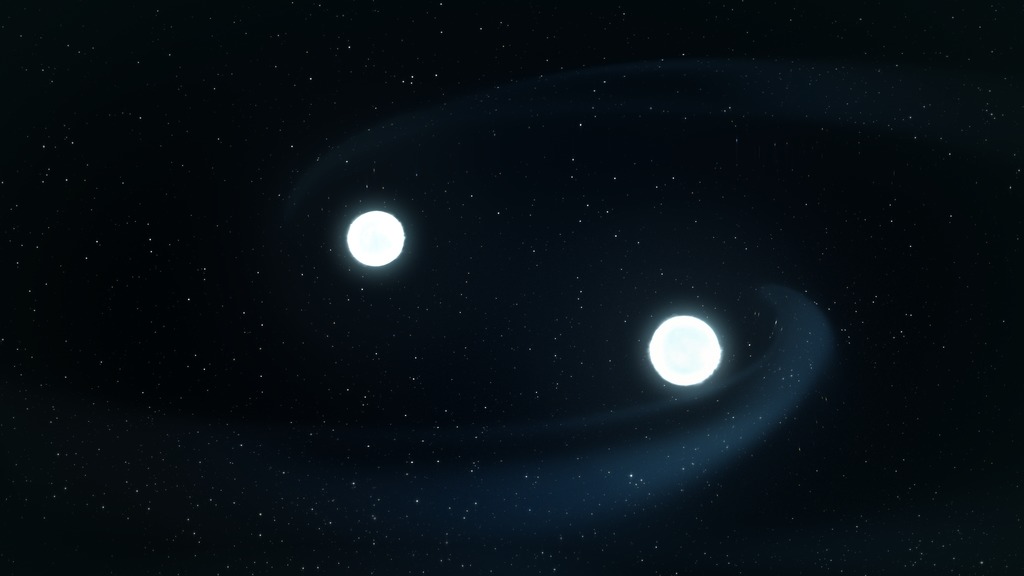
NASA illustration of two neutron stars approaching a merger; illustrative, not an image of EP250704a. Credit: NASA’s Goddard Space Flight Center/CI Lab. Image source.
A cosmic explosion that looked almost instantaneous in gamma rays kept shining in soft X-rays for nearly ten minutes. Research highlighted on September 30, 2026, connects the event, EP250704a/GRB 250704B, to a compact-object merger and suggests that the collision may have left behind a powerful, rapidly spinning neutron star. The explosion reached Earth’s detectors on July 4, 2025; the recent development is the published analysis of what those detectors recorded. Nanjing University’s research account explains the coordinated observations.
A second act in softer light
The research paper reports a gamma-ray flash lasting roughly 0.4 seconds followed by approximately 560 seconds of soft X-ray emission. Einstein Probe supplied the crucial lower-energy coverage. The X-ray signal’s changing brightness and spectrum did not fit the simplest explanation of a brief initial explosion followed by an ordinary afterglow from a blast wave sweeping into surrounding material.
Instead, the authors identify a distinct, longer episode associated with the explosion’s central engine. This distinction matters because an instrument sensitive only to the initial gamma rays would tell an incomplete story. The burst could be filed as short while a substantial part of its early activity went unseen. The finding therefore concerns both the physics of the source and the observational limits of earlier surveys.
Building the case for a merger
Follow-up observations supplied the context. Using the Very Large Telescope’s X-shooter instrument, researchers measured a redshift of 0.6610, placing the event more than six billion years of light-travel time away. Deep optical observations subsequently failed to reveal the bright supernova expected in the alternative scenario of a massive star’s collapse. The distance, burst properties and missing supernova collectively support a neutron-star-merger interpretation. These findings are detailed in the research team’s September 30 release.
One possible remnant is a magnetar: a neutron star with an exceptionally strong magnetic field. A rapidly rotating magnetar could continue supplying energy after the initial collision, accounting for a longer-lived signal. That explanation remains an interpretation of the observations. The researchers are not presenting a direct photograph of the remnant, and this event was not announced as a joint detection of light and gravitational waves.
Why watch for more?
Conventional narrow-field X-ray telescopes often have to turn toward a burst after another instrument raises an alert. Einstein Probe’s wide-field monitoring can catch activity during the opening stages. Nanjing’s account argues that this capability could uncover other mergers hidden among fast X-ray transients.
The next useful test is repetition: find comparable flashes, establish their distances and compare their signals across wavelengths. Pairing such a flash with a future gravitational-wave detection would offer an especially strong check. For now, the result is a reminder that the apparent length of an explosion depends partly on which kind of light an observatory can see.
Leave a Reply