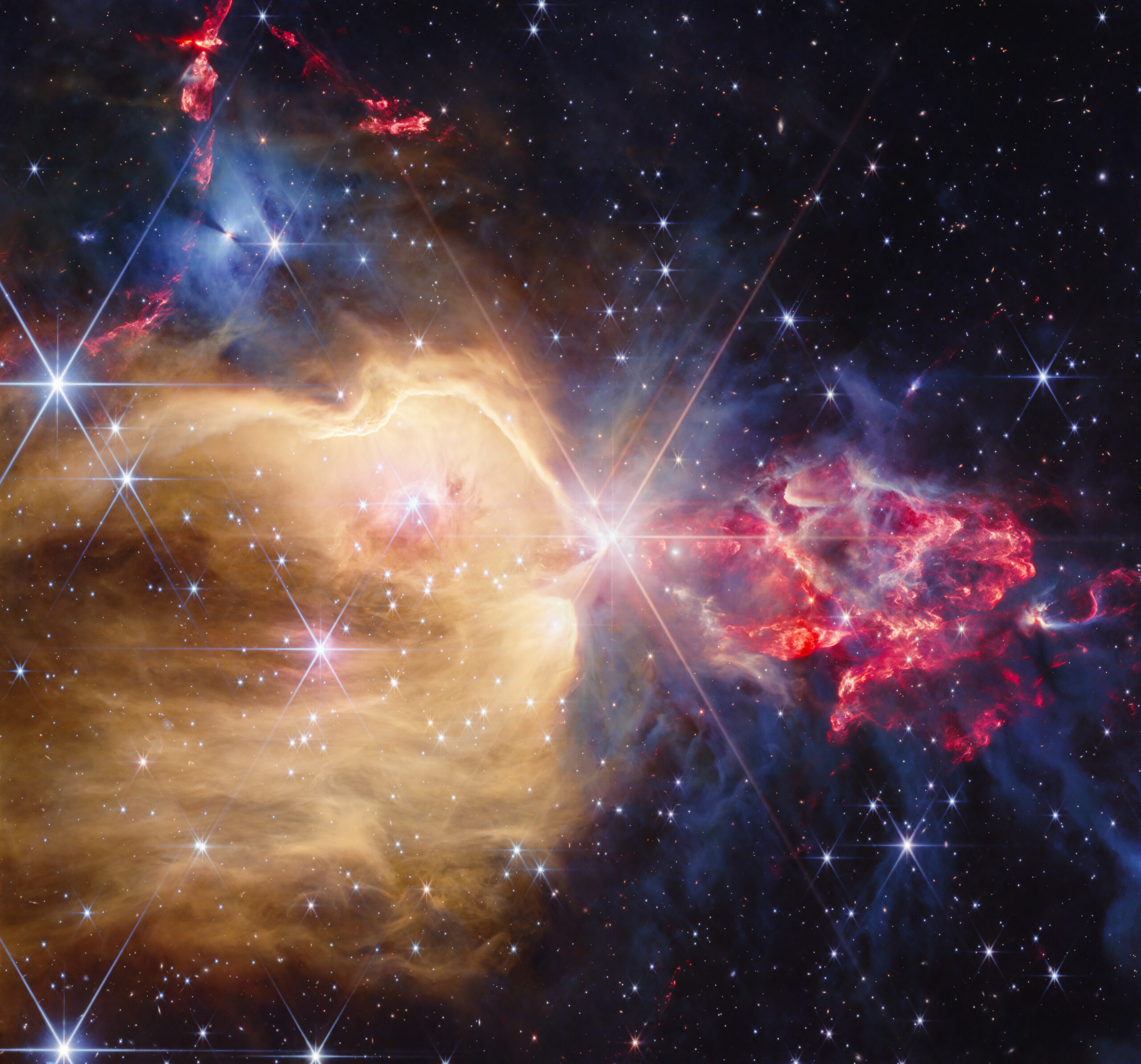
A new James Webb Space Telescope image brings the busy interior of NGC 7129 into view. Released on October 6, 2026, the portrait shows a stellar nursery about 3,300 light-years away, where young stars are already changing the cloud that produced them.
The central star, LkH(alpha) 234, contains roughly five to eight times the Sun’s mass. It is still contracting toward the stage when sustained hydrogen fusion will power it. To its left, a cavity about 3.5 light-years across records the effects of stellar outflows and radiation. Gas has been pushed aside, while some material has been compressed into conditions that can support further star formation.
On the other side of the star, younger protostars are still collecting material. Their outflows collide with surrounding gas, producing shocks. Multiple overlapping flows contribute to the tangled appearance described in the ESA/Webb image release.
Reading the colors
The image’s colors distinguish different parts of this environment. Hot hydrogen atoms appear in the golden region. Cooler molecular hydrogen occupies much of the area to the right, where shocks from the embedded protostars create red features. The dense, cold material represented in gray includes places where protostars have not yet formed.
These are infrared measurements translated into a visible image. The published image details list six NIRCam filters, spanning wavelengths from 1.15 to 4.7 micrometers. Several isolate emissions associated with particular material, including molecular hydrogen. The result lets viewers follow physical differences that would be difficult to separate in an ordinary visible-light photograph.
Why infrared matters
Stars begin forming inside dense clouds of gas and dust. Those surroundings obscure much of the visible light from the youngest objects, making a stellar nursery difficult to investigate from its outward appearance alone.
As NASA’s overview of Webb’s star-formation research explains, infrared observations can reveal structures and stars hidden within dusty regions. Webb can also study material around growing stars through spectroscopy, which separates incoming light by wavelength to investigate its physical and chemical properties.
NGC 7129 offers a particularly readable example: neighboring areas contain stars at different stages of development and gas responding in different ways. Comparing those regions helps astronomers examine how star formation changes its own surroundings. The newly released portrait is an invitation to study that process in detail, rather than a claim that every object or outflow in the scene has already been explained.
Featured image: NGC 7129 in Webb’s near-infrared view, released October 6, 2026. Colors represent different infrared measurements. Credit: NASA, ESA, CSA, STScI; Image Processing: A. Pagan (STScI). Image source. CC BY 4.0 usage terms.
Leave a Reply