DARK FIRESORIGINS UNKNOWN

Author: Dark Fires

  • A Close Companion Helps Explain a Red Giant’s Extreme Superflares

    A Close Companion Helps Explain a Red Giant’s Extreme Superflares

    A red giant famous for violent stellar eruptions appears to owe its activity to a partnership, but not a simple magnetic trigger from its companion. In an October 21, 2026 announcement, Hungary’s Konkoly Observatory described how a nearby dwarf star helps establish the conditions for KIC 2852961’s superflares.

    The object was already exceptional. A 2020 study catalogued 59 verified flares in its Kepler observations. That work linked the energy released over several rotations with the changing brightness pattern produced by starspots. It suggested that ordinary flares and much larger superflares could arise from the same basic magnetic process, operating at different energy scales. The new investigation asks what keeps this particular giant so magnetically productive.

    The new paper, posted on October 8, combines ground-based radial-velocity measurements with space observations. It confirms a close binary system whose orbit is nearly circular. Tidal forces have brought the giant’s rotation close to the orbital rhythm, without completely eliminating differential rotation: different parts of the star still turn at different rates.

    That remaining shear can help sustain a magnetic dynamo and twist magnetic structures above extensive starspots. The researchers interpret the star’s large rotational brightness variations as evidence of spotted regions capable of supporting substantial magnetic-energy storage. Reconnection of stressed magnetic fields then offers a route to powerful eruptions.

    Crucially, the flares did not favor particular positions in the binary orbit. The team therefore favors activity generated within the giant over a companion-driven trigger tied to orbital phase. That is an interpretation of the observations, not a direct view inside the star.

    The result also illustrates the longevity of a space-telescope archive. NASA retired Kepler on October 30, 2018, but its repeated brightness measurements remain available for investigations far beyond the mission’s original planet-hunting work. Here, combining that record with later spectroscopy changes the question from how energetic the flares are to why their host can keep producing them.

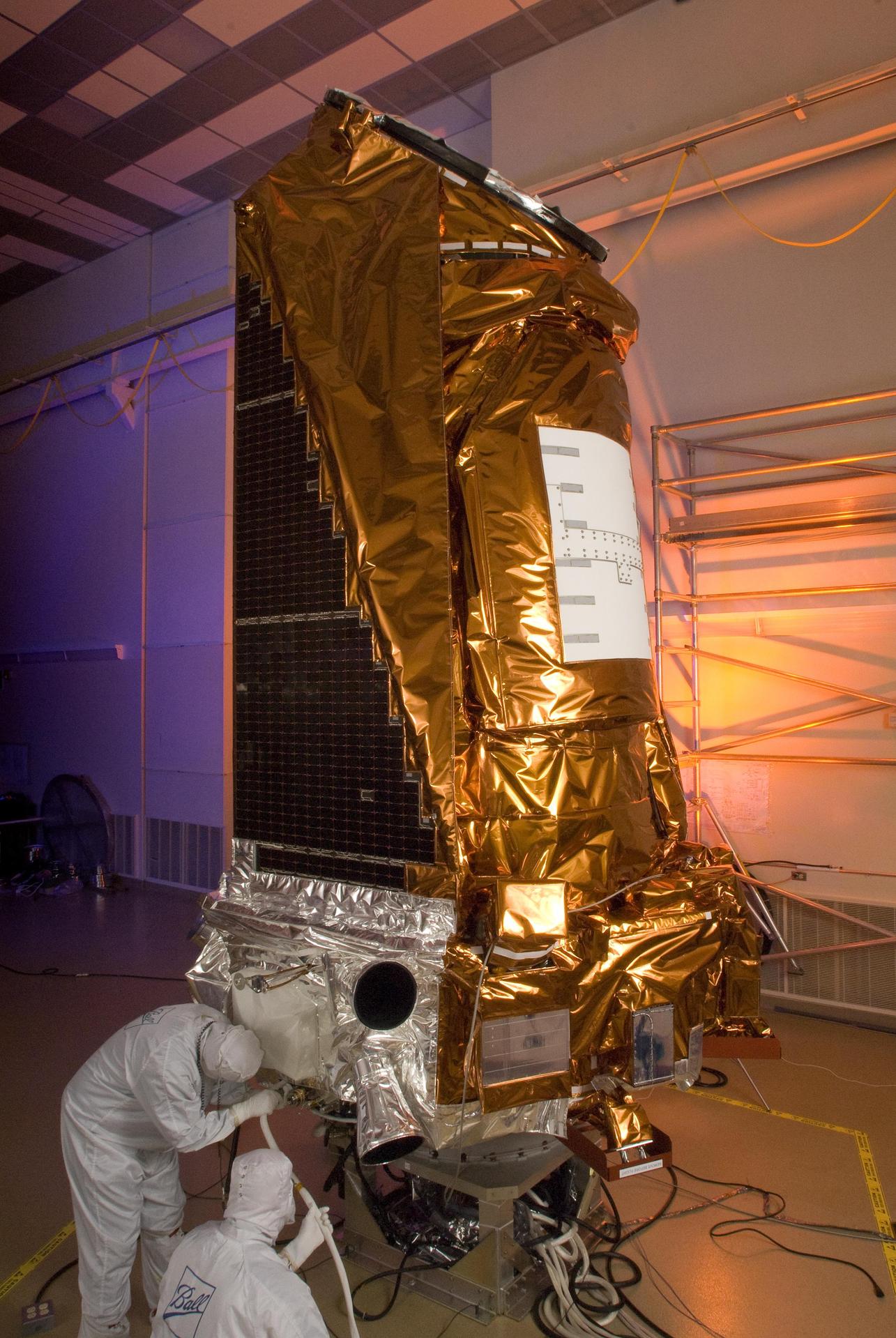
    Image: NASA’s Kepler spacecraft during prelaunch preparation at Ball Aerospace in Boulder, Colorado, on December 18, 2008. Archival photograph, not an image of KIC 2852961. Credit: NASA/JPL-Caltech/Ball. Image source. Usage policy.
  • Could Ancient Auroras Have Organized Chemistry Before Life Began?

    Could Ancient Auroras Have Organized Chemistry Before Life Began?

    Could the same planetary machinery that produces auroras have helped organize chemistry before life began? In an October 21, 2026, interview with Ask an Astrobiologist, Kyoto University researcher Shinya Kato explains a hypothesis that places recurring particle-driven reactions at high latitudes, while emphasizing that the proposed supply of molecules has not been demonstrated.

    A proposed chemical role for auroral regions

    Kato’s BioSystems paper, assigned to the journal’s November 2026 issue, considers an early atmosphere dominated by nitrogen, carbon dioxide and water, with smaller amounts of reduced gases. Earlier irradiation experiments show that energetic particles can generate amino acids and other organic precursors under plausible prebiotic conditions. The proposal asks whether magnetic focusing could repeatedly deliver that chemistry to restricted regions, rather than distributing its effects evenly around the planet.

    The underlying space physics is familiar. The solar wind carries charged particles and magnetic fields, and its interaction with Earth’s magnetic environment can store and release energy. Particles entering the atmosphere cause the auroral glow. The familiar light show is therefore a visible consequence of energy transfer, not the energy source itself. Translating that mechanism to ancient atmospheric chemistry requires assumptions about conditions that differed from today’s Earth.

    From a hypothesis to an experiment

    In the new interview, Kato identifies two unresolved links: how much useful material could have formed, and how much could have survived the journey to the surface. He proposes irradiating molecules relevant to life and examining their behavior through repeated freezing and thawing. The aim is to investigate products that can persist while remaining capable of further reactions.

    This is a fresh explanation of an existing proposal, not an announcement that auroras created life. Kato had already described the idea in his own September 7 account. There, he emphasized tests that compare particle-driven chemistry with ultraviolet irradiation, alongside models of ancient magnetic geometry and searches for distinctive chemical signatures.

    The scientific value lies in a question that experiments can address: can a particular arrangement of energy, atmosphere and concentrating environments sustain chemical pathways that would otherwise be inefficient? Connecting those steps remains the work ahead.

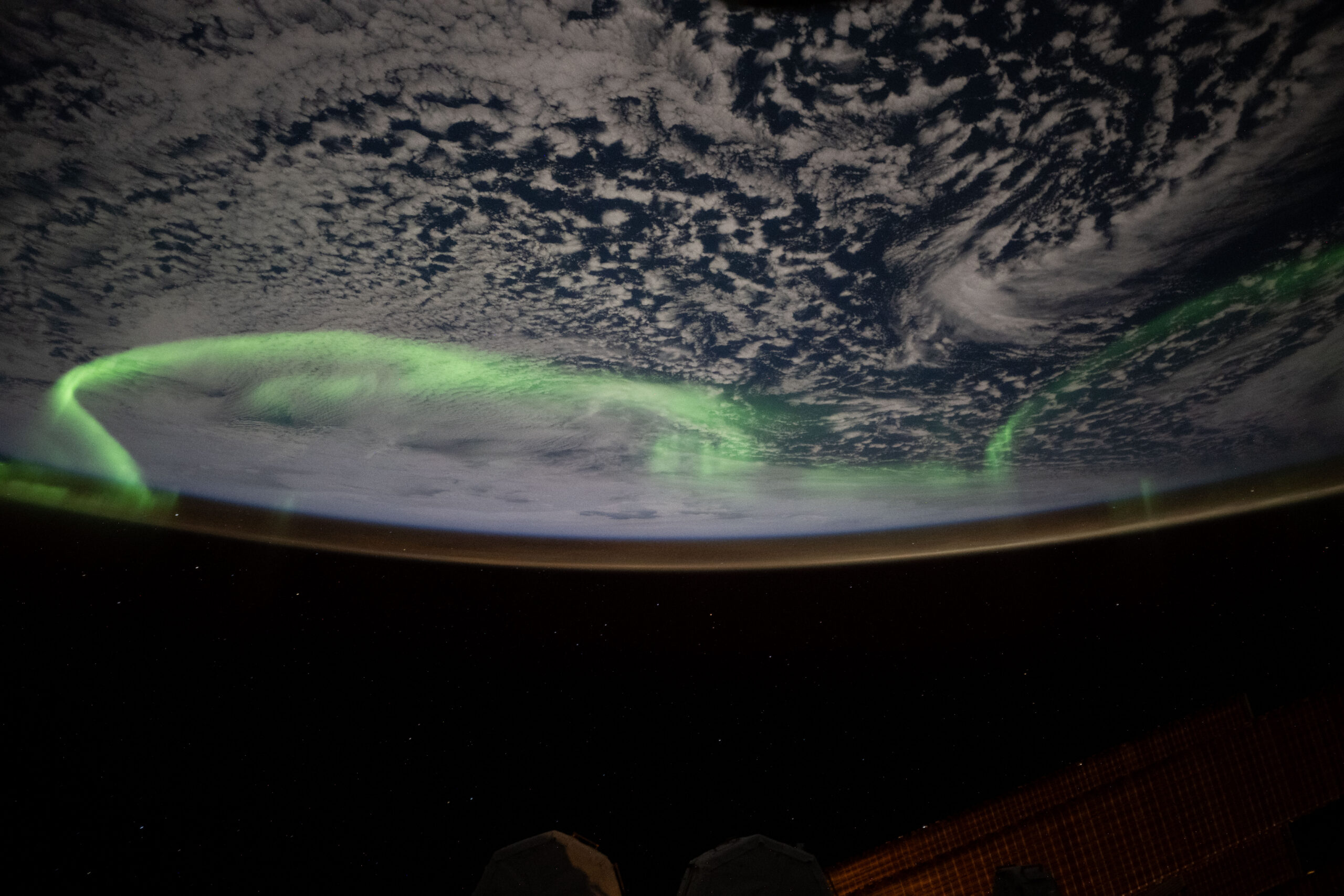
    The aurora australis above the Indian Ocean, photographed from the International Space Station on June 12, 2025. This modern display illustrates auroral activity, not evidence that the proposed ancient chemistry occurred. Credit: NASA/Nichole Ayers.

  • NASA Fires an RS-25 for 500 Seconds to Test Future Artemis Hardware

    NASA Fires an RS-25 for 500 Seconds to Test Future Artemis Hardware

    NASA fired developmental RS-25 engine No. 10001 for 500 seconds on October 21, 2026, at the Fred Haise Test Stand in Mississippi. The run matched the approximate duration of an engine firing during a Space Launch System ascent and reached a power setting of 111%.

    The test announcement identifies two objectives: acceptance testing of flight components for future Artemis missions and validation of a new thermal protection system around the engine nozzle. Engine No. 10001 is a development unit and will not fly. Its role is to expose hardware to demanding operating conditions while engineers collect performance and reliability data.

    Why an engine can run above 100%

    The percentage uses a historical reference rather than a modern engine’s absolute limit. NASA’s RS-25 technical overview explains that the original rated thrust established the 100% baseline. Shuttle missions routinely operated at 104.5%; the newer SLS production engines are designed for 111%. Earlier ground tests also reached 113% to examine operating margin.

    The RS-25 design comes from the space shuttle programme, but its new assignment brings different conditions. Four liquid-hydrogen and liquid-oxygen engines work together beneath the SLS core stage, alongside two solid rocket boosters. Adapting the inherited engines required new controllers and additional insulation against the hotter surroundings near those boosters.

    The production programme also changes how engines are made. NASA describes simplified designs and manufacturing approaches such as selective laser melting, which builds metal components from powder. Using fewer separate pieces can reduce assembly work and manufacturing time. Newly produced engines are to undergo a hot-fire test before flight.

    A component test, not a launch

    Wednesday’s firing belongs to that continuing ground-development effort. It should not be mistaken for an Artemis launch or a test of an assembled Moon rocket. The immediate result reported is a completed engine run; its value lies in the evidence engineers can extract about the hardware exposed to it.

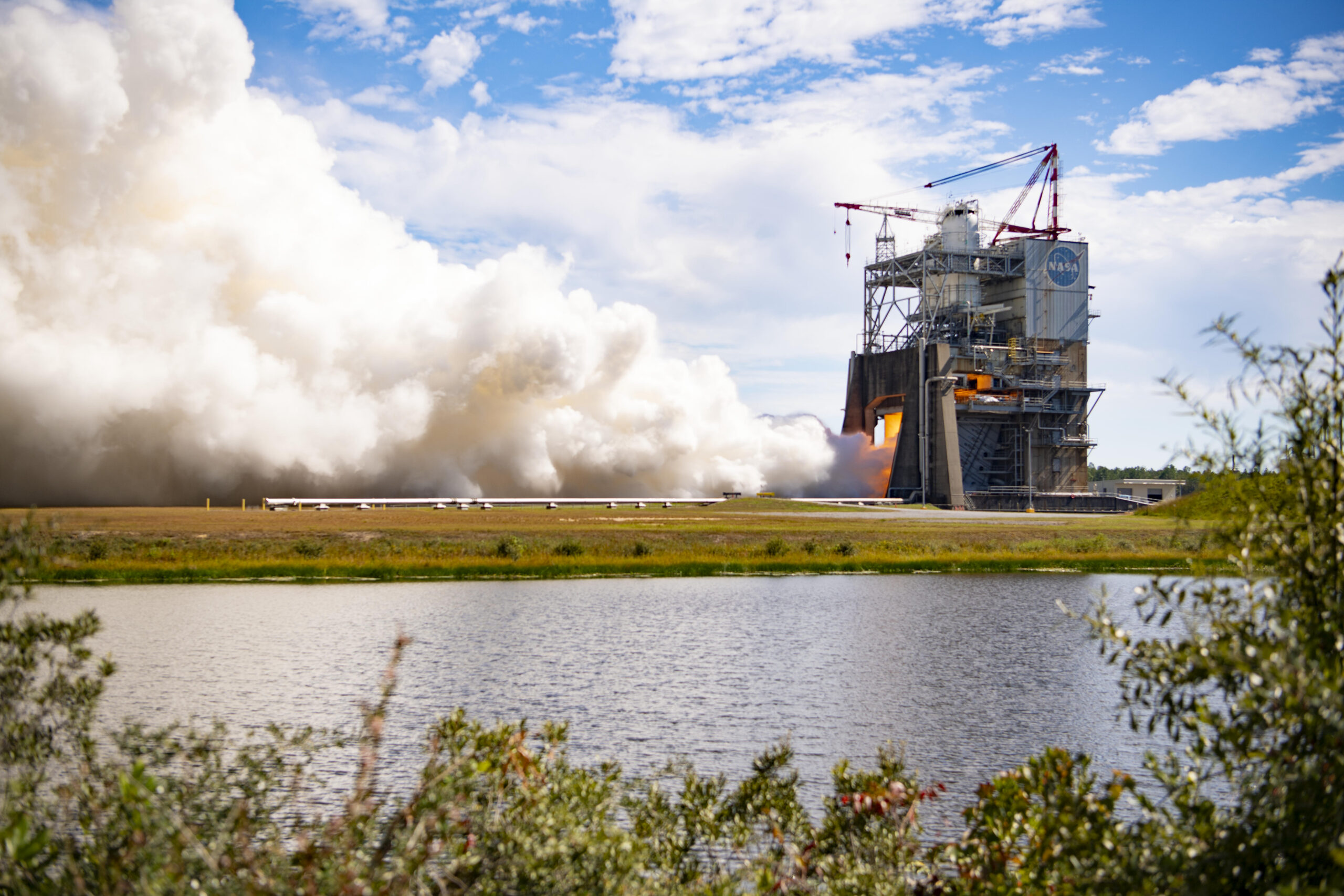
    RS-25 engine No. 10001 during its October 21, 2026, hot-fire test at NASA Stennis. Credit: NASA/Danny Nowlin. Image source.

  • Ryugu’s Ancient Water Points to an Alkaline Setting for Prebiotic Chemistry

    Ryugu’s Ancient Water Points to an Alkaline Setting for Prebiotic Chemistry

    A study published on October 16, 2026, in Nature Communications reconstructs the water that once altered Ryugu’s parent asteroid. Its mineral evidence points to a strongly alkaline, chemically reducing environment, with less dissolved salt than earlier estimates suggested.

    Takahiro Kawai and colleagues combined electron-microprobe measurements and X-ray spectroscopy with chemical-equilibrium calculations. They inferred a pH of roughly 10.3–11.5. Much of the sodium and chlorine was associated with clay minerals rather than simple salt, changing the chemistry reconstructed from the returned grains.

    The authors interpret the results as consistent with liquid water beneath an ice cover, followed by freezing and loss of ice directly into space. Their reconstruction concerns the dominant water-altered material at a late stage of its history; it should not be read as one universal condition for every part of the parent body.

    Putting the water beside the organic inventory

    The broader context comes from years of sample analysis. An initial organic-chemistry investigation reported in February 2023 identified amino acids and several other families of carbon-bearing compounds in Ryugu material. Some of those molecules form in reactions involving liquid water. Such compounds can arise without organisms, so detecting them is evidence about chemical ingredients rather than proof of biology. Hayabusa2 delivered its samples to Earth in December 2020, allowing laboratories to examine material collected directly from the asteroid instead of relying only on meteorites.

    More recently, JAMSTEC and its partners announced on March 17, 2026, that Ryugu samples contained all five nucleobases used by terrestrial DNA and RNA. That team also found a relationship between the relative abundances of different nucleobases and ammonia, offering a possible tracer of non-biological chemical evolution. The new water reconstruction adds environmental context to that growing molecular inventory.

    For origin-of-life research, the useful comparison is between ingredients and conditions: which reactions could proceed, which products could survive, and how different asteroid environments shaped the material available to young planets.

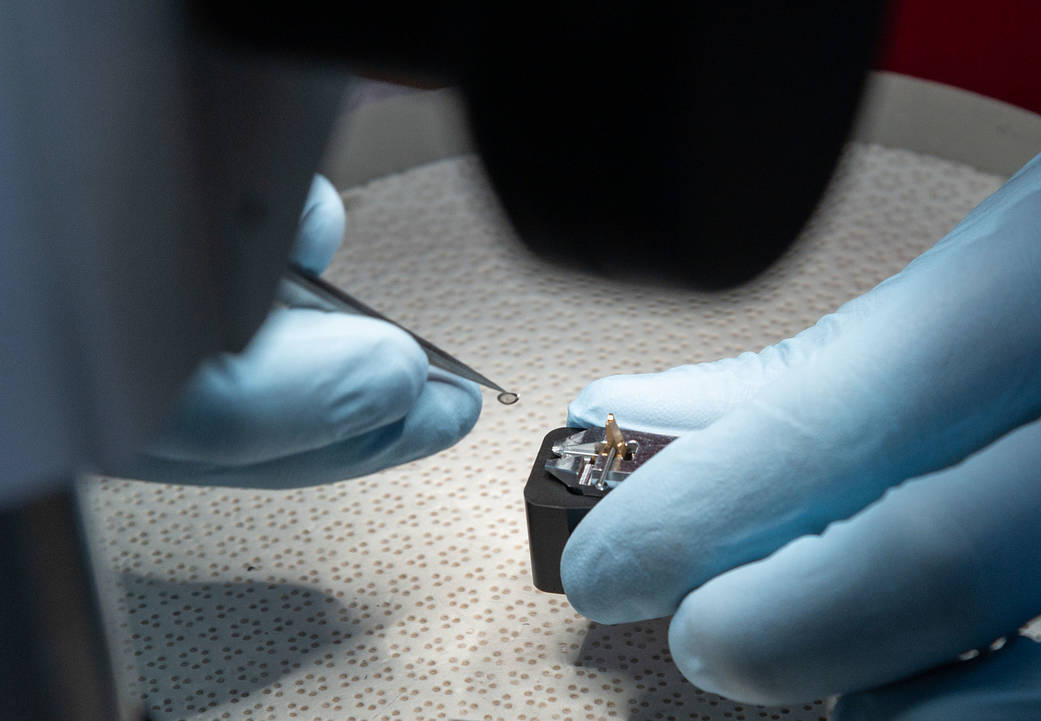
    Laboratory handling of a sample from asteroid Ryugu in an image published in 2021. This archival photograph does not depict the October 2026 study. Credit: NASA.

  • XRISM Finds Evidence for Opposing Gas Streams in the Coma Galaxy Cluster

    XRISM Finds Evidence for Opposing Gas Streams in the Coma Galaxy Cluster

    Hot gas in the Coma galaxy cluster moves in distinct streams, according to a study published October 19, 2026, in Publications of the Astronomical Society of Japan. Researchers used XRISM’s Resolve instrument to examine the shapes of iron emission lines.

    Kosei Sakai and colleagues report evidence for an additional gas component in the northwestern part of the central field moving toward us at roughly 1,270 kilometers per second relative to the cluster’s average galaxy velocity. In a southern field, they identify another component moving in the opposite direction at approximately 1,250 kilometers per second.

    Motion revealed through X-ray energy

    Resolve measures the energy of individual X-rays using a detector with just 36 pixels. Each incoming photon produces a tiny amount of heat. Operating extremely close to absolute zero allows the instrument to measure those temperature changes accurately enough to distinguish closely spaced spectral features.

    Motion shifts the energy at which a known element appears: gas approaching the observer produces a higher-energy signal, while receding gas produces a lower-energy one. A broad spectral line can contain several overlapping contributions. Separating them helps researchers distinguish organized flows from a simple picture of gas stirring randomly in place.

    Building on earlier measurements

    The new analysis revisits two fields already studied in earlier XRISM research. Those observations established substantial gas velocities in the cluster’s center and a region to its south. The latest work asks what finer structure is concealed inside the emission-line profiles, rather than announcing a newly discovered galaxy cluster.

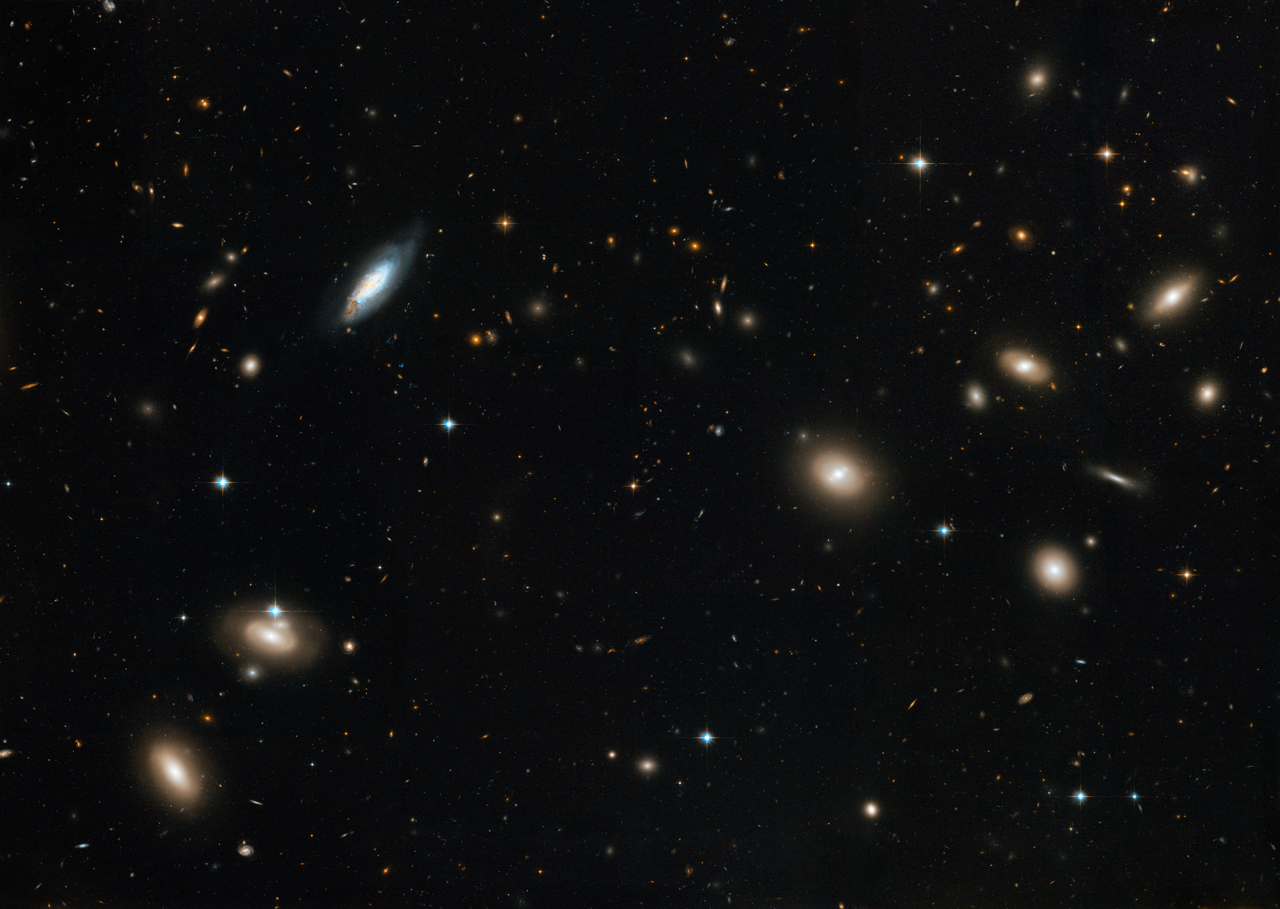
    Hubble observations of Coma show why it is such a rich setting for this work. More than 300 million light-years away, the cluster contains thousands of galaxies across a region exceeding 20 million light-years in diameter. Many central members are ellipticals dominated by older stars; spiral galaxies also inhabit the wider cluster.

    The limits of the map

    The reported velocities are line-of-sight components, not complete three-dimensional trajectories. The observations cover two small fields, not the entire cluster. The authors estimate that turbulence and bulk flows carry comparable energy densities. Their paper appeared first as a September preprint; the new date is its journal publication.

    The accompanying Hubble image, released in June 2008, shows galaxies in part of Coma. It provides visual context, but does not display the X-ray gas flows or mark the exact Resolve fields. Optical imagery and X-ray spectroscopy describe different components of the same enormous system.

    Image: Archival Hubble view of part of the Coma galaxy cluster, released June 10, 2008. This optical image does not show the X-ray gas velocities or identify the Resolve observation fields. Credit: NASA, ESA, and the Hubble Heritage Team (STScI/AURA). Acknowledgment: D. Carter (Liverpool John Moores University) and the Coma HST ACS Treasury Team. CC BY 4.0.

  • Webb Maps Water Ice Behind the Dust in Four Colliding Galaxy Systems

    Webb Maps Water Ice Behind the Dust in Four Colliding Galaxy Systems

    Water ice offers clues to structures hidden inside dusty galaxies. A study submitted on October 16, 2026, and accepted for Astronomy & Astrophysics, maps obscuration and ice in four interacting galaxy systems with James Webb Space Telescope spectroscopy.

    Giovanna Speranza and colleagues examined Arp 220, NGC 6240, VV 114 and NGC 3256. Hydrogen emission and ice absorption show greater obscuration and larger ice columns near their centers.

    Reading a spectrum at each position

    The observations used Webb’s Near-Infrared Spectrograph, or NIRSpec. A spectrograph separates incoming light by wavelength, allowing atoms and molecules to be identified through characteristic features. Those features also carry information about the physical conditions of the material producing or absorbing the light.

    In integral-field mode, the instrument gathers spatially resolved spectra rather than reducing an entire target to one combined measurement. Astronomers can therefore compare different locations within a galaxy. This is important when a luminous central region and surrounding gas contribute very different signals, which would otherwise be blended together.

    Different gas, different obscuration

    The ionized gas appears more deeply obscured than the hot molecular gas. The interpretation places ice-bearing dust around both components, plus extra ice near some nuclei. The median carbon-dioxide-to-water ice ratio is approximately 0.10. This is not evidence for life or oceans.

    Arp 220 shows the setting

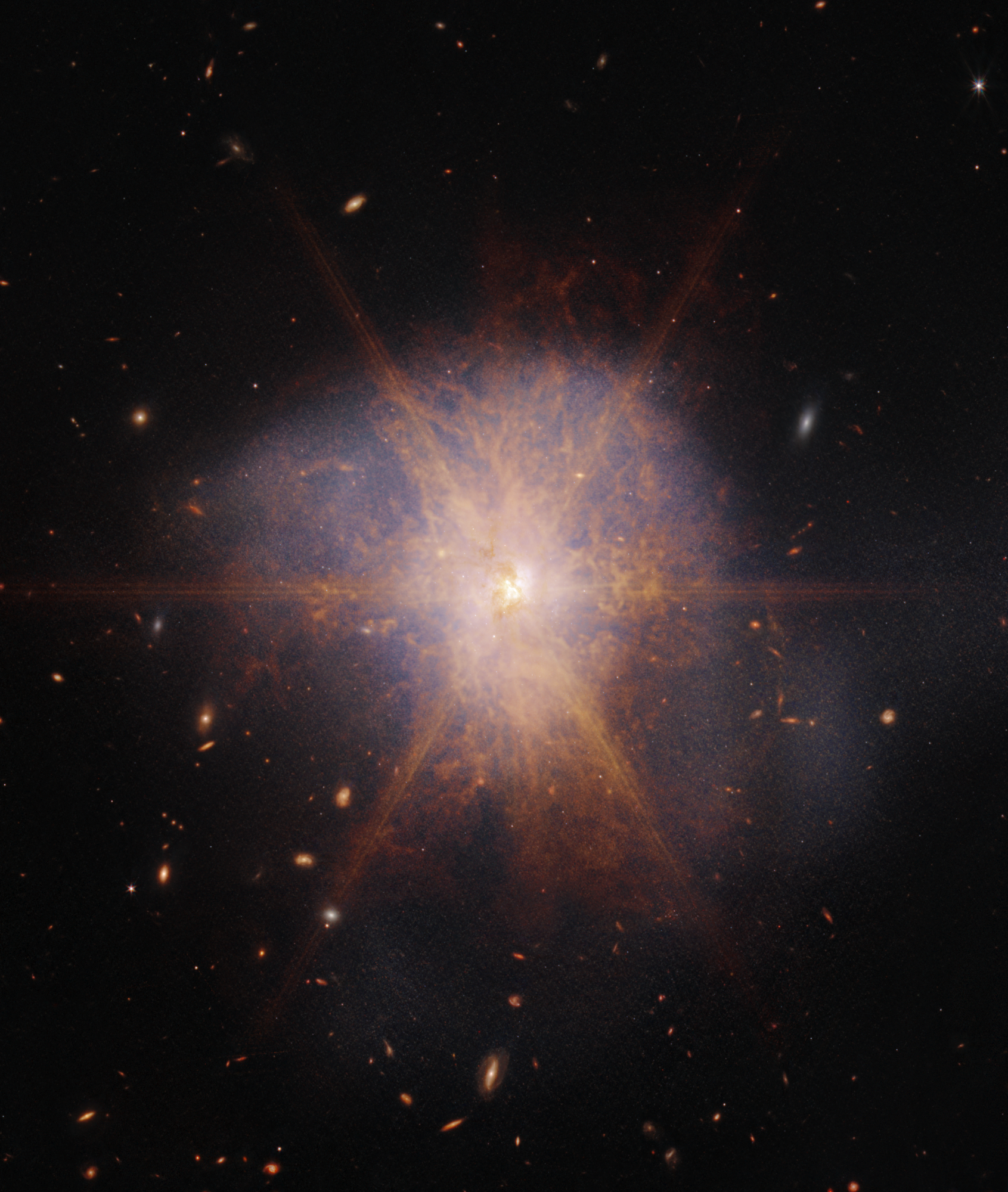
    Webb’s earlier portrait of Arp 220 provides useful context. The system comprises two merging spiral galaxies and radiates more than a trillion times the Sun’s luminosity. Its collision triggered intense star formation within a compact, dusty region. Gravity has also drawn material into extended tidal structures.

    The accompanying image was released in April 2023, using Webb’s NIRCam and MIRI instruments. Its colors represent selected infrared bands, so it is not a visible-light view or a direct photograph of ice. The chemical evidence comes from the separate spectroscopic analysis described here.

    Ice columns and obscuration are inferred using spectral models and assumptions about the emitting and absorbing material. Four systems provide a detailed comparison, but cannot establish a universal arrangement for all merging galaxies.

    Image: Arp 220 in an archival Webb image released April 17, 2023. It is one of the systems in the new spectroscopic study; this NIRCam/MIRI image is not an ice map. Credit: NASA, ESA, CSA, K. Pontoppidan (STScI), A. Pagan (STScI). CC BY 4.0.

  • ALMA2040 Proposals Aim to Map the Chemistry That Builds Rocky Worlds

    ALMA2040 Proposals Aim to Map the Chemistry That Builds Rocky Worlds

    Two white papers posted on October 15, 2026, outline a route toward a more detailed chemical inventory of forming planetary systems. Their proposed ALMA2040 capabilities would help astronomers study the material available to rocky planets and search for rarer molecules in interstellar clouds. These are science cases for a future facility, not announcements of newly detected life or a completed upgrade.

    Looking closer to a young star

    In “Chemistry on solar system scales,” Catherine Walsh and colleagues focus on the small inner regions of planet-forming disks. Those regions help determine the ingredients of terrestrial worlds, yet faint molecular emission there is difficult to map with present instruments.

    The team calls for roughly tenfold better spectral-line sensitivity and resolution corresponding to about five astronomical units or less at a distance of 140 parsecs. An astronomical unit is approximately the Earth–Sun distance. The objective is to move chemical mapping closer to the zones where rocky planets assemble, rather than concentrating on larger, easier-to-observe structures.

    Water is a particular target. The paper examines how improved observations could probe material inside the water snowline, the boundary beyond which water freezes onto grains. It uses simulated observations to explore what the proposed instrument might reveal.

    A broader molecular search

    A companion white paper led by Víctor M. Rivilla considers chemical complexity across star- and planet-forming environments. Its authors note that more than 350 interstellar molecules are already known, while the full inventory remains uncertain.

    They argue for broad frequency coverage and greater sensitivity so that several weak spectral transitions from a candidate molecule could be measured together. Those multiple lines matter: a convincing identification needs a consistent molecular fingerprint, rather than one suggestive feature in a crowded spectrum.

    The proposed searches include molecular families relevant to prebiotic chemistry, such as amino acids, sugars and nucleobases. Establishing their distribution would address the availability of chemical ingredients. It would not, by itself, show that organisms use those ingredients anywhere beyond Earth.

    Separate ambitions from work already under way

    ALMA does have an existing modernization programme: the Wideband Sensitivity Upgrade. ESO describes that project as improvements to receivers, digital electronics, signal transport and the correlator, with observing bandwidth intended to double initially and eventually quadruple. The upgrade is part of the ALMA 2030 roadmap.

    That established programme should not be confused with the larger capabilities explored in the new ALMA2040 papers. A technical requirement in a science proposal is not evidence that the equipment has been funded, built or scheduled for operation.

    The papers’ immediate contribution is a clearer observing agenda: determine which measurements are missing, calculate the performance needed to obtain them, and connect chemical inventories to the formation of planets. Those steps can make the search for life’s raw materials more testable without turning a promising molecule into a claim of biology.

    Generated illustration. Radio dishes and a conceptual planet-forming disk represent proposed observations of planetary chemistry. The disk is not a real object in the sky above ALMA.

  • Laboratory Impact-Crater Habitats Quickly Develop Heat-Loving Microbial Communities

    Laboratory Impact-Crater Habitats Quickly Develop Heat-Loving Microbial Communities

    A laboratory study published in Geobiology on October 17, 2026, finds that warm, water-soaked impact rocks can support diverse microbial communities within weeks. The experiment tests how existing organisms become established after an impact environment cools, rather than how life first originates. Read the study.

    Rebuilding a small part of a crater

    Sabrina M. C. Hardy and colleagues placed rock from Germany’s Ries impact structure in water baths at 50, 60 and 70 degrees Celsius. They added temperate soil to introduce microbes; the impact rock was also unsterilized. Communities developed on oxidized rock surfaces, inside submerged fragments and in sediment.

    Genetic analysis identified potential for several chemical cycles, including sulfur metabolism. Finding the relevant genes, however, does not demonstrate that every predicted reaction occurred.

    Why hot water and broken rock matter

    Hydrothermal environments interest astrobiologists because they bring water, rock and chemical energy together. At Earth’s seafloor vents, microorganisms can obtain energy from chemical reactions instead of relying directly on sunlight. Temperature gradients also create different living spaces around a single vent. NASA’s hydrothermal-vent overview explains why those ecosystems helped broaden scientific thinking about potentially habitable environments beyond Earth.

    Impact-generated systems have a different source of heat, but their geological record shows why they deserve attention. A 2020 investigation of Chicxulub, the crater associated with the end-Cretaceous extinction, examined a deep drill core and found extensive chemical and mineral alteration caused by circulating hot fluids. The recovered rocks preserve a setting in which water could move through damaged crust long after the initial catastrophe.

    A separate study of sulfur isotopes in Chicxulub minerals, first published online on October 30, 2020, identified signatures interpreted as microbial sulfate reduction. Tiny pyrite structures in porous rock supplied evidence for an ancient subsurface community. Such mineral evidence can help reconstruct an ecosystem after the organisms themselves are gone.

    What the new experiment can establish

    The new experiment used one heat bath per temperature, limiting statistical comparisons between temperatures. It also used one crater’s material and modern organisms. The authors did not directly measure active sulfate reduction. These qualifications matter when extending laboratory results to ancient Earth or Mars. Methods and limitations.

    Together, the approaches address different questions. Drill cores preserve the aftermath of real events; controlled experiments allow researchers to watch communities develop. Neither can establish that every wet crater was inhabited. For life-searching missions, the useful distinction is between identifying a plausible habitat and finding independent evidence that something actually lived there.

    Generated illustration. A conceptual laboratory setup for studying microbial communities in warm impact rocks, with a magnified microbial inset. It is not a photograph of the experiment.

  • Inouye Telescope Finds Fresh Evidence for Magnetic Reconnection Close to the Sun’s Surface

    Inouye Telescope Finds Fresh Evidence for Magnetic Reconnection Close to the Sun’s Surface

    Small solar brightenings offer a closer look at how magnetic energy becomes heat. A study submitted on October 16, 2026, and marked accepted by The Astrophysical Journal Letters, reports new evidence that Ellerman bombs originate through magnetic reconnection in the photosphere.

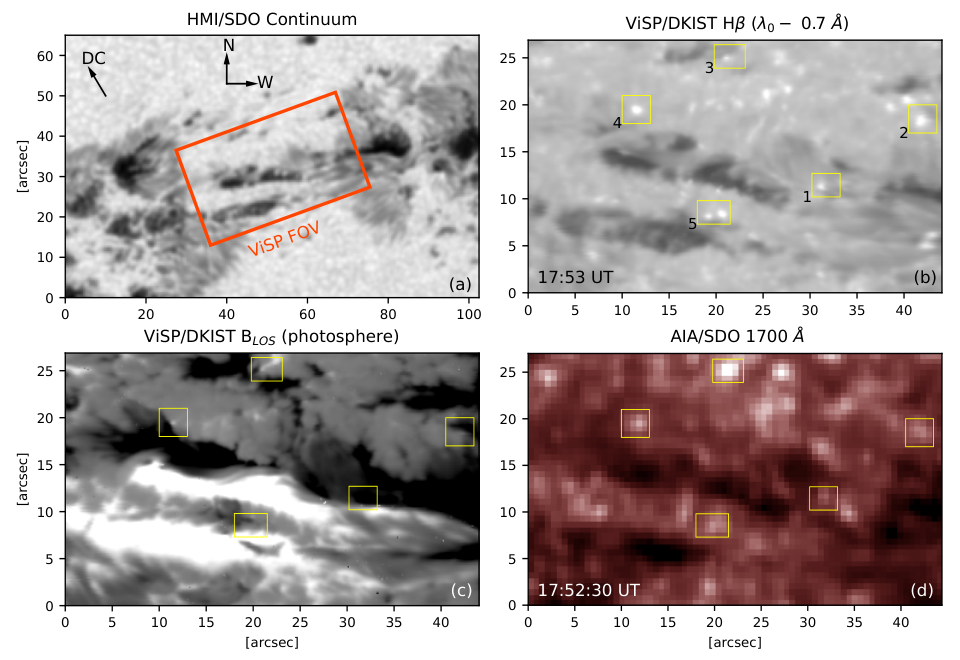
    Rahul Yadav and colleagues analyzed observations made on June 18, 2024, with the Daniel K. Inouye Solar Telescope. They identified 14 distinct events and compared signatures in hydrogen, sodium and iron. Their atmospheric reconstruction indicated localized temperature increases reaching approximately 800 kelvin, alongside relatively weak upward and downward flows.

    Why several spectral lines matter

    The instrument behind the measurements, the Visible Spectro-Polarimeter, does more than take a detailed solar photograph. It can observe three selected spectral lines simultaneously and measure polarization, the orientation properties of light. Its camera arms can be adjusted independently to sample different parts of the visible spectrum.

    This combination provides complementary information about the solar atmosphere. Spectral profiles show how brightness changes across a narrow wavelength range, while polarization measurements help researchers investigate magnetic fields. Recording multiple lines at once is especially useful for a rapidly changing target: it avoids treating measurements taken at different moments as if they described precisely the same event.

    A small-scale test of magnetic physics

    As NASA’s explanation of solar magnetism describes, the Sun consists of plasma whose moving charged particles interact with magnetic fields. Motion and magnetism continually affect each other. The visible surface is therefore part of a dynamic system, rather than a quiet boundary beneath a separate active atmosphere.

    Magnetic reconnection changes how magnetic fields are connected and can release stored energy. The same broad physical process is important in much larger solar eruptions, but identifying it in a small brightening does not turn that event into a forecast of a major flare or an Earth-directed storm.

    What the result establishes

    The team compared its measurements with simulated spectra from the Bifrost model. Their agreement strengthens the reconnection interpretation, but the inferred heating and atmospheric structure remain model-dependent. This is an analysis of earlier observations, not a report of a solar explosion occurring today.

    Image: Observations from June 18, 2024, used in the new analysis. Yellow boxes mark example Ellerman-bomb locations; the lower-left panel maps inferred magnetic polarity. Credit: Rahul Yadav, Maria D. Kazachenko and Viggo Hansteen (2026), Figure 1; DKIST/ViSP and NASA/SDO data. CC BY 4.0.

  • Two NASA-Backed Relay Experiments Reach Orbit on Bandwagon-5

    Two NASA-Backed Relay Experiments Reach Orbit on Bandwagon-5

    Two NASA-funded communications demonstrations reached low Earth orbit on October 20, 2026, aboard SpaceX’s Bandwagon-5 rideshare. NASA confirmed the launch and said partners Viasat and SES Space and Defense would prepare for tests in the following weeks.

    Two approaches to keeping spacecraft connected

    Viasat’s demonstration uses Maxwell, a spacecraft built by Rocket Lab. NASA says the experiment will route information between Maxwell, Viasat’s geosynchronous satellites and ground stations, using autonomous technology to manage the path. It will test both high-rate data transfer and lower-rate communications needed to support spacecraft operations.

    SES identified its payload as flying on Planet’s Pelican-12 satellite in a separate October 20 announcement. The company reported liftoff at 7:04 a.m. Eastern from Cape Canaveral Space Force Station. Its relay approach combines geosynchronous satellites with the O3b mPOWER constellation in medium Earth orbit, supporting different data-rate requirements through those two orbital layers.

    More than a fast download

    A spacecraft needs several kinds of connection. High-rate links can carry large science files or detailed imagery; lower-rate channels support tracking and commands. NASA’s launch report describes the demonstrations as tests of that broader communications job. A fast transfer alone would not establish that a service can satisfy every operational need.

    The new flights build on earlier work. In a December 2025 progress report, updated in February 2026, NASA described SES flight tests with Planet that relayed data between low Earth orbit and higher-orbit communications satellites. That report also described Viasat’s successful monitoring of New Glenn launch telemetry in November 2025, using its existing satellite network.

    Those earlier tests are useful context for the latest launch: the effort is developing several services and operational situations, rather than waiting for a single all-or-nothing demonstration. The December report described launch tracking, spacecraft command and control, and high-volume science delivery as different capabilities under evaluation.

    Preparing for life after the government relay fleet

    NASA has explained that its transition toward commercial relays is intended to support future near-Earth missions as its Tracking and Data Relay Satellite fleet is gradually retired. The Communications Services Project initially provided $278.5 million to six industry partners in 2022. The agency’s objective is to buy services in a broader market, rather than remain the sole operator of the communications infrastructure.

    The distinction between launch and service readiness remains important. Sending demonstration hardware to orbit allows testing under real operating conditions; it does not, by itself, establish coverage, availability or reliability for a future customer mission. For these two flights, the next meaningful evidence will be measured end-to-end performance: commands reaching the spacecraft and mission information arriving where it is needed on Earth.

    NASA illustration of satellite relay communications around Earth. This conceptual image does not show the Bandwagon-5 launch or its specific payloads. Credit: NASA/Morgan Johnson.