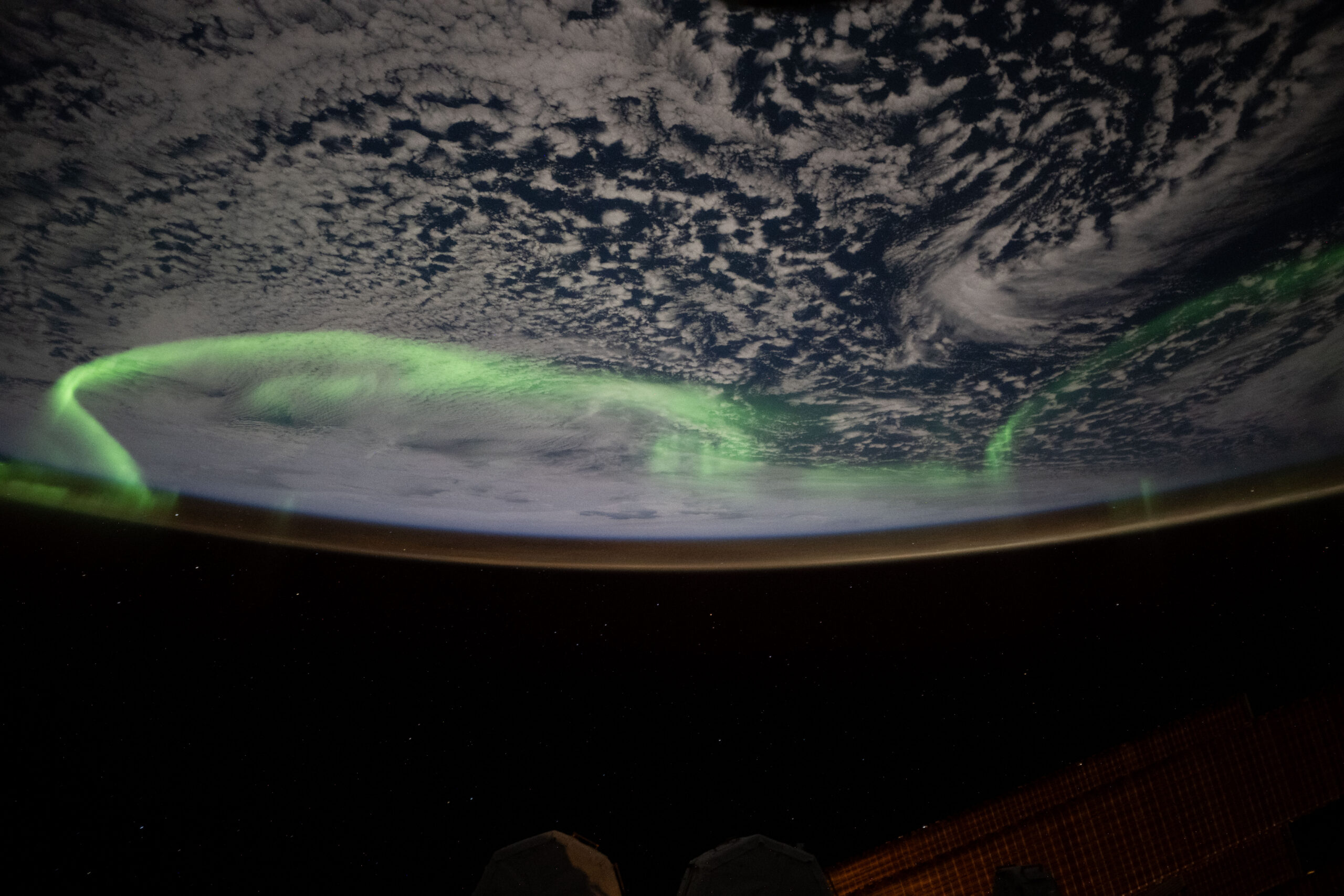
Could the same planetary machinery that produces auroras have helped organize chemistry before life began? In an October 21, 2026, interview with Ask an Astrobiologist, Kyoto University researcher Shinya Kato explains a hypothesis that places recurring particle-driven reactions at high latitudes, while emphasizing that the proposed supply of molecules has not been demonstrated.
A proposed chemical role for auroral regions
Kato’s BioSystems paper, assigned to the journal’s November 2026 issue, considers an early atmosphere dominated by nitrogen, carbon dioxide and water, with smaller amounts of reduced gases. Earlier irradiation experiments show that energetic particles can generate amino acids and other organic precursors under plausible prebiotic conditions. The proposal asks whether magnetic focusing could repeatedly deliver that chemistry to restricted regions, rather than distributing its effects evenly around the planet.
The underlying space physics is familiar. The solar wind carries charged particles and magnetic fields, and its interaction with Earth’s magnetic environment can store and release energy. Particles entering the atmosphere cause the auroral glow. The familiar light show is therefore a visible consequence of energy transfer, not the energy source itself. Translating that mechanism to ancient atmospheric chemistry requires assumptions about conditions that differed from today’s Earth.
From a hypothesis to an experiment
In the new interview, Kato identifies two unresolved links: how much useful material could have formed, and how much could have survived the journey to the surface. He proposes irradiating molecules relevant to life and examining their behavior through repeated freezing and thawing. The aim is to investigate products that can persist while remaining capable of further reactions.
This is a fresh explanation of an existing proposal, not an announcement that auroras created life. Kato had already described the idea in his own September 7 account. There, he emphasized tests that compare particle-driven chemistry with ultraviolet irradiation, alongside models of ancient magnetic geometry and searches for distinctive chemical signatures.
The scientific value lies in a question that experiments can address: can a particular arrangement of energy, atmosphere and concentrating environments sustain chemical pathways that would otherwise be inefficient? Connecting those steps remains the work ahead.
The aurora australis above the Indian Ocean, photographed from the International Space Station on June 12, 2025. This modern display illustrates auroral activity, not evidence that the proposed ancient chemistry occurred. Credit: NASA/Nichole Ayers.
Leave a Reply