A study published on October 16, 2026, in Nature Communications reconstructs the water that once altered Ryugu’s parent asteroid. Its mineral evidence points to a strongly alkaline, chemically reducing environment, with less dissolved salt than earlier estimates suggested.
Takahiro Kawai and colleagues combined electron-microprobe measurements and X-ray spectroscopy with chemical-equilibrium calculations. They inferred a pH of roughly 10.3–11.5. Much of the sodium and chlorine was associated with clay minerals rather than simple salt, changing the chemistry reconstructed from the returned grains.
The authors interpret the results as consistent with liquid water beneath an ice cover, followed by freezing and loss of ice directly into space. Their reconstruction concerns the dominant water-altered material at a late stage of its history; it should not be read as one universal condition for every part of the parent body.
Putting the water beside the organic inventory
The broader context comes from years of sample analysis. An initial organic-chemistry investigation reported in February 2023 identified amino acids and several other families of carbon-bearing compounds in Ryugu material. Some of those molecules form in reactions involving liquid water. Such compounds can arise without organisms, so detecting them is evidence about chemical ingredients rather than proof of biology. Hayabusa2 delivered its samples to Earth in December 2020, allowing laboratories to examine material collected directly from the asteroid instead of relying only on meteorites.
More recently, JAMSTEC and its partners announced on March 17, 2026, that Ryugu samples contained all five nucleobases used by terrestrial DNA and RNA. That team also found a relationship between the relative abundances of different nucleobases and ammonia, offering a possible tracer of non-biological chemical evolution. The new water reconstruction adds environmental context to that growing molecular inventory.
For origin-of-life research, the useful comparison is between ingredients and conditions: which reactions could proceed, which products could survive, and how different asteroid environments shaped the material available to young planets.
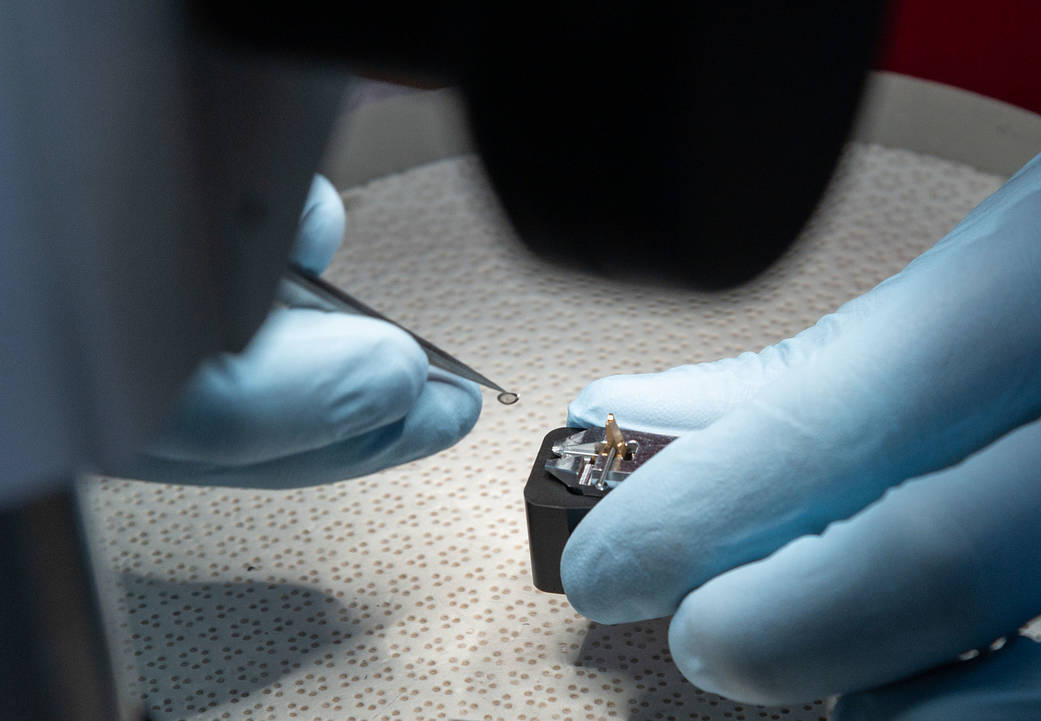
Laboratory handling of a sample from asteroid Ryugu in an image published in 2021. This archival photograph does not depict the October 2026 study. Credit: NASA.
Leave a Reply