Hot gas in the Coma galaxy cluster moves in distinct streams, according to a study published October 19, 2026, in Publications of the Astronomical Society of Japan. Researchers used XRISM’s Resolve instrument to examine the shapes of iron emission lines.
Kosei Sakai and colleagues report evidence for an additional gas component in the northwestern part of the central field moving toward us at roughly 1,270 kilometers per second relative to the cluster’s average galaxy velocity. In a southern field, they identify another component moving in the opposite direction at approximately 1,250 kilometers per second.
Motion revealed through X-ray energy
Resolve measures the energy of individual X-rays using a detector with just 36 pixels. Each incoming photon produces a tiny amount of heat. Operating extremely close to absolute zero allows the instrument to measure those temperature changes accurately enough to distinguish closely spaced spectral features.
Motion shifts the energy at which a known element appears: gas approaching the observer produces a higher-energy signal, while receding gas produces a lower-energy one. A broad spectral line can contain several overlapping contributions. Separating them helps researchers distinguish organized flows from a simple picture of gas stirring randomly in place.
Building on earlier measurements
The new analysis revisits two fields already studied in earlier XRISM research. Those observations established substantial gas velocities in the cluster’s center and a region to its south. The latest work asks what finer structure is concealed inside the emission-line profiles, rather than announcing a newly discovered galaxy cluster.
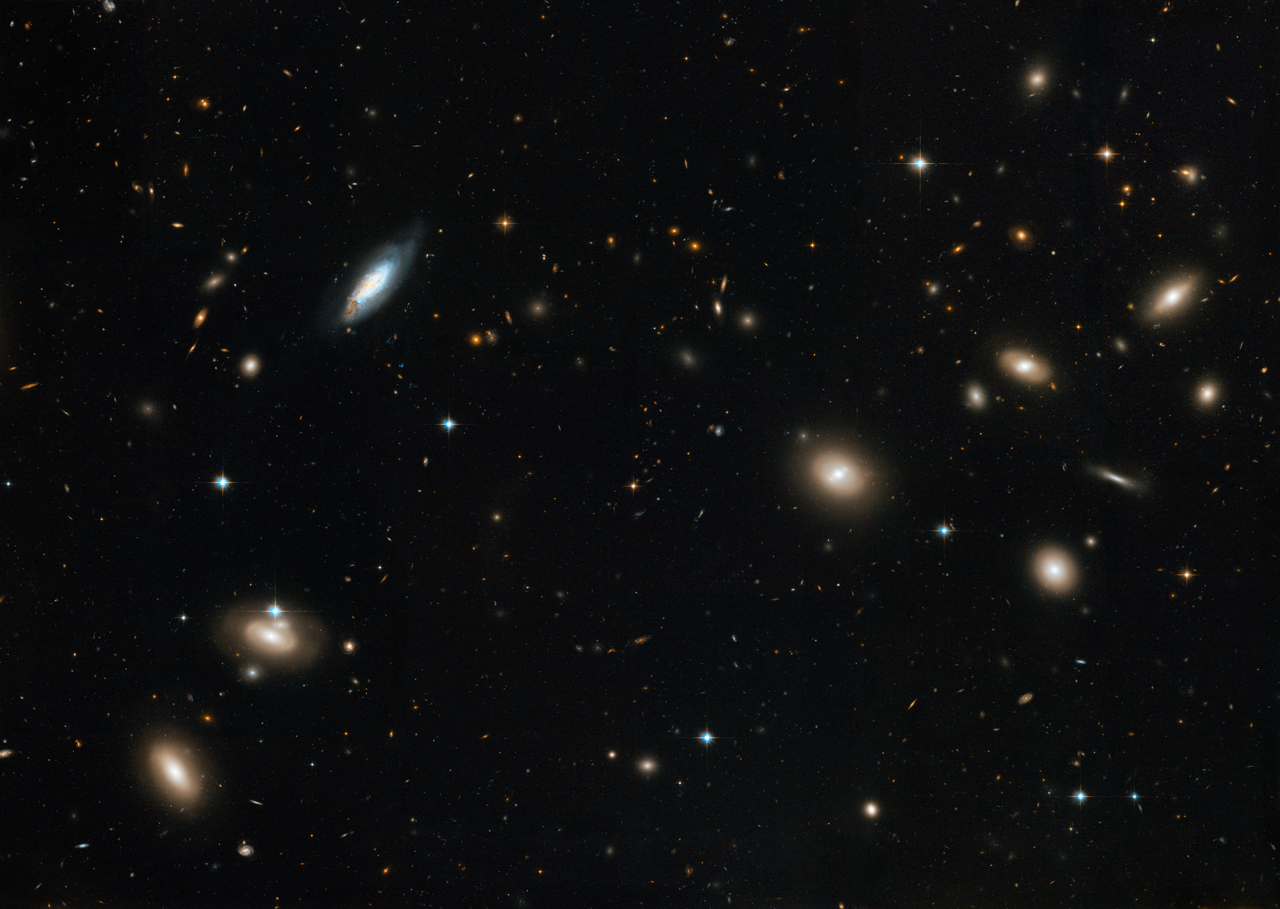
Hubble observations of Coma show why it is such a rich setting for this work. More than 300 million light-years away, the cluster contains thousands of galaxies across a region exceeding 20 million light-years in diameter. Many central members are ellipticals dominated by older stars; spiral galaxies also inhabit the wider cluster.
The limits of the map
The reported velocities are line-of-sight components, not complete three-dimensional trajectories. The observations cover two small fields, not the entire cluster. The authors estimate that turbulence and bulk flows carry comparable energy densities. Their paper appeared first as a September preprint; the new date is its journal publication.
The accompanying Hubble image, released in June 2008, shows galaxies in part of Coma. It provides visual context, but does not display the X-ray gas flows or mark the exact Resolve fields. Optical imagery and X-ray spectroscopy describe different components of the same enormous system.
Image: Archival Hubble view of part of the Coma galaxy cluster, released June 10, 2008. This optical image does not show the X-ray gas velocities or identify the Resolve observation fields. Credit: NASA, ESA, and the Hubble Heritage Team (STScI/AURA). Acknowledgment: D. Carter (Liverpool John Moores University) and the Coma HST ACS Treasury Team. CC BY 4.0.
Leave a Reply