A red giant famous for violent stellar eruptions appears to owe its activity to a partnership, but not a simple magnetic trigger from its companion. In an October 21, 2026 announcement, Hungary’s Konkoly Observatory described how a nearby dwarf star helps establish the conditions for KIC 2852961’s superflares.
The object was already exceptional. A 2020 study catalogued 59 verified flares in its Kepler observations. That work linked the energy released over several rotations with the changing brightness pattern produced by starspots. It suggested that ordinary flares and much larger superflares could arise from the same basic magnetic process, operating at different energy scales. The new investigation asks what keeps this particular giant so magnetically productive.
The new paper, posted on October 8, combines ground-based radial-velocity measurements with space observations. It confirms a close binary system whose orbit is nearly circular. Tidal forces have brought the giant’s rotation close to the orbital rhythm, without completely eliminating differential rotation: different parts of the star still turn at different rates.
That remaining shear can help sustain a magnetic dynamo and twist magnetic structures above extensive starspots. The researchers interpret the star’s large rotational brightness variations as evidence of spotted regions capable of supporting substantial magnetic-energy storage. Reconnection of stressed magnetic fields then offers a route to powerful eruptions.
Crucially, the flares did not favor particular positions in the binary orbit. The team therefore favors activity generated within the giant over a companion-driven trigger tied to orbital phase. That is an interpretation of the observations, not a direct view inside the star.
The result also illustrates the longevity of a space-telescope archive. NASA retired Kepler on October 30, 2018, but its repeated brightness measurements remain available for investigations far beyond the mission’s original planet-hunting work. Here, combining that record with later spectroscopy changes the question from how energetic the flares are to why their host can keep producing them.
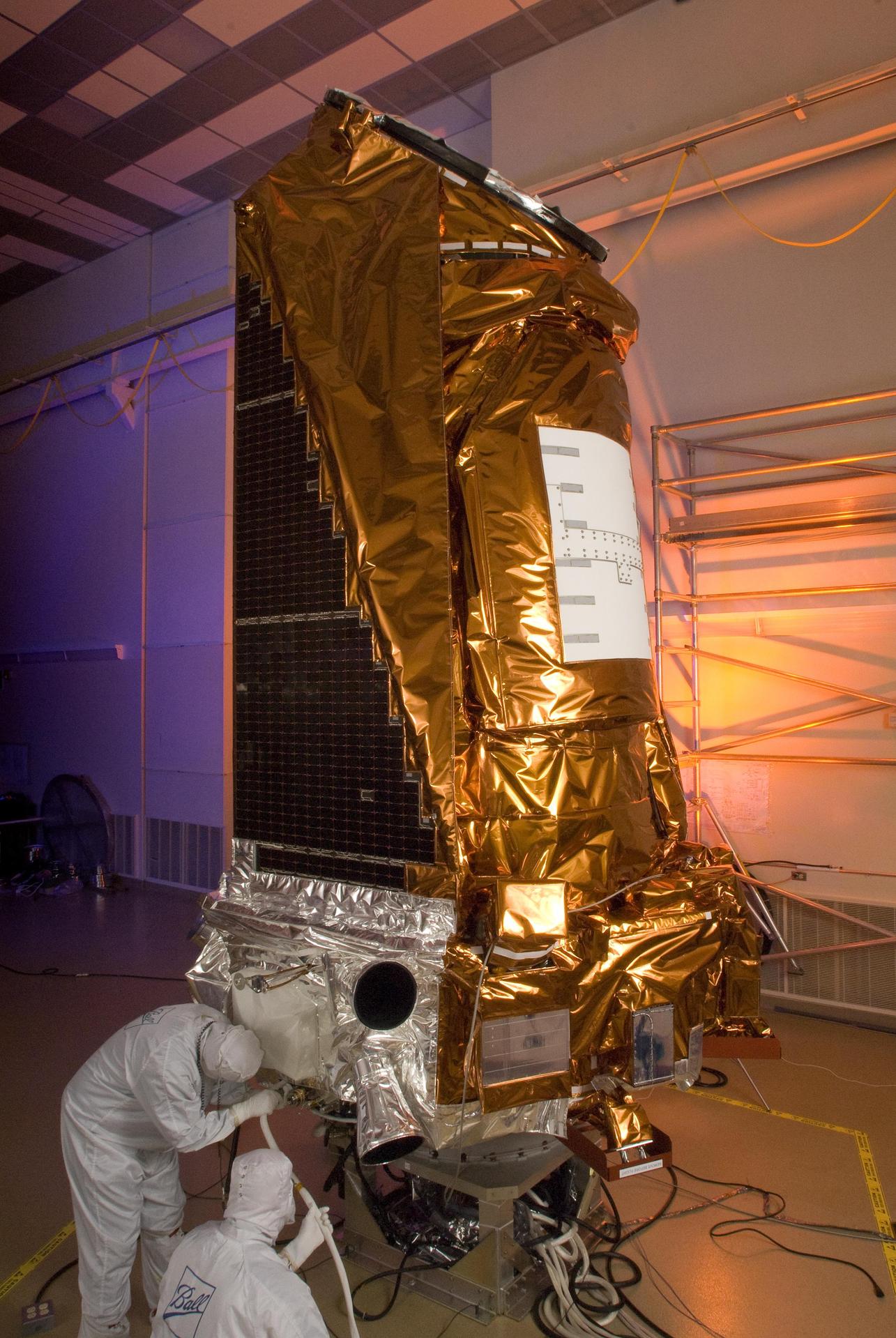
Image: NASA’s Kepler spacecraft during prelaunch preparation at Ball Aerospace in Boulder, Colorado, on December 18, 2008. Archival photograph, not an image of KIC 2852961. Credit: NASA/JPL-Caltech/Ball. Image source. Usage policy.
Leave a Reply