DARK FIRESORIGINS UNKNOWN

Author: Dark Fires

  • Galileo’s Next Generation Tests a Navigation Payload That Can Change in Orbit

    Galileo’s Next Generation Tests a Navigation Payload That Can Change in Orbit

    A key part of Europe’s next-generation navigation satellites has passed testing on the ground. In an October 20, 2026 update, ESA said Airbus’s first new signal generation module had completed examinations in Toulouse and returned to Friedrichshafen for the next stage of assembly.

    Changing the signal without changing the satellite

    The module turns timing information from onboard atomic clocks into navigation signals. Its important new feature is reprogrammability: Galileo Second Generation satellites are intended to generate different signals in real time and accept new configurations after launch. ESA says this flexibility could support improved resistance to interference, faster signal acquisition and greater positioning accuracy.

    The hardware still needs integration with the radio-frequency output module. ESA expects payload testing and full integration of the first flying satellite model next year. The reported success is therefore a component milestone, not an announcement that the new service is already available.

    Why timing belongs at the center of the story

    Satellite navigation is fundamentally a measurement of travel time. As ESA’s explanation of the method describes, a receiver compares the arrival of a radio signal with the time it was transmitted. Combining that interval with the speed of radio waves gives a distance to the satellite.

    Measurements from multiple satellites let the receiver work out where it is. Four are normally needed to solve for the three spatial dimensions and the receiver’s clock offset. That last unknown is essential: an ordinary receiver does not carry the same kind of precise time reference as the satellites overhead. Reliable positioning consequently depends on the transmitted timing information as well as the receiver’s calculations.

    The satellite must also work with its control network

    The latest hardware news follows a different test reported by ESA in August 2026. On July 3, a control center in Oberpfaffenhofen, Germany, sent commands to a Thales Alenia Space satellite model in Rome. The model interpreted and executed the commands, activated its navigation payload and returned telemetry about its condition.

    That exercise tested compatibility between ground equipment and spacecraft systems. ESA described twelve second-generation satellites in development, split between Thales Alenia Space and Airbus, alongside upgrades to the ground segment. The new spacecraft are intended to join the existing constellation, so compatibility is part of the mission rather than an optional final check.

    For users, the distinction between those stages is worth keeping in view. A successful component test answers whether particular hardware meets its test objectives. A ground-to-spacecraft compatibility test examines another part of the chain. Delivering a dependable navigation service requires those pieces to work together after launch. The reprogrammable module offers room for future changes, but the practical benefits will need to be demonstrated by the integrated system.

    Artist’s illustration of the Galileo navigation constellation. It does not depict the newly tested module. Credit: © ESA/P. Carril.

  • NASA’s Moon Rover Update Puts Crew Trials and VIPER Testing in Focus

    NASA’s Moon Rover Update Puts Crew Trials and VIPER Testing in Focus

    NASA’s next lunar rovers are moving through a less spectacular but essential stage of exploration: finding out whether vehicles, spacesuits and operating procedures work together. In an October 20, 2026 progress update, the agency said the fully assembled VIPER prospecting rover is undergoing final testing at Johnson Space Center, while commercial crew-rover designs are being evaluated with astronauts.

    Testing the vehicles people will actually use

    Astrolab has supplied a CLV-1 mockup to Axiom Space for astronaut evaluations using mock-up lunar suits. Lunar Outpost has delivered a static Pegasus mockup to Johnson for tests with pressurized suits. Both companies are preparing wheel and soil-interaction work at NASA Glenn, followed by trials of drivable mockups. NASA says flight-ready hardware remains targeted for the end of 2027.

    These checks matter because a rover’s usefulness depends on more than whether its wheels turn. Crew members need to reach controls, move equipment and work around the vehicle while wearing bulky protective suits.

    Mobility before and between astronaut visits

    The broader plan was outlined in NASA’s May 26 announcement: Astrolab received a $219 million task order and Lunar Outpost received $220 million for the first phase of lunar terrain vehicles. The agency described an approach in which robotic driving, terrain characterization and equipment movement would help prepare the region before astronauts arrive.

    A crew-capable rover can therefore serve two kinds of mission. It can extend an astronaut’s reach during a surface visit, while remote or autonomous operations can continue gathering information at other times. NASA’s stated objectives include identifying terrain hazards, moving materials and staging resources. Those are planned uses, and the earlier announcement set deployment by 2028 as the goal.

    VIPER’s different job: examining the ice

    VIPER is a scientific prospecting robot rather than an astronaut transport. NASA’s instrument description explains how its neutron spectrometer can flag hydrogen-rich ground for investigation. Hydrogen is a useful clue because water contains it, but that indirect signal needs follow-up measurements. A drill and additional instruments are designed to examine material and assess possible resources.

    The rover also has headlights and cameras for working across strongly contrasting illumination. Its observations should connect measurements of potential ice with the terrain in which it occurs. Detecting a promising signal and establishing how accessible a deposit might be are different questions, both important to future exploration.

    NASA’s latest schedule places VIPER’s South Pole mission in 2027, following delivery by a Blue Moon Mark 1 lander. The next convincing milestones will be the results of the testing campaign and, eventually, performance on the lunar surface.

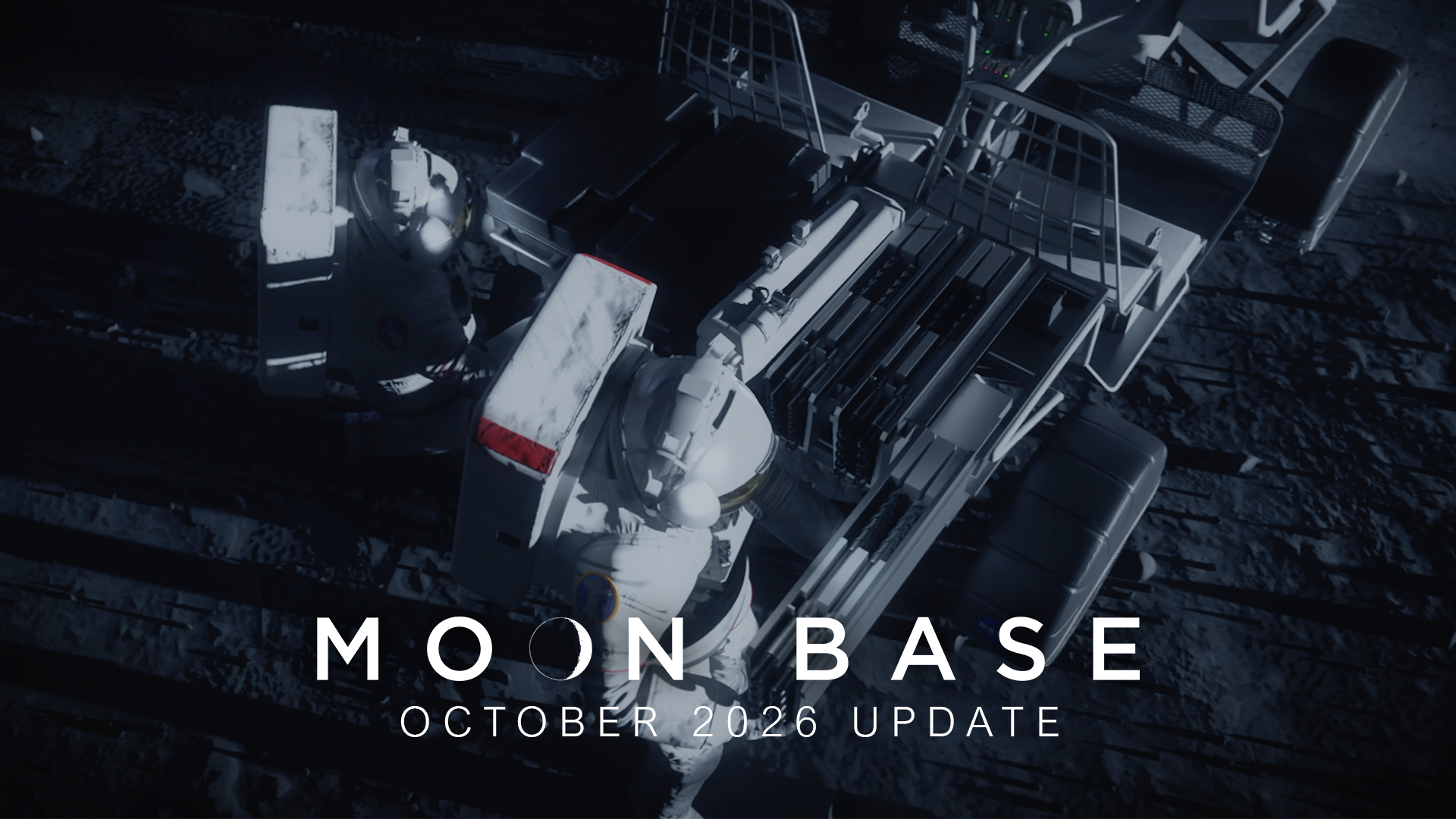
    NASA illustration of astronauts working beside a lunar terrain vehicle. This is an artist’s rendering, not a photograph of a mission. Credit: NASA.

  • A Long-Lived Heavy Neutrino Could Have Altered the Early Universe’s Expansion

    A Long-Lived Heavy Neutrino Could Have Altered the Early Universe’s Expansion

    Featured image: Generated illustration of cosmic structure and hypothetical particles; not an observation or a simulation from the study.

    A hypothetical heavy neutrino that is often left out of calculations could have changed the early universe’s expansion and influenced how matter came to outnumber antimatter. Research by Rishav Roshan and Sudipta Show was highlighted in an October 19 University of Southampton release, following publication in Physical Review Letters on September 8.

    The theoretical paper examines a version of the type-I seesaw model, which introduces heavy right-handed neutrinos to help explain the tiny masses of familiar neutrinos. A very weakly interacting member of that hypothetical family can survive long enough to contribute substantially to the cosmos’s energy density before decaying.

    In the researchers’ calculations, that produces an early matter-dominated interval and changes when certain interactions involving charged leptons come into equilibrium. The timing matters for leptogenesis, a proposed mechanism connected to the origin of the matter–antimatter imbalance.

    Two different meanings of matter dominating

    It is important not to confuse an era when matter dominates the energy budget with an excess of particles over antiparticles. The paper links the two through the expansion history and particle interactions; one is not automatically proof of the other.

    CERN’s explanation of the wider problem notes that the Standard Model already permits some differences between matter and antimatter, called charge–parity violation. Those known effects are too small to explain the observed cosmic imbalance. That is why researchers pursue both precise particle measurements and theories with additional ingredients.

    No heavy neutrino of this kind was detected in the new work, and the study does not establish that the proposed cosmic episode occurred. The authors discuss possible links to neutrino measurements and primordial gravitational-wave signals, rather than reporting those signals.

    The useful advance is a warning about simplifying assumptions: a particle with little direct influence on one calculation may still matter by changing the universe in which the relevant reactions occur. Testing that possibility remains a separate observational challenge.

    Reporting checked October 20, 2026 (UTC). Catch-up coverage of the October 19 research announcement.

  • Uranus and Neptune May Have Formed From Chemically Different Building Blocks

    Uranus and Neptune May Have Formed From Chemically Different Building Blocks

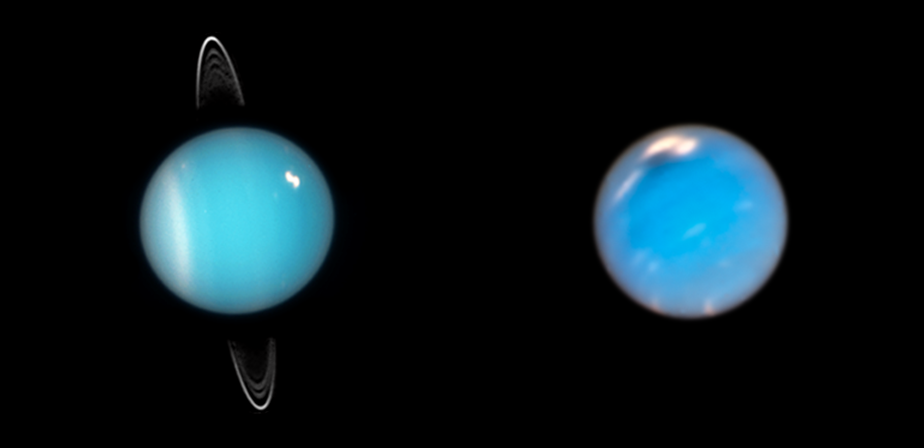
    Featured image: Archival, color-composite Hubble views of Uranus (left, 2005) and Neptune (right, 2018), shown for context rather than as images of their formation. Credit: NASA, ESA, Mark Showalter (SETI Institute), Amy Simon (NASA-GSFC), Michael Wong (UC Berkeley), Andrew Hsu (UC Berkeley). Image source and details.

    Uranus and Neptune look like close relatives, but their chemical histories may be less alike than their sizes suggest. In an October 19 announcement, Southwest Research Institute highlighted research indicating that Neptune’s deep atmosphere is considerably more oxygen-rich than Uranus’s.

    The study, published in the September issue of Astronomy & Astrophysics, does not directly sample either planet’s deep interior. Instead, it combines atmospheric chemistry models with observations of carbon monoxide, including ALMA measurements, to infer conditions beneath the visible clouds.

    Researchers then compare the inferred carbon-to-oxygen ratios with models of the disk from which the Solar System formed. Different compounds condensed into solids in different regions of that disk, creating chemically distinct reservoirs. One interpretation is that some of Neptune’s building materials originated closer to the young Sun and traveled outward before being incorporated into the planet.

    The atmosphere is a clue, not a core sample

    The paper led by Tom Briand examines variations with latitude as well as uncertainty in chemical reactions. Its largest sensitivity comes from vertical mixing: how efficiently material is transported through the atmosphere changes the deep oxygen abundance needed to reproduce the carbon monoxide measurements.

    When that mixing is varied, the modeled oxygen-to-hydrogen enrichment spans roughly 62–177 times the protosolar value for Uranus and 222–342 times for Neptune. Those numbers describe inferred elemental ratios relative to the early Sun’s composition, not the percentage of either planet made of oxygen.

    The ranges support a chemical contrast within the tested models, while also showing why a single abundance estimate would conceal important uncertainty. Different formation or evolutionary histories remain interpretations to investigate, not a uniquely established reconstruction of where each planet grew.

    The broader lesson is that resemblance in size need not imply identical ingredients. Until deeper measurements are available, chemistry offers an indirect route into these distant worlds, but the route depends on understanding both the reactions and the circulation that carry their signatures upward.

    Reporting checked October 20, 2026 (UTC). Catch-up coverage of the October 19 announcement.

  • A Three-Hour Binary Offers a Close Look at an Intensely Heated Brown Dwarf

    A Three-Hour Binary Offers a Close Look at an Intensely Heated Brown Dwarf

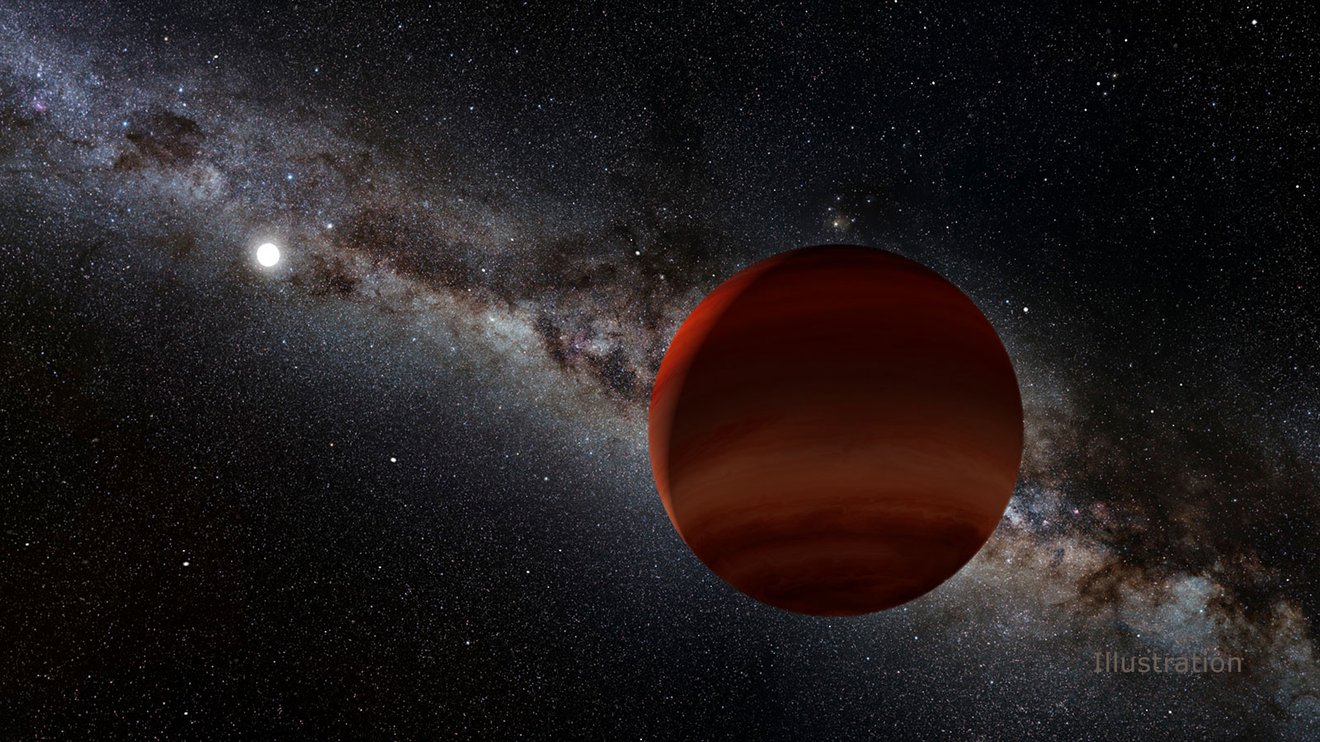
    Featured image: Artist’s illustration of a white dwarf–brown dwarf pair, used for context; it does not depict the J0404+1112 system studied here. Credit: NOIRLab/NSF/AURA/P. Marenfeld; acknowledgement: William Pendrill. CC BY 4.0.

    A brown dwarf circling the white dwarf J0404+1112 every 2.93 hours offers astronomers an unusually clear view of an atmosphere under intense irradiation. An October 16 AAS Nova highlight describes follow-up work that revises the system’s physical properties after its initial discovery in 2025.

    The white dwarf is now estimated to contain about 60 percent of the Sun’s mass, with a temperature near 28,000 kelvin. Its companion weighs roughly 40 Jupiters, rather than the approximately 25-Jupiter estimate from the preliminary analysis. Additional observations from the Gran Telescopio Canarias and United Kingdom Infra-Red Telescope helped resolve ambiguities in the earlier interpretation.

    The nearly edge-on orbit provides the crucial advantage. The brown dwarf completely covers the much smaller white dwarf during an eclipse, temporarily removing the brighter object’s light. That allows the companion’s nightside emission to be isolated, giving an estimated temperature around 1,750 kelvin. Its irradiated face should be substantially hotter, but that prediction still needs better observational constraints.

    An eclipse as an atmospheric experiment

    The research paper by Julien de Wit and colleagues, published in The Astrophysical Journal Letters, combines spectra, rapid brightness measurements and Gaia distance information. The revised dimensions put the white dwarf’s radius at about 0.015 times the Sun’s, while the brown dwarf is approximately 0.9 times Jupiter’s radius.

    These proportions explain why an object far less massive than the star can nevertheless hide it entirely. They also make the system a promising target for measurements throughout an orbit, potentially tracking how energy moves between the brown dwarf’s illuminated and darker hemispheres.

    The comparison with ultra-hot giant exoplanets is useful but imperfect. A hot white dwarf supplies a different radiation spectrum, including a stronger ultraviolet component, than a normal star heating a close-orbiting planet. Studying both environments could help separate the effects of heat from the effects of high-energy light on atmospheric chemistry.

    This is a refined portrait of a known binary, not a newly discovered planet. Its value lies in the unusually clean experiment its geometry makes possible.

    Reporting checked October 20, 2026 (UTC). Catch-up coverage of the October 16 research highlight.

  • Early Life on Earth Does Not Settle How Common Life Is Elsewhere

    Life appeared early in Earth’s history, but that does not by itself establish that life is easy to start throughout the universe. A theoretical preprint posted October 16 revisits this problem by explicitly accounting for the fact that observers can only ask the question where conditions allowed them to exist.

    Brendon J. Brewer, Geraint F. Lewis and Jesse Goodman describe a Bayesian framework called Full Indexical Conditioning. It uses the reasoner’s available evidence while allowing that different evidence could have been observed. The authors apply it to life’s early appearance and to our location around a Sun-like star rather than a red dwarf.

    Their conclusion is cautious: early life on Earth does not eliminate scenarios in which life is rare. The paper also considers how possible life around long-lived red dwarfs could be distributed far into the future. It is a preprint, not a new biological detection or a settled census of inhabited worlds.

    A probability argument is not a second Earth

    NASA’s overview of the search for life makes the observational starting point clear: Earth remains the only world known to host it. Astronomers hope to expand that evidence through measurements of other planets, including spectra that reveal the composition of their atmospheres.

    Light passing through an atmosphere can carry information about gases such as oxygen, carbon dioxide and methane. Those measurements would concern real planetary environments, rather than the timing of events in Earth’s past. Searches also consider possible traces of technology and potentially habitable environments within our own Solar System.

    The distinction matters when interpreting confident claims about cosmic odds. A mathematical framework can show how assumptions affect a conclusion, but it cannot supply observations that do not yet exist. This study is best read as an examination of what follows from our peculiar vantage point, not as evidence that the universe is either crowded with life or mostly empty.

    Reporting checked October 20, 2026 (UTC). Catch-up coverage of the October 16 theoretical preprint.

  • A SETI Machine-Learning Stress Test Finds Missed Signals and False Alarms

    A preprint posted October 15 and revised October 16 examines whether a machine-learning detector can cope with signals unlike its training examples. Using public Breakthrough Listen data, it reports failures in both directions: simulated signals were missed, and some interference-like patterns were accepted.

    Author Omer Imran trained a competition-style convolutional neural network once, then held it fixed while testing 15,000 synthetic injections in real Green Bank Telescope backgrounds. The tests covered ten signal shapes and five strengths. In one narrow-line test, the fraction recovered fell from 59 percent to nine percent as signals became brighter.

    The detector used observations pointed at a target, but not the corresponding observations pointed away. That limits its ability to distinguish a celestial source from interference. A simple time-averaged comparison filter did not resolve the problem in this experiment.

    This is a narrow, preliminary result: one training run, synthetic signals and one filter. It does not show that an actual extraterrestrial transmission was overlooked, or that all SETI detection methods share the same weakness.

    Why the comparison observations matter

    Breakthrough Listen’s investigation of the BLC1 candidate in 2021 provides a real-world example of the verification problem. Radio observations contain abundant emissions from human technology, including satellites, radar and communications systems. Searches therefore check both how signals change in frequency and whether they appear when the telescope points away from the intended target.

    BLC1 initially survived important checks. Researchers then found roughly 60 related signals in a larger dataset, including examples appearing in off-target observations. Their shared properties pointed to human-made interference, although its specific source remained unidentified.

    The lesson from that established case is not that automated searches are futile. It is that a candidate list begins an investigation rather than ends it. For new algorithms, the relevant question is whether the full observing and verification process can distinguish unfamiliar astronomical signals from unfamiliar terrestrial noise.

    Reporting checked October 20, 2026 (UTC). Catch-up coverage of the October 15–16 preprint.

  • Two Planet-Forming Disks Show Strikingly Different Water and Organic Chemistry

    Two Planet-Forming Disks Show Strikingly Different Water and Organic Chemistry

    The ingredients available to forming planets can differ sharply even in seemingly comparable stellar nurseries. An ALMA study posted October 15 and accepted by The Astrophysical Journal compares water and organic molecules in the disks around HD 100546 and IRS 48.

    Both water vapor and methanol were detected around HD 100546. Their inferred methanol-to-water column-density ratio is about 0.02, near the median measured for comets. Around IRS 48, methanol appeared but water vapor did not, placing the ratio above 0.2. Nondetection does not mean the entire disk lacks water.

    The contrast continues with methyl formate: its abundance relative to methanol is approximately 0.2 in IRS 48 but about two in HD 100546. The latter may reflect chemical enhancement in the gas. These are model-dependent molecular inventories, not measurements of biological activity. The authors also examine excitation and opacity, which affect how emission translates into abundance.

    Reading the material in the ice

    IRS 48 already has an important chemical history. In research announced by ESO in March 2022, astronomers detected dimethyl ether in its disk. The system contains an asymmetric concentration of dust that can collect icy grains. Such grains provide surfaces where atoms and simpler molecules meet and react in cold environments.

    Heating can then turn those ices into gas, making previously hidden molecules visible to radio telescopes. This offers a way to investigate material that could eventually enter comets, asteroids and planets. The older work helped establish IRS 48 as a place to follow that chemical journey, rather than merely counting molecules in isolation.

    The new comparison adds a useful warning to that picture: there is no reason to assume every planet-forming disk starts with the same recipe or preserves it unchanged. Understanding the ingredients is a step toward understanding planetary environments. It is not evidence that either system has produced living organisms.

    Reporting checked October 20, 2026 (UTC). Catch-up coverage of the October 15 research paper.

    Image: Archival ALMA view of the asymmetric dust concentration around Oph-IRS 48, released in 2013. This is not an image from the new chemical comparison. Credit: ALMA (ESO/NAOJ/NRAO)/Nienke van der Marel. Source image, used under CC BY 4.0. Reproduced without image edits.

  • How Common Are Planets Orbiting Two Red Dwarfs? TESS Sets New Limits

    A new search of TESS observations is putting numbers on a difficult question: how often do planets orbit a pair of red dwarf stars? A preprint posted October 15, led by Dominic Oddo, reports one new planet-sized candidate in a sample of eclipsing binaries containing two M dwarfs.

    The team used a custom algorithm to find individual planetary transits, then tested the survey’s sensitivity and accounted for gaps in its observing coverage. The result is not a confirmed new planet or a precise population count.

    For planets with radii between two and 16 times Earth’s and orbital periods up to 600 days, the authors obtain a 95 percent confidence upper limit of 33 percent if planetary and stellar orbits share a plane. Assuming instead randomly oriented planetary orbits raises that limit to 40.2 percent. These are ceilings under specified assumptions, not evidence that one-third of red-dwarf binaries host such planets. The study has been submitted to AAS journals.

    Two moving targets

    Finding these systems requires favorable geometry. A transit is a temporary loss of starlight when a planet passes in front of a star. In a circumbinary system, both stars also move around each other, complicating the timing and appearance of those crossings.

    A NASA account of the 2021 discovery of TIC 172900988 b illustrates the problem. That giant planet takes roughly 200 days to orbit its two Sun-like stars, but the available TESS observations covered only about 30 days. The fortunate arrangement let astronomers see it cross both stars five days apart, while the stars themselves produced multiple eclipses.

    That earlier discovery involved different kinds of stars, so it is not a direct comparison of population rates. It shows why a survey’s viewing angle and time coverage matter. A sparse list of detections cannot be read straightforwardly as a sparse population of planets.

    Reporting checked October 20, 2026 (UTC). Catch-up coverage of the October 15 preprint.

  • NASA Streamlines the Models Used to Check Launch Shock and Vibration

    NASA engineers at Kennedy Space Center have developed a standardized workflow for using commercial modeling software to assess launch shock and vibration. The agency’s October 19 account describes the approach as a way to make detailed structural analysis easier to apply during rocket certification. Read NASA’s report.

    The team used it while evaluating a commercial launcher whose supplied testing covered vibration but not shock. The analysis helped examine additional scenarios, including shocks during transportation. NASA did not identify the provider or publish a numerical reduction in failure risk.

    The method uses finite-element modeling: representing a complicated structure with smaller connected elements so that its response to forces can be calculated. The new contribution is a reusable workflow for the engineering team, rather than the invention of finite-element analysis.

    Why a better model still needs tests

    NASA’s published vibration-testing guidance illustrates why analysis and hardware measurements belong together. A vibration test can reveal structural behavior, but inappropriate test settings can also damage hardware. The guidance recommends sufficient advance analysis, lower-level runs before full testing, and comparisons between measured behavior and predictions.

    That creates a feedback loop. A model helps engineers decide what to test and where to measure. The test then checks whether the real structure behaves as expected. Disagreement can reveal missing assumptions, unexpected interactions or a need to revise the model.

    NASA’s load-analysis standard similarly emphasizes consistent methods and integration across projects. Standardization is valuable because a sophisticated calculation is harder to review or reuse when each analyst must reconstruct the process from scratch.

    The October announcement is therefore best understood as an improvement in the practical tools of verification. Evidence of broader impact would include repeated use across missions and comparisons against later measurements. A faster workflow is helpful, but confidence in flight hardware still depends on the quality of its assumptions, test coverage and demonstrated agreement with reality.

    Reporting checked October 20, 2026 (UTC). Catch-up coverage of NASA’s October 19 engineering announcement.