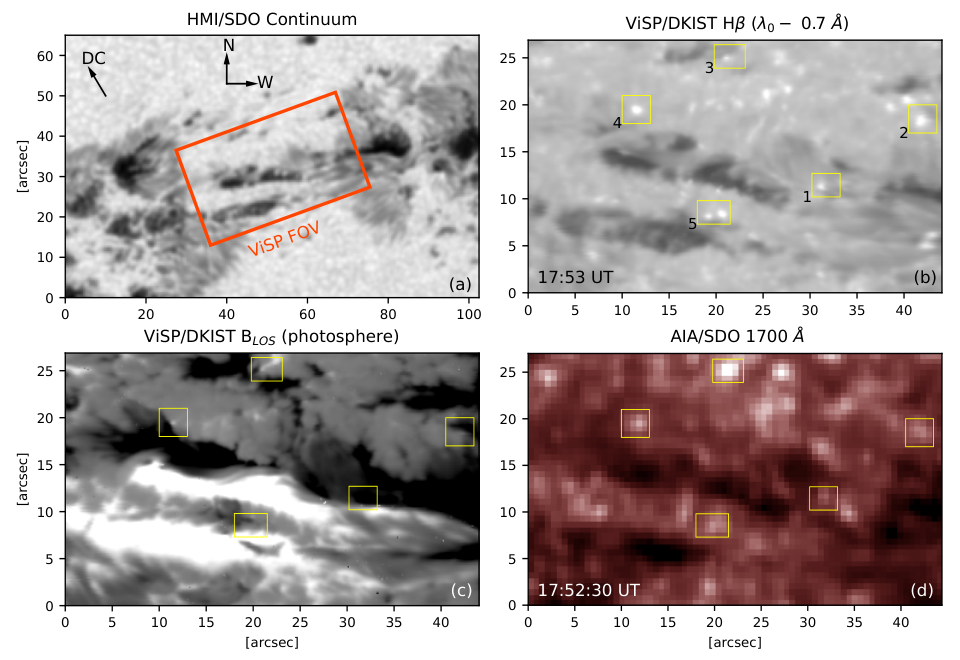
Small solar brightenings offer a closer look at how magnetic energy becomes heat. A study submitted on October 16, 2026, and marked accepted by The Astrophysical Journal Letters, reports new evidence that Ellerman bombs originate through magnetic reconnection in the photosphere.
Rahul Yadav and colleagues analyzed observations made on June 18, 2024, with the Daniel K. Inouye Solar Telescope. They identified 14 distinct events and compared signatures in hydrogen, sodium and iron. Their atmospheric reconstruction indicated localized temperature increases reaching approximately 800 kelvin, alongside relatively weak upward and downward flows.
Why several spectral lines matter
The instrument behind the measurements, the Visible Spectro-Polarimeter, does more than take a detailed solar photograph. It can observe three selected spectral lines simultaneously and measure polarization, the orientation properties of light. Its camera arms can be adjusted independently to sample different parts of the visible spectrum.
This combination provides complementary information about the solar atmosphere. Spectral profiles show how brightness changes across a narrow wavelength range, while polarization measurements help researchers investigate magnetic fields. Recording multiple lines at once is especially useful for a rapidly changing target: it avoids treating measurements taken at different moments as if they described precisely the same event.
A small-scale test of magnetic physics
As NASA’s explanation of solar magnetism describes, the Sun consists of plasma whose moving charged particles interact with magnetic fields. Motion and magnetism continually affect each other. The visible surface is therefore part of a dynamic system, rather than a quiet boundary beneath a separate active atmosphere.
Magnetic reconnection changes how magnetic fields are connected and can release stored energy. The same broad physical process is important in much larger solar eruptions, but identifying it in a small brightening does not turn that event into a forecast of a major flare or an Earth-directed storm.
What the result establishes
The team compared its measurements with simulated spectra from the Bifrost model. Their agreement strengthens the reconnection interpretation, but the inferred heating and atmospheric structure remain model-dependent. This is an analysis of earlier observations, not a report of a solar explosion occurring today.
Image: Observations from June 18, 2024, used in the new analysis. Yellow boxes mark example Ellerman-bomb locations; the lower-left panel maps inferred magnetic polarity. Credit: Rahul Yadav, Maria D. Kazachenko and Viggo Hansteen (2026), Figure 1; DKIST/ViSP and NASA/SDO data. CC BY 4.0.
Leave a Reply