Water ice offers clues to structures hidden inside dusty galaxies. A study submitted on October 16, 2026, and accepted for Astronomy & Astrophysics, maps obscuration and ice in four interacting galaxy systems with James Webb Space Telescope spectroscopy.
Giovanna Speranza and colleagues examined Arp 220, NGC 6240, VV 114 and NGC 3256. Hydrogen emission and ice absorption show greater obscuration and larger ice columns near their centers.
Reading a spectrum at each position
The observations used Webb’s Near-Infrared Spectrograph, or NIRSpec. A spectrograph separates incoming light by wavelength, allowing atoms and molecules to be identified through characteristic features. Those features also carry information about the physical conditions of the material producing or absorbing the light.
In integral-field mode, the instrument gathers spatially resolved spectra rather than reducing an entire target to one combined measurement. Astronomers can therefore compare different locations within a galaxy. This is important when a luminous central region and surrounding gas contribute very different signals, which would otherwise be blended together.
Different gas, different obscuration
The ionized gas appears more deeply obscured than the hot molecular gas. The interpretation places ice-bearing dust around both components, plus extra ice near some nuclei. The median carbon-dioxide-to-water ice ratio is approximately 0.10. This is not evidence for life or oceans.
Arp 220 shows the setting
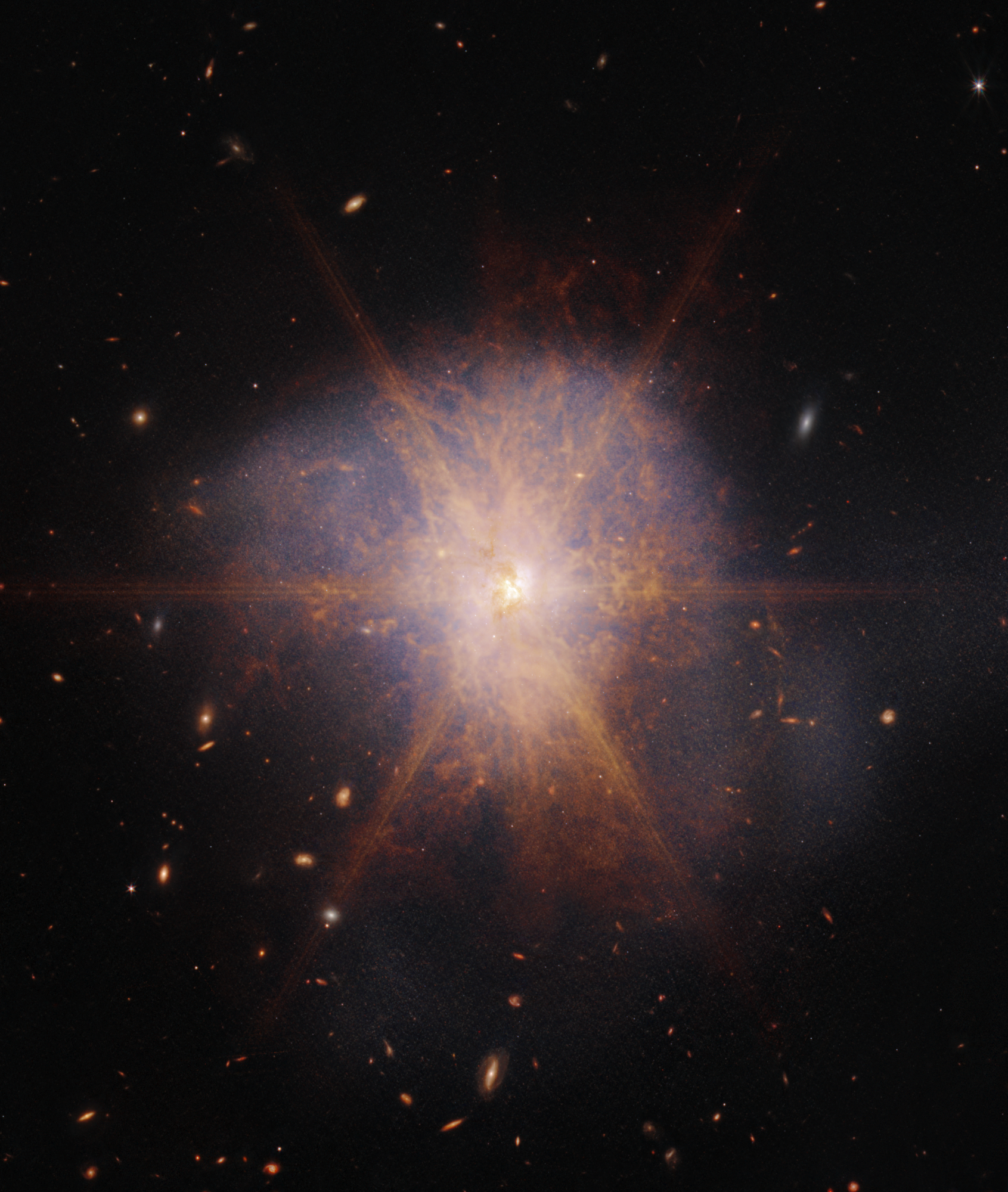
Webb’s earlier portrait of Arp 220 provides useful context. The system comprises two merging spiral galaxies and radiates more than a trillion times the Sun’s luminosity. Its collision triggered intense star formation within a compact, dusty region. Gravity has also drawn material into extended tidal structures.
The accompanying image was released in April 2023, using Webb’s NIRCam and MIRI instruments. Its colors represent selected infrared bands, so it is not a visible-light view or a direct photograph of ice. The chemical evidence comes from the separate spectroscopic analysis described here.
Ice columns and obscuration are inferred using spectral models and assumptions about the emitting and absorbing material. Four systems provide a detailed comparison, but cannot establish a universal arrangement for all merging galaxies.
Image: Arp 220 in an archival Webb image released April 17, 2023. It is one of the systems in the new spectroscopic study; this NIRCam/MIRI image is not an ice map. Credit: NASA, ESA, CSA, K. Pontoppidan (STScI), A. Pagan (STScI). CC BY 4.0.
Leave a Reply