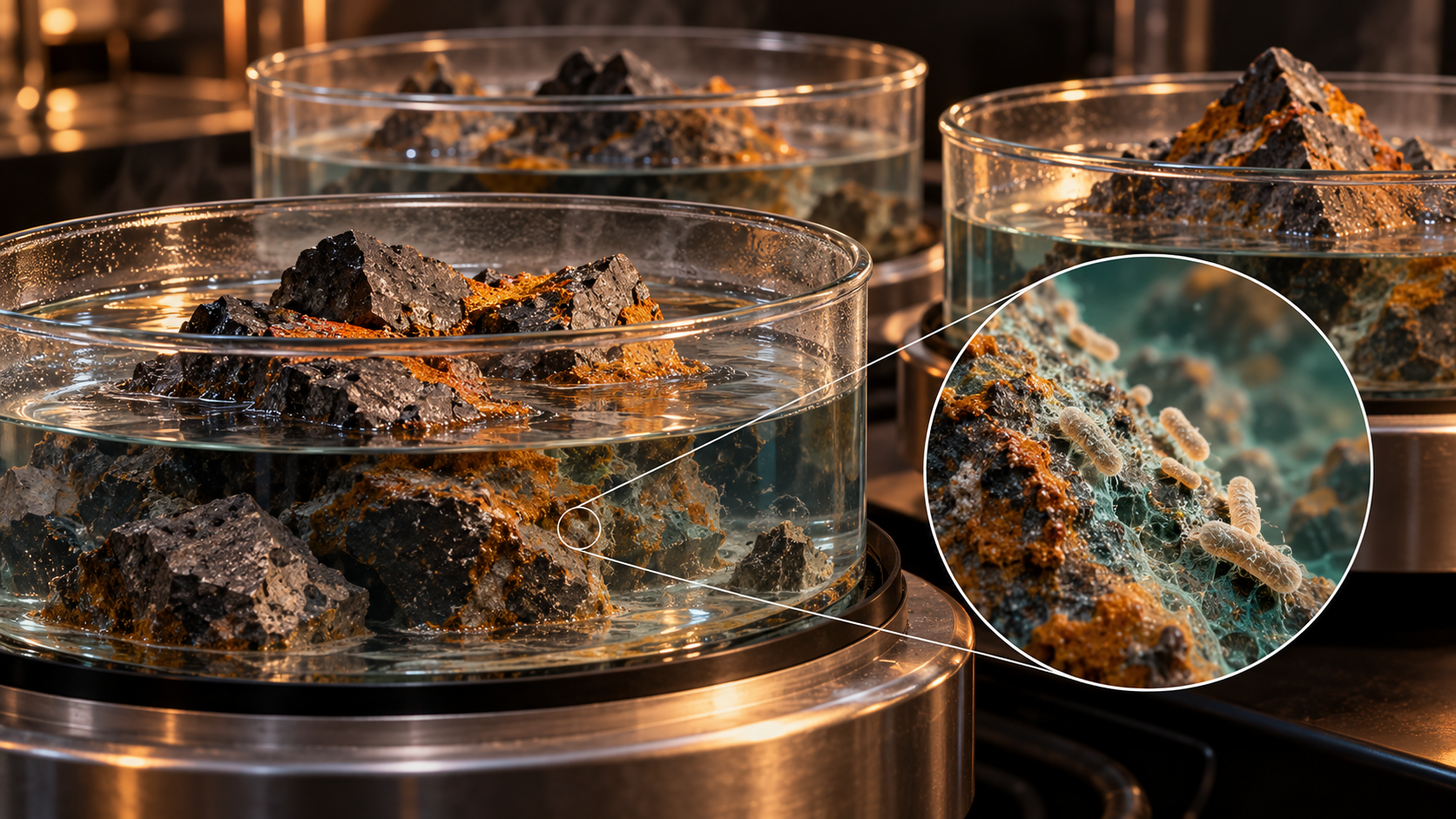
A laboratory study published in Geobiology on October 17, 2026, finds that warm, water-soaked impact rocks can support diverse microbial communities within weeks. The experiment tests how existing organisms become established after an impact environment cools, rather than how life first originates. Read the study.
Rebuilding a small part of a crater
Sabrina M. C. Hardy and colleagues placed rock from Germany’s Ries impact structure in water baths at 50, 60 and 70 degrees Celsius. They added temperate soil to introduce microbes; the impact rock was also unsterilized. Communities developed on oxidized rock surfaces, inside submerged fragments and in sediment.
Genetic analysis identified potential for several chemical cycles, including sulfur metabolism. Finding the relevant genes, however, does not demonstrate that every predicted reaction occurred.
Why hot water and broken rock matter
Hydrothermal environments interest astrobiologists because they bring water, rock and chemical energy together. At Earth’s seafloor vents, microorganisms can obtain energy from chemical reactions instead of relying directly on sunlight. Temperature gradients also create different living spaces around a single vent. NASA’s hydrothermal-vent overview explains why those ecosystems helped broaden scientific thinking about potentially habitable environments beyond Earth.
Impact-generated systems have a different source of heat, but their geological record shows why they deserve attention. A 2020 investigation of Chicxulub, the crater associated with the end-Cretaceous extinction, examined a deep drill core and found extensive chemical and mineral alteration caused by circulating hot fluids. The recovered rocks preserve a setting in which water could move through damaged crust long after the initial catastrophe.
A separate study of sulfur isotopes in Chicxulub minerals, first published online on October 30, 2020, identified signatures interpreted as microbial sulfate reduction. Tiny pyrite structures in porous rock supplied evidence for an ancient subsurface community. Such mineral evidence can help reconstruct an ecosystem after the organisms themselves are gone.
What the new experiment can establish
The new experiment used one heat bath per temperature, limiting statistical comparisons between temperatures. It also used one crater’s material and modern organisms. The authors did not directly measure active sulfate reduction. These qualifications matter when extending laboratory results to ancient Earth or Mars. Methods and limitations.
Together, the approaches address different questions. Drill cores preserve the aftermath of real events; controlled experiments allow researchers to watch communities develop. Neither can establish that every wet crater was inhabited. For life-searching missions, the useful distinction is between identifying a plausible habitat and finding independent evidence that something actually lived there.
Generated illustration. A conceptual laboratory setup for studying microbial communities in warm impact rocks, with a magnified microbial inset. It is not a photograph of the experiment.
Leave a Reply