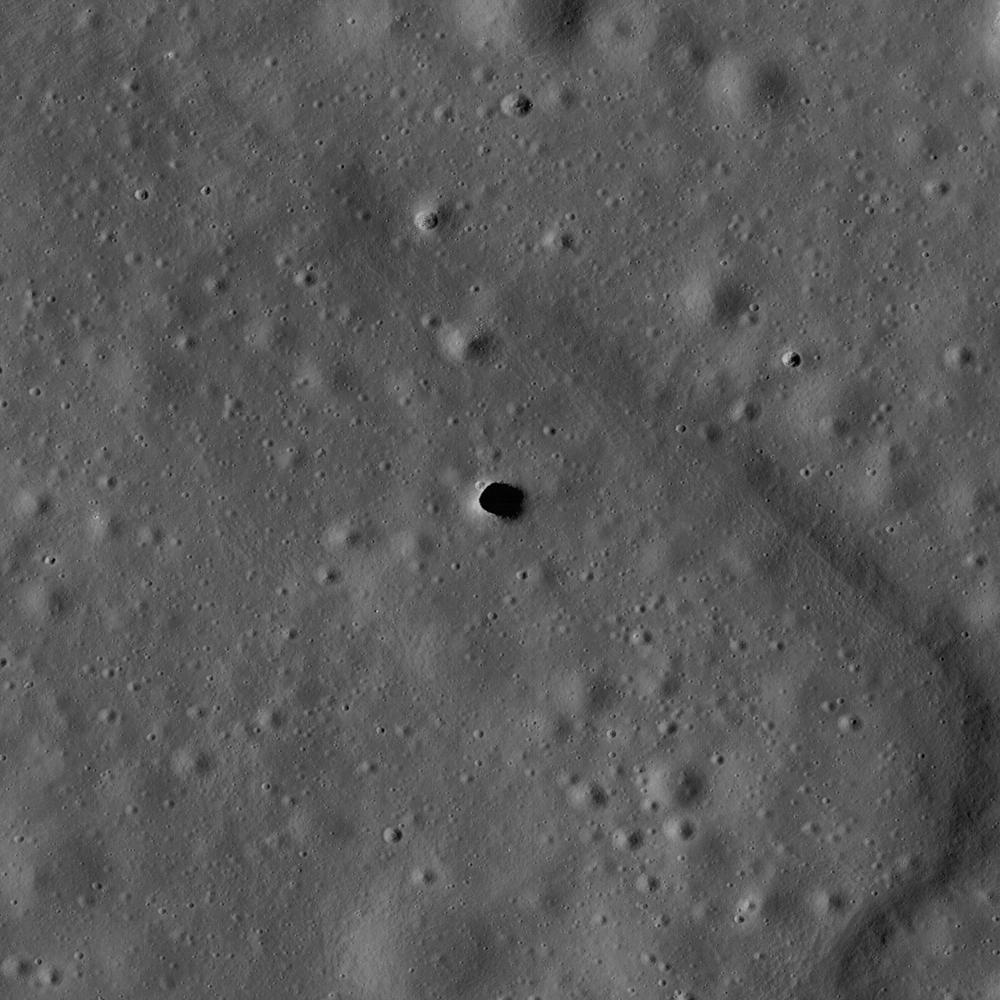
Marius Hills Pit photographed from lunar orbit. Credit: NASA/GSFC/Arizona State University. Image source.
A dark opening in the Moon’s volcanic landscape is getting a closer investigation. NASA selected GIMLI on September 30, 2026, to determine whether the Marius Hills Pit connects to a substantial underground lava tube. The Planetary Science Institute described the project on October 1. The announcement marks a new investigation, not the discovery of a habitable cave. NASA’s selection announcement identifies the payload as Geophysical Instruments for Marius Lunar pit Investigation.
What the opening already reveals
The Lunar Reconnaissance Orbiter Camera’s pit atlas describes an elliptical opening within a winding channel. Its inner dimensions are approximately 49 by 55 metres, with a depth of about 40 metres. The floor appears comparatively flat but is strewn with boulders, and slight overhangs occur near its base. The atlas cautions that debris may complicate access to any deeper void. That makes the difference between seeing an opening and mapping what lies beyond it especially important.
Several ways to look underground
Led by PSI’s Nathaniel “Than” Putzig, GIMLI will combine ground-penetrating radar, seismic measurements, a gravimeter and cameras. Radar and seismic observations will probe the subsurface, while gravity measurements provide another way to investigate its structure. Cameras will document the surface and exposed pit walls. The instruments are intended to establish whether an underground void exists and, if so, constrain its dimensions. PSI’s project description also identifies Honeybee Robotics as an equipment and integration partner and the Norwegian Space Agency as the radar provider.
The geology matters even if the cave search comes up empty. Layers exposed in the walls could record separate lava flows and intervals between eruptions. Measurements around the opening could also help explain how the pit itself formed. Those are useful results regardless of whether the site eventually has practical value for exploration.
From intriguing feature to measured environment
NASA selected GIMLI alongside two other lunar investigations: LEMS-SP, designed to monitor environmental hazards and seismic activity, and DISCO, intended to investigate ice in small cold traps and surface conditions. The payloads are to reach the Moon through the Commercial Lunar Payload Services initiative. NASA’s announcement does not provide a launch date or name a delivery company for GIMLI.
The appeal of a lunar cave is easy to understand: surrounding rock could provide shielding and a more stable thermal environment. But the immediate task is narrower and scientifically testable. Before anyone can assess a shelter, they need to know whether the cavity exists, how large it is and what its surroundings are like. GIMLI would turn a promising orbital target into a place whose subsurface can be measured directly.
Leave a Reply