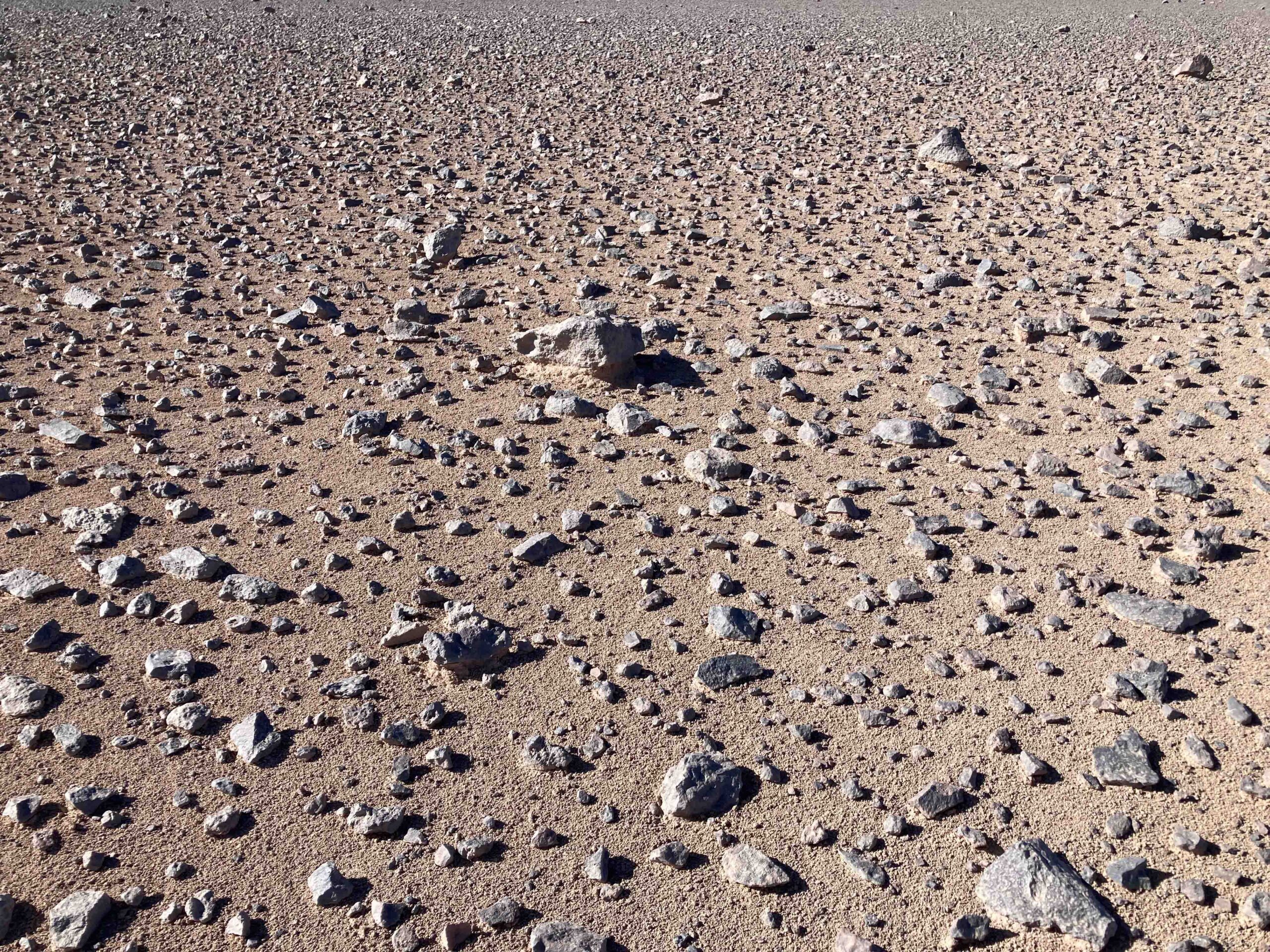
The North of Antofagasta site in the Atacama Desert, where soil analyzed in the study was collected. Credit: Christopher E. Carr. The University of Osaka lists no usage restrictions. Image source and credit.
A new laboratory technique can distinguish the mirror-image forms of individual amino acids by measuring tiny electrical currents. Published on October 5, 2026, in Nature Communications, the study by Takahito Ohshiro and colleagues advances a possible way to investigate the chemistry of future planetary samples. Its immediate achievement is a measurement method; no extraterrestrial organism was detected.
Reading molecules through a nanogap
The researchers place molecules between two gold nanowires separated by an extremely small gap. Electrical tunneling produces changing current patterns as individual molecules pass through. An artificial-intelligence classifier searches those patterns for differences between amino-acid forms. According to the University of Osaka’s research announcement, this approach could help make instruments smaller and less vulnerable to vibration than systems dependent on substantial optical equipment.
The property being measured is chirality, often described as molecular handedness. Two forms can have the same chemical ingredients but arrangements that cannot be superimposed, like left and right hands. The distinction matters because terrestrial biology strongly favors one form when constructing proteins. However, handedness must be interpreted alongside other evidence. NASA’s analysis of returned Bennu material found both mirror-image forms in equal proportions, illustrating how life’s ingredients can exist without establishing that life exists.
A promising result with important limits
The new paper reports greater than 80 percent accuracy when distinguishing individual enantiomers. Harder tests were less accurate: a blind classification exercise involving 39 amino-acid forms exceeded 50 percent, while four-amino-acid mixtures exceeded 66 percent. Those are separate tests with different challenges, so the headline accuracy should not be applied to every sample. In extracts from the Murchison meteorite and Chile’s Atacama Desert, an 11-amino-acid target panel recovered major compositional features also seen with liquid chromatography–mass spectrometry. Background signals and scarce molecules remained complications.
Those natural samples are important because a planetary sample will contain a chemical mixture rather than one conveniently isolated target. The university’s detailed announcement identifies several steps still needed before spaceflight: handling unknown substances, controlling contamination, improving quantitative accuracy and testing equipment under space conditions. The attraction is a future instrument able to identify molecules and their handedness electrically, while reducing the demands of a large optical system.
One measurement in a larger investigation
Bennu provides a useful reminder of the scientific stakes. NASA reported 14 of the 20 amino acids used in terrestrial proteins and all five nucleobases used in DNA and RNA in its samples. The mission’s findings concern chemical ingredients and environments that could support prebiotic reactions. Why Earth’s biology developed its strong handedness preference remains unresolved. A compact sensor could help investigate that question across more samples, provided its results are checked against contamination and nonbiological chemistry.
Leave a Reply