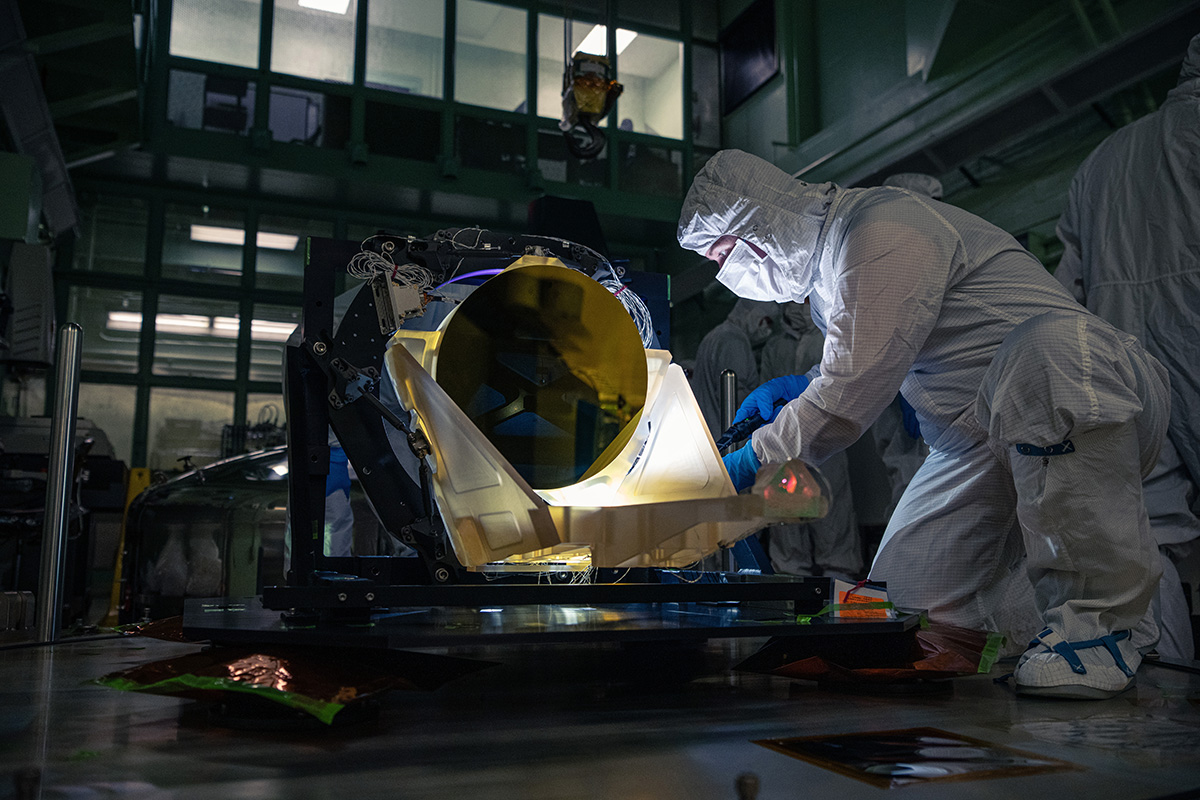
A technician inspects LISA’s earlier prototype telescope at NASA Goddard in May 2024. The October 2026 announcement concerns the next engineering-test unit. Credit: NASA/Dennis Henry.
NASA is moving ahead with the next test version of a telescope designed to connect spacecraft across millions of kilometres. The agency’s October 8, 2026 update says L3Harris Technologies will design, assemble and integrate an Engineering Test Unit for LISA, the planned space-based gravitational-wave observatory.
The new unit will incorporate lessons from an earlier prototype. NASA describes it as the final pre-flight telescope unit and the first optical telescope it will deliver to the European Space Agency. A metal structural model was delivered in June 2026. The optical unit remains a development step toward eventual flight hardware.
A telescope used as part of a ruler
LISA, short for Laser Interferometer Space Antenna, is an ESA-led mission with NASA participation. Its three spacecraft are designed to form a triangle with sides approximately 2.5 million kilometres long, following Earth around the Sun. Each spacecraft will carry two telescopes that exchange infrared laser light with its companions.
The purpose of that light is exceptionally precise measurement. Passing gravitational waves stretch and compress the distances between free-floating test masses protected inside the spacecraft. Comparing the laser signals lets researchers search for those tiny changes. The design calls for sensitivity to shifts smaller than the diameter of a helium atom across the vast separation.
At that scale, the measuring equipment must be extraordinarily stable. A tiny unwanted change inside the instrument can complicate the effort to identify a real change in the distance being measured.
Why the material matters
NASA’s October 2024 prototype report explains the choice of Zerodur, an amber-coloured glass-ceramic whose shape changes very little as its temperature varies. The prototype arrived at Goddard Space Flight Center in May 2024. Its main mirror was coated in gold to reflect infrared light efficiently and help limit heat loss.
The new telescope continues that approach. Its job fits into a much larger system in which optical stability, laser control and the behaviour of the test masses all matter.
Other parts of that system are also progressing. In a January 27, 2026 update, NASA reported tests of a second early frequency-reference system, which helps control the lasers. The agency is also contributing devices to manage electrical charge on the test masses and the framework for processing the mission’s data.
A different range of cosmic signals
The enormous spacecraft separation will give LISA access to lower-frequency gravitational waves than ground-based observatories can measure. Its targets include mergers of massive black holes and compact stellar systems within the Milky Way. Those signals could help researchers reconstruct how black holes grow and test gravity in extreme environments.
NASA continues to place launch in the mid-2030s, while ESA lists a planned 2035 launch. The October announcement marks progress on an essential component of that future observatory. The measurement itself will depend on the complete constellation working together, with six telescopes turning exchanged light into a record of changes in spacetime.
Leave a Reply