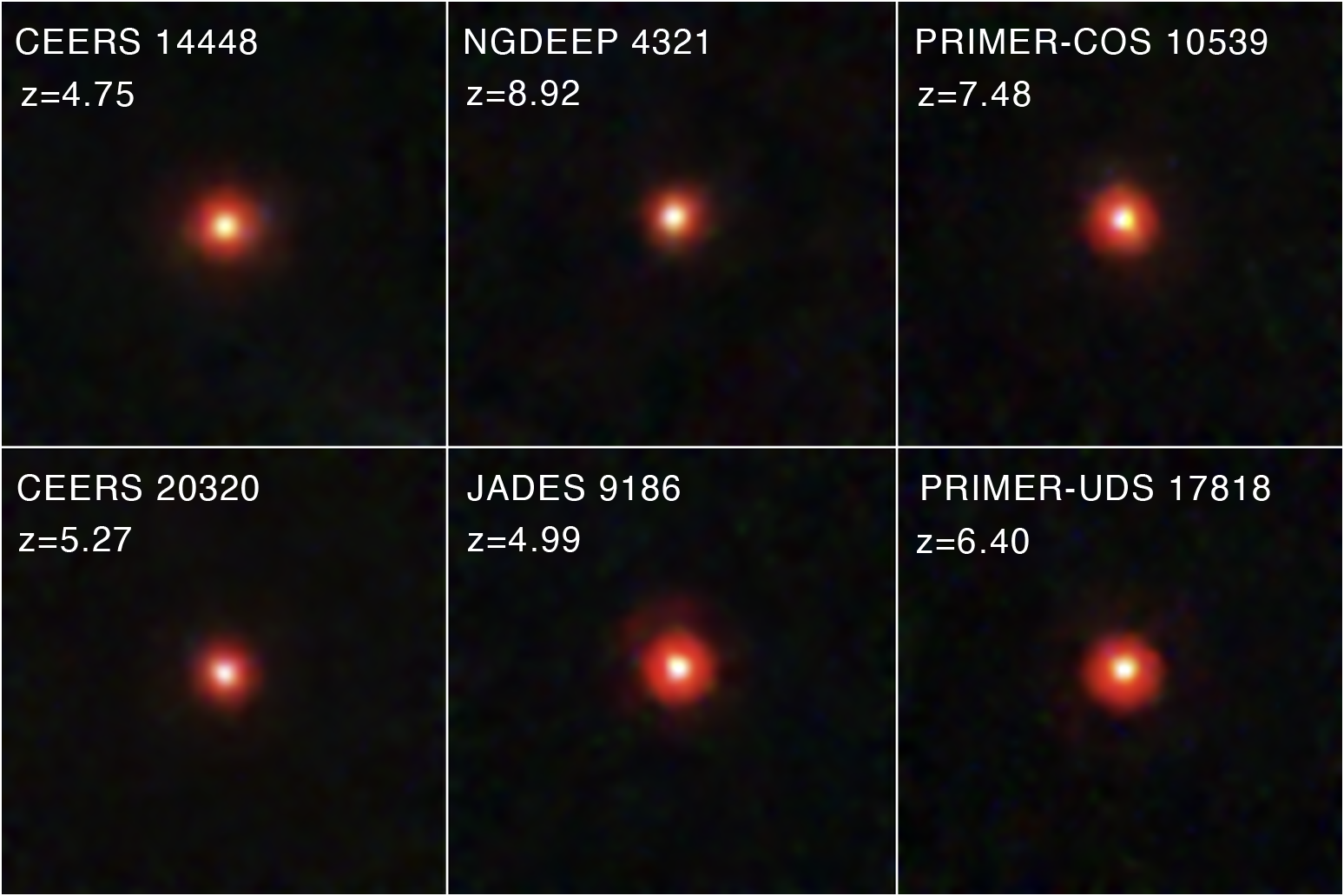
Six examples of Webb’s little red dots, shown in a previously released survey mosaic reproduced in NASA’s October 2026 overview. These examples do not include Abell 2744-QSO1. Credit: NASA, ESA, CSA, STScI, Dale Kocevski (Colby College).
The small red objects appearing in James Webb Space Telescope images have become a major test of ideas about the early universe. A NASA science overview released October 9, 2026 describes how these “little red dots” are reshaping research into black holes and their host galaxies.
The new overview brings together an ongoing debate. These sources look compact and red, but appearances alone leave substantial questions about their central engines, surrounding material and evolutionary histories. Two research papers published earlier this year illustrate the different kinds of evidence needed to investigate them.
How to weigh something hidden
A black hole’s mass can be inferred from the motion of nearby material. For very distant objects, astronomers often examine spectral lines from glowing gas. Motion toward and away from us shifts the light, broadening those lines. Turning the width into a mass estimate requires a model of where the gas is and what drives its motion.
That last step is particularly important for little red dots. Their unusual spectra make it necessary to check whether methods calibrated using more familiar active galaxies remain reliable.
One object offers a dynamical check
In a Nature paper published May 27, 2026, Ignas Juodžbalis and colleagues examined Abell 2744-QSO1, a little red dot at redshift 7.04. A foreground gravitational lens magnifies and distorts its appearance, giving Webb a valuable opportunity to investigate spatial detail.
The team used spectroscopy to trace a gas rotation curve. Their analysis found motion consistent with a central point mass of about 50 million Suns and inconsistent with the nuclear-star-cluster explanation they tested. The result agreed with previous black-hole mass estimates derived from broad emission lines.
This supplies a strong check for that particular source. It also shows why resolving motion is so useful: researchers can compare a dynamical estimate with a different, more indirect method. Extending such tests to a varied sample would help establish how broadly the agreement holds.
Simulations explore how the sources could form
A separate Nature study published September 16, 2026, led by Sunmyon Chon, investigated formation through radiation-hydrodynamic simulations. In the model, dense early environments produced large black-hole seeds that grew rapidly while surrounded by thick gas disks.
The simulated gas scattered light strongly enough to broaden hydrogen emission into profiles resembling those observed in little red dots. That gives researchers a possible physical route connecting an obscured early growth phase with later massive black holes.
A simulated match still needs observational tests. It depends on the model’s conditions and how faithfully the calculation captures gas flow and radiation. The authors note that their simulation does not yet resolve the full large-scale inflows needed to sustain growth over longer periods.
Together, these results make the next questions concrete: which sources contain accreting black holes, how reliably can their masses be measured, and how much does surrounding gas alter the light we receive? Webb is providing observations with which to test each part of that picture.
Leave a Reply