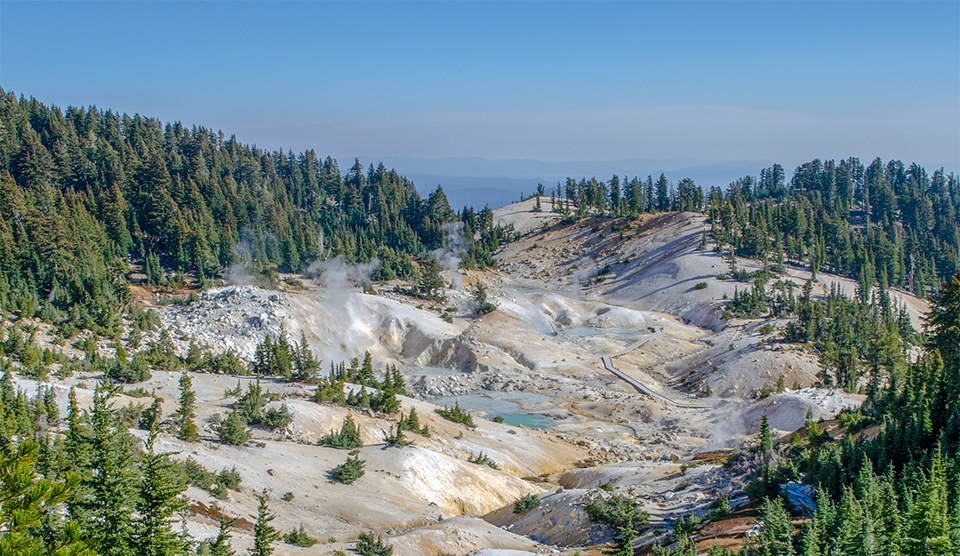
Bumpass Hell basin in Lassen Volcanic National Park, photographed in 2018. This landscape provides regional geothermal context; the amoeba was sampled from a different stream in the park. Credit: NPS Photo/Amanda Sweeney.
An amoeba from a California geothermal stream is extending the known operating range of complex cells. In a study published online in Cell on September 22, 2026, researchers describe Incendiamoeba cascadensis, which divides at 63 degrees Celsius, about 145 degrees Fahrenheit, and can move at 64 degrees Celsius.
The result raises the documented growth ceiling for eukaryotes, organisms whose cells contain a nucleus. That group includes single-celled species as well as plants and animals. Here, “complex” describes cellular organization: the record belongs to a microscopic amoeba.
The discovery began in an ordinary-looking stream
Syracuse University’s account traces the fieldwork to Lassen Volcanic National Park. The researchers sampled diverse geothermal environments, eventually recovering the organism from a tributary rather than one of the conspicuous acidic pools.
The setting demanded care around hot water and fragile ground. Long tools helped keep researchers at a distance; in the narrow stream, the team used barbecue tongs to collect material. Back in the laboratory, increasing incubation temperatures revealed how unusually well the amoeba handled heat.
The university also identifies practical reasons to investigate those adaptations. Understanding heat-tolerant cellular components could eventually inform more durable enzymes, materials or industrial processes. Those are research possibilities, rather than products established by this study.
Growth, movement and survival measure different things
The research paper describes growth experiments across multiple temperatures, including repeat cultures and independent temperature checks. Growth was strongest around 55 to 57 degrees Celsius; reproduction at the upper limit of 63 degrees varied among replicates. No growth was observed at 64 degrees or above.
Genetic analyses identified features associated with maintaining proteins, protecting DNA and handling environmental conditions. The authors also found distinctive predicted protein properties, including increased positive surface charge resembling adaptations in some heat-loving bacteria and archaea. These offer leads for explaining the amoeba’s resilience.
NASA’s research summary adds an important distinction: the organism could recover after five minutes at 70 degrees Celsius. Brief exposure followed by recovery is a different result from reproducing continuously at that temperature. Describing both simply as a temperature limit would obscure the experimental achievement.
A broader search still needs the whole environment
For astrobiology, the discovery supplies a new example of what Earth’s cellular machinery can endure. NASA emphasizes that habitability also depends on water, acidity, pressure, oxygen and food. The amoeba belongs to an ecosystem and cannot support itself in isolation.
The lesson is therefore more useful than assigning a new temperature cutoff to every planet. A promising environment must satisfy several requirements together, for long enough to support biological activity. A warmer range expands the conditions worth testing while leaving those other requirements in place.
The research appeared first as a November 2025 preprint, before September’s peer-reviewed publication. Its lasting contribution is a measurable biological exception that can be investigated, repeated and compared with other organisms as researchers map life’s limits.
Leave a Reply