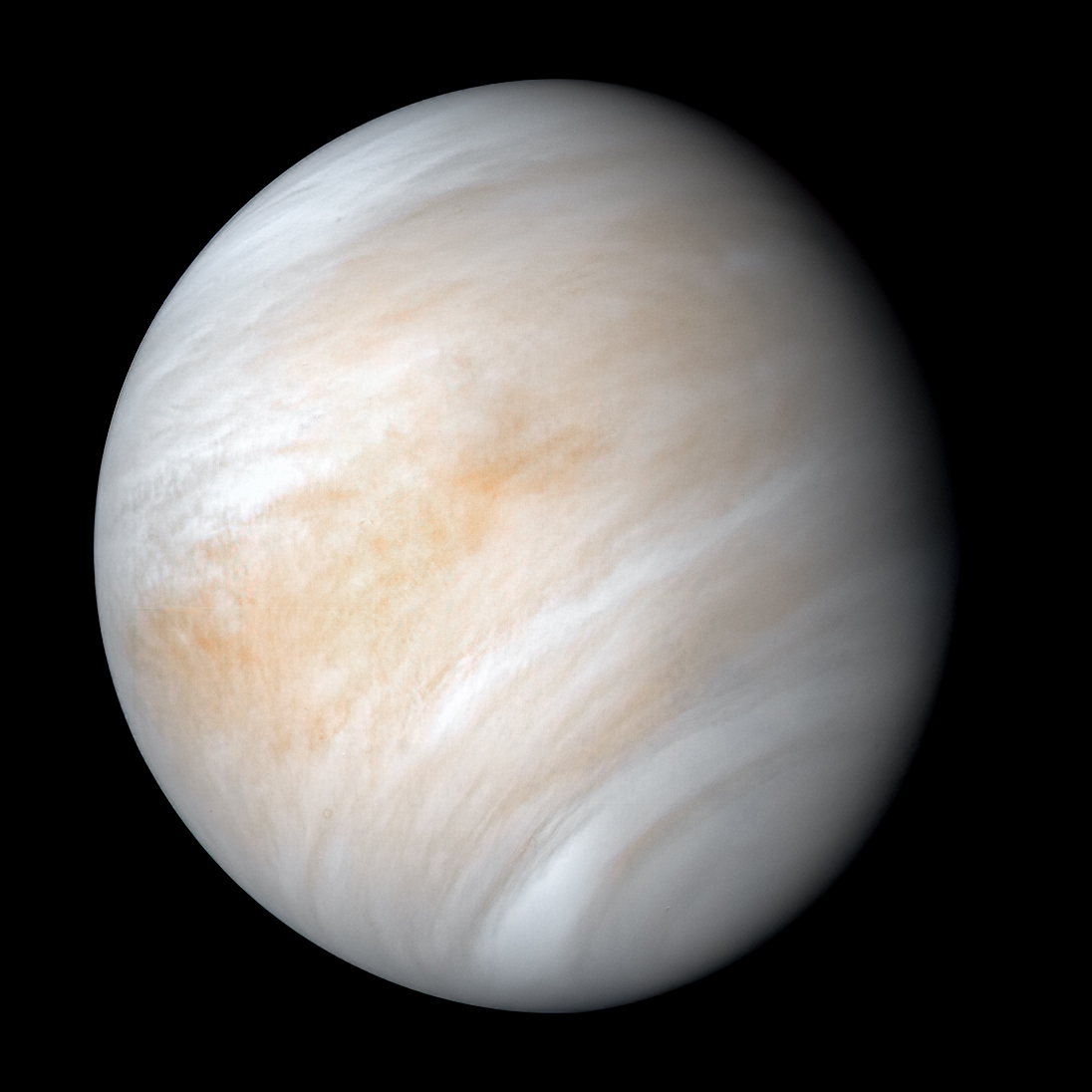
Venus in a false-color composite assembled from Mariner 10 images taken in February 1974. Atmospheric observations help characterize possible habitats; they have not established an aerial biosphere. Credit: NASA/JPL-Caltech.
Clouds can carry living microorganisms across great distances. Could an atmosphere also support a population that keeps reproducing without returning to the ground? A paper in the October 2026 issue of Astrobiology, “Atmospheres as Habitats,” organizes that question into a research program spanning Earth, laboratories and other planets.
First published online on August 5, the study led by Noam Izenberg is a framework for investigation. It does not report an airborne ecosystem on another world. Its central uncertainty starts at home: sustained, multigenerational airborne life on Earth has yet to be established or excluded.
What Earth’s clouds already tell us
A useful foundation comes from a 2019 study of cloud water collected at France’s Puy de Dôme atmospheric station. Pierre Amato and colleagues examined both microbial genetic material and the RNA associated with gene activity, investigating what the organisms were doing within their cloudy surroundings.
They found evidence of active microbial communities, largely bacteria, responding to cold, oxidizing chemicals and changes in their watery environment. Their results pointed to protective functions, membrane adjustments and exchanges between cells and cloud droplets. Clouds were chemically demanding surroundings in which biological activity could continue.
The sampling location is important: this was research on terrestrial cloud water, with organisms that could have arrived from environments below. Activity during transport answers a different question from whether a population can replace itself indefinitely while remaining airborne. Both are interesting, and each requires its own measurements.
Why Venus keeps the question alive
NASA’s Venus overview explains the strong contrast between the planet’s surface and higher atmosphere. Around 50 kilometers above the ground, temperatures can be roughly 30 to 70 degrees Celsius, with pressures comparable to Earth’s surface. Those conditions have encouraged discussion of possible aerial habitats despite the planet’s punishing ground-level environment.
Venus also has sulfuric-acid clouds. A tolerable temperature and pressure leave major chemical questions unresolved. NASA explicitly notes that the observations discussed in its overview provide no compelling evidence of life in those clouds.
For a reader evaluating future Venus findings, this distinction is useful: a measurement may improve a model of where life could survive while leaving the question of whether anything lives there entirely open.
Experiments that could move the question forward
The new paper proposes studying whether microbes can persist and evolve in controlled airborne conditions, alongside better field observations. Time spent suspended, access to nutrients and repeated environmental stresses all enter the problem. The authors also call for atmospheric modeling and observations of worlds beyond the solar system.
A decisive advance would connect several kinds of evidence: organisms present, activity measured, reproduction demonstrated and a credible account of how that population remains supplied. This is the attraction of the research agenda. It breaks an expansive idea about life in alien skies into questions that experiments on Earth can begin to answer.
Leave a Reply