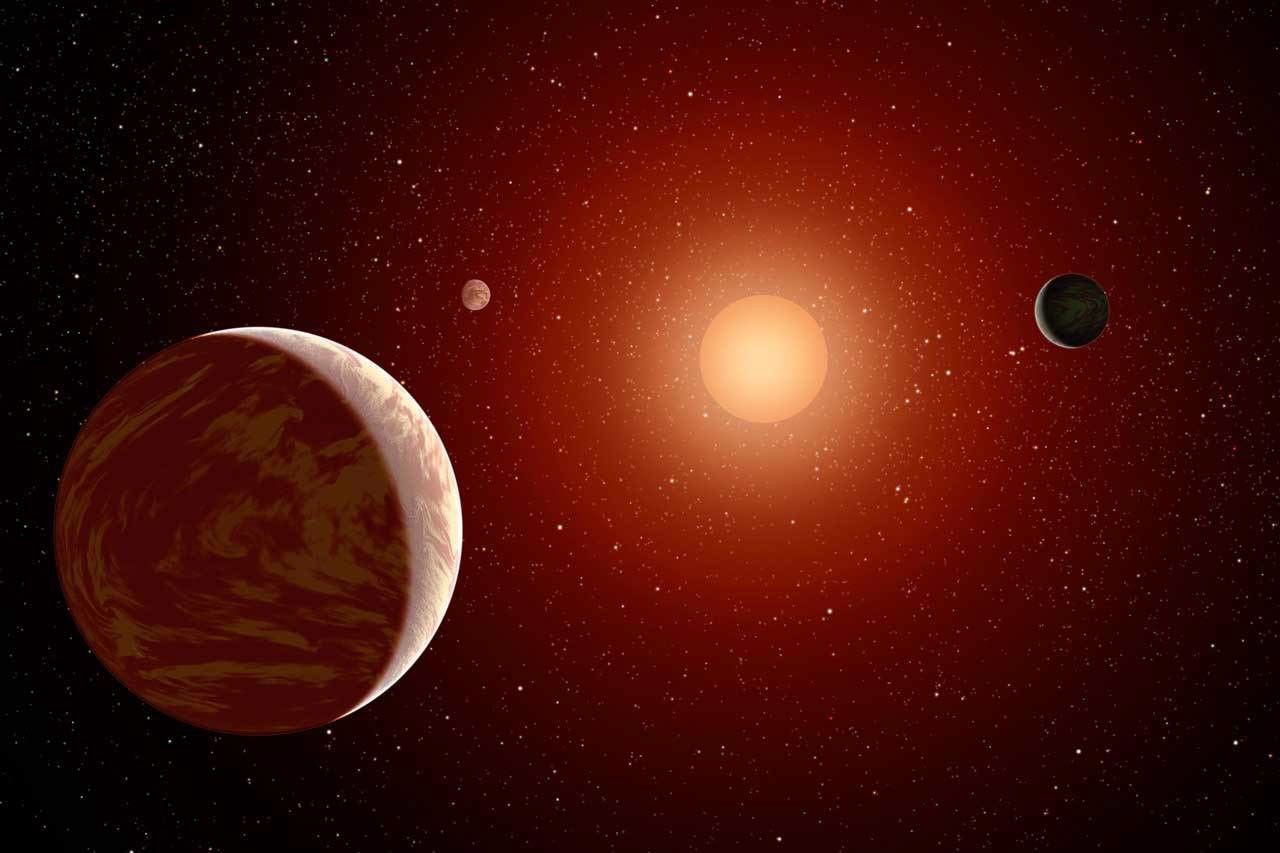
Context illustration of planets orbiting a red dwarf star. The new research simulates atmospheric and climate possibilities rather than imaging these worlds. Credit: NASA/JPL-Caltech. Image source and credit.
A new study explores outer-habitable-zone planets, where substantial carbon dioxide may be needed to keep surface water liquid. Daria Pidhorodetska and colleagues posted the research on September 29, 2026; it is also published in The Astrophysical Journal. Their simulations connect possible climates with the atmospheric signals future telescopes could seek.
Distance alone leaves important questions unanswered
The habitable zone describes where an appropriately equipped planet could maintain liquid surface water. As NASA’s overview explains, its location depends on the star: dim red dwarfs have close-in zones, while hotter stars illuminate broader, more distant regions. An orbital address is consequently only an initial clue. A rocky world also needs conditions that actually allow the water to persist. Stellar radiation, atmospheric survival and the planet’s physical characteristics all affect the interpretation.
The new work uses the three-dimensional Generic Planetary Climate Model to examine high-carbon-dioxide climates. It finds broad agreement with earlier one-dimensional predictions while showing why carbon dioxide condensation and clouds deserve explicit treatment. The researchers also calculate spectra, predicting differences between habitable and nonhabitable versions of these carbon-dioxide-rich worlds. They consider direct imaging around Sun-like stars and transmission or emission measurements for planets around M dwarfs. These are modeled possibilities, not detections of new inhabited planets.
The carbon cycle complicates the picture
Earlier NASA-supported research on the outer habitable zone examined another difficulty: maintaining warmth over time. Volcanic carbon dioxide can help a frozen planet thaw, but weathering can subsequently remove that greenhouse gas. Under some modeled conditions, a planet cycles between warmer intervals and prolonged glaciation. The balance depends on uncertain properties such as outgassing and how efficiently exposed rocks react with water. A snapshot of possible warmth therefore leaves a separate question about how long it lasts.
Potentially habitable for which organisms?
Carbon dioxide also changes what habitability means biologically. A 2019 study by Edward Schwieterman and colleagues compared atmospheric models with physiological limits of complex aerobic life on Earth. It found that the gas concentrations required to warm some outer-zone planets could exceed the tolerances of such organisms. Its proposed zone for complex life was narrower than the conventional liquid-water zone. Those constraints concern known terrestrial biology; they do not establish a universal boundary for every conceivable form of life.
Taken together, these studies suggest a careful sequence for interpretation: establish the atmosphere, assess its climate, and then ask what kinds of environments it might support. The latest simulations contribute to the first two steps by predicting observable consequences of thick carbon dioxide and clouds. Identifying those consequences would help astronomers decide which apparently promising worlds merit closer investigation.
Leave a Reply