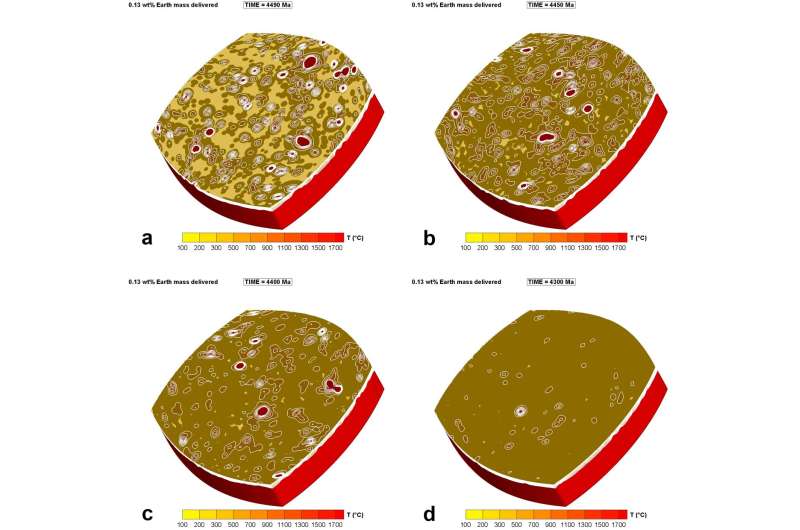
Model snapshots show impact heating becoming less widespread as early bombardment declines. Colors represent modeled temperatures about 4 kilometers below the surface; circles mark craters. Credit: Abramov et al., Nature Communications, Figure 2, CC BY 4.0. Figure source. CC BY 4.0.
Earth may have developed especially favorable conditions for the chemistry preceding life about 4.33 billion years ago, according to a study published on September 22, 2026, in Nature Communications. The estimate comes from a computer reconstruction of heating and cooling in the young planet’s crust. It identifies an environmental opportunity rather than a directly measured date for life’s origin.
When a cool interval became lasting shelter
Oleg Abramov and colleagues simulated impact heating from 4.5 billion to 3.5 billion years ago. The Planetary Science Institute’s research account emphasizes persistence: could a region cool enough for vulnerable molecules to survive, then remain cool through later bombardment? Another major impact could destroy chemistry accumulating during a temporarily favorable interval.
In the model, regions of shallow crust that remained below the study’s temperature threshold began appearing after about 4.4 billion years ago. The paper also assessed cooler conditions appropriate to preserving molecular building blocks, including a conservative 60°C threshold for RNA-related chemistry. This distinction matters: an environment tolerable to an already evolved heat-loving microbe may still damage molecules involved in an earlier, more fragile chemical system.
Impacts could also supply useful environments
Bombardment also supplied useful heat. Water circulating through impact-heated rock can form hydrothermal systems with chemical-energy sources. The institute describes a period when globally destructive heating had declined while these systems remained widespread. That overlap helps explain the preferred window for persistent chemistry near 4.33 billion years ago.
How the estimate fits life’s family tree
A separate line of research works backward from organisms alive today. In a 2024 study led by the University of Bristol, researchers compared genes and used evolutionary models to estimate that the last universal common ancestor, or LUCA, lived about 4.2 billion years ago. LUCA represents an ancestor shared by modern cellular life. The reconstruction suggested an organism already possessing considerable biological complexity, rather than the first tentative step from chemistry into biology.
These approaches address different parts of the problem. Molecular clocks infer evolutionary history; the new thermal calculations ask when suitable environments could endure. Agreement between their broad timelines is interesting, but it does not turn a model into a fossil record of an RNA world.
The new work does not simulate a complete origin of life or demonstrate that RNA-based organisms actually occupied its modeled refuges. Its value is in narrowing physical conditions that proposed origin scenarios must satisfy. Future evidence about impact history, ancient crust and molecular stability can test how robust that opportunity window really was.
Leave a Reply