Two samples can share nearly the same average carbon-isotope signature yet preserve different chemical histories inside individual molecules. That is the central lesson of a beta-alanine study comparing asteroid Bennu with the Murchison meteorite, highlighted in a Penn State account updated November 12, 2026.
The peer-reviewed study was published September 24 in Communications Earth & Environment. The later university coverage is not the date of a new asteroid sample return or the discovery of life.
Looking within the molecule
According to Penn State’s explanation, the team measured isotope differences at separate carbon positions in beta-alanine. The average carbon values for the two samples agreed within uncertainty, but their internal values differed. Both showed one carbon position enriched in the heavier isotope and two depleted positions, with different magnitudes.
Researchers interpret that shared arrangement as potentially related chemistry, while the differences point toward different source environments. This is a reconstruction of formation conditions, not a direct observation of the reactions occurring in the early solar system. Beta-alanine is relevant to prebiotic chemistry but is not one of the standard twenty protein-forming amino acids.
Why this changes the question
A bulk average compresses several measurements into one number. Two different combinations can produce the same average, so agreement at that level need not imply an identical history. Position-specific measurements retain information that the average discards. The scientific gain is therefore not simply another entry on a list of molecules found in space; it is a way to distinguish histories that previously looked alike.
One next step identified by the researchers is testing how processes such as exposure to water change these internal isotope patterns. Until those effects are better understood, the pattern should be treated as evidence constraining possible pathways, rather than a unique address labeling where each molecule formed. Organic chemistry in an asteroid is important to origins-of-life research without being evidence that the asteroid hosted organisms.
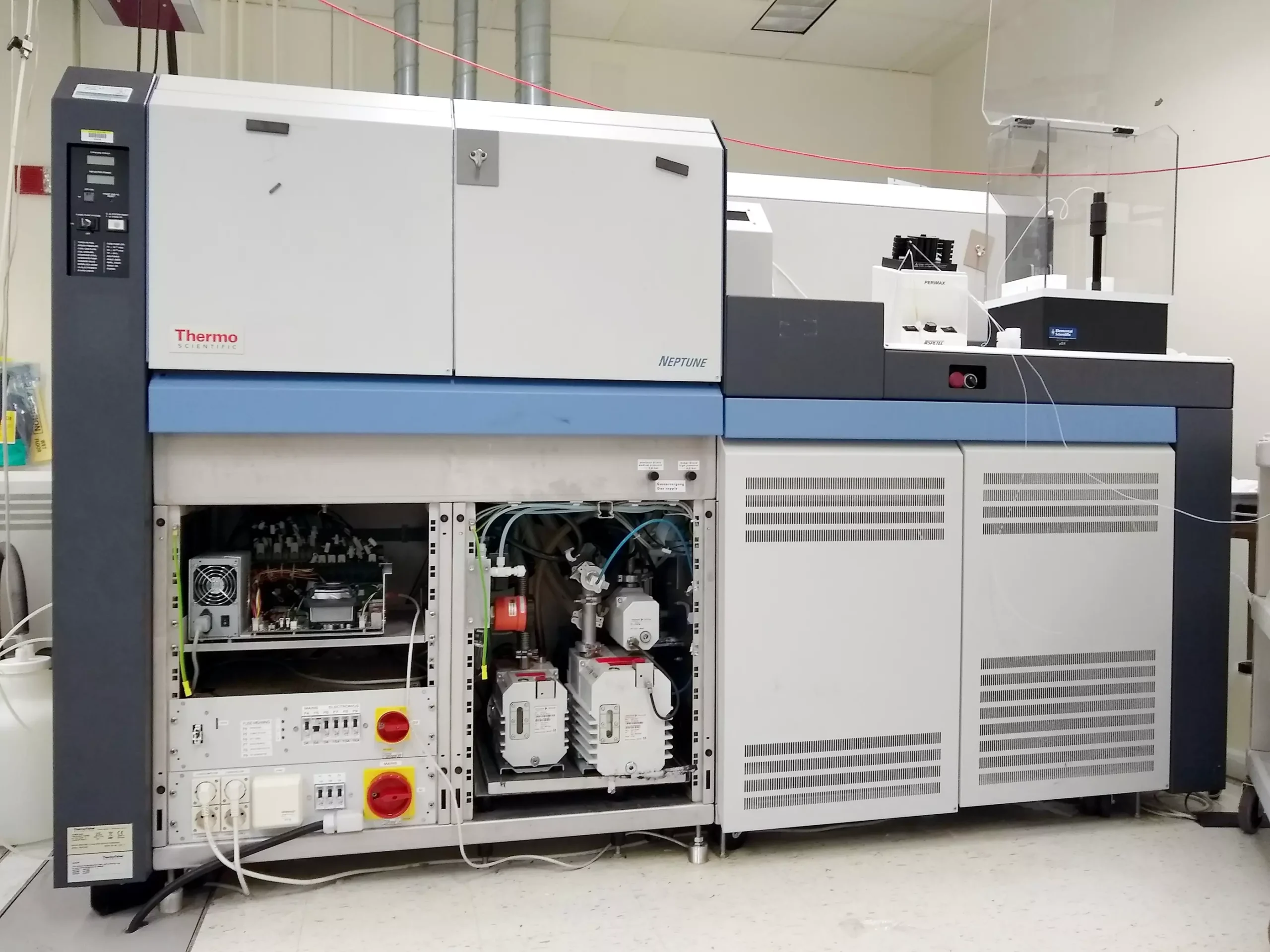
Featured image: A NIST multicollector mass spectrometer, illustrating isotope measurement generally, not the instruments used in this Bennu study. Credit: Lane Sander / NIST. Image source; reuse policy.
Leave a Reply