A vertical glow above a town can look like a searchlight, a descending object or a structure hanging in the sky. Before assigning it a vehicle, test a different possibility: a light pillar. The useful question is not whether the image looks strange, but whether the lighting, weather and viewing geometry fit a known optical effect.
What makes the column
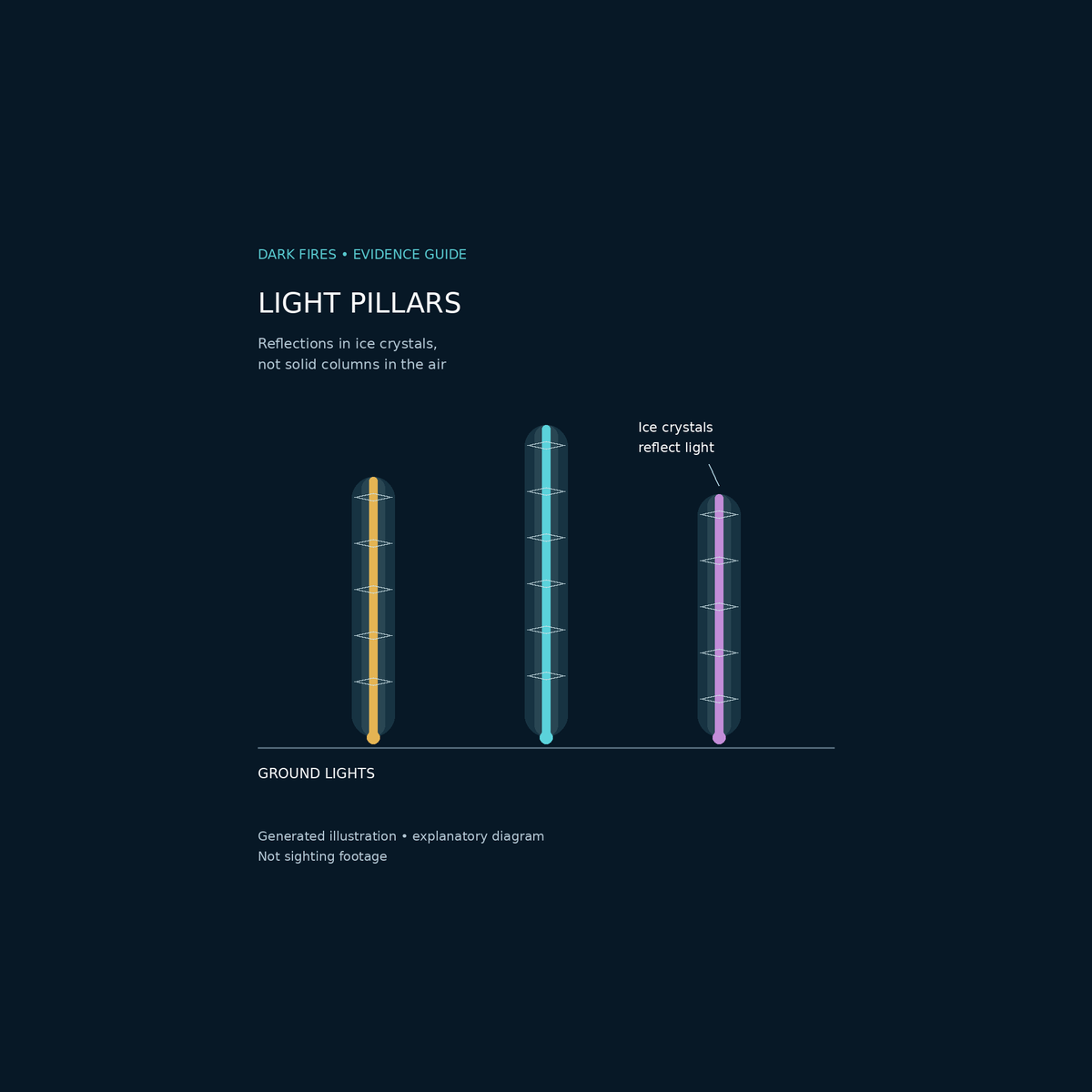
The National Weather Service’s light-pillar explanation describes reflections from thin, plate-shaped ice crystals in the atmosphere. Their orientation helps produce the apparent vertical column. Its appearance depends on the crystals’ height, shape and angle, as well as the distance to the light source. The source can be the Sun or Moon, but it can also be an ordinary streetlight.
MetService’s example from Paraparaumu identifies artificial ground lights reflected by ice crystals toward the observer. Its photograph was taken by Leah Cameron in May 2016; that is an example of the mechanism, not a new event. A pillar therefore need not mean that a powerful beam is physically being fired upward. The observed shape is produced by the light’s path to the viewer.
A practical comparison
For an unexplained report, start with an uncropped view that includes the horizon. Note the observation time, location and compass direction, then map candidate lights along that line of sight. A row of differently colored pillars above corresponding industrial or town lights is a more informative clue than a tight crop of one bright streak.
Check weather observations for conditions compatible with ice crystals, but keep their limits in mind. A reading at a nearby station is not a direct measurement of every layer along the sightline. Record whether the glow changes as clouds pass, whether other pillars appear, and whether another observer sees a corresponding effect from a different position. Preserve the original image rather than enhancing its outline into a seemingly solid object.
Do not turn a candidate into a verdict
These are investigation steps, not a diagnosis of any particular photograph. A light source and plausible weather make the pillar hypothesis testable; they do not automatically prove it. Conversely, an incomplete weather record does not establish an exotic object. The strongest conclusion comes from a match between the recorded scene and the proposed optical geometry, with remaining gaps stated plainly.
Featured graphic: Generated illustration. Explanatory diagram by Dark Fires, not a photograph of a reported sighting.
Leave a Reply