NASA reported on November 13, 2026 that the Nancy Grace Roman Space Telescope has aligned its instruments, a commissioning milestone rather than the start of its full science program. The update concerns the precision of the observatory’s measurements, not a new planet or cosmological discovery.
A telescope needs an accurate internal map
Launch and the space environment can shift an observatory from its ground-tested configuration. Roman’s team compared observed star positions with expected positions to refine that internal map. Its Wide Field Instrument’s 18 detectors must work together for accurate guiding.
The instrument also keeps watch on guide stars while the Coronagraph Instrument observes another field. The coronagraph’s next challenge is active control of starlight using its deformable mirrors. Aligning optics is necessary, but is not equivalent to demonstrating the final ability to uncover faint planets beside bright stars. NASA’s November 13 update describes that distinction.
What commissioning establishes
NASA’s commissioning overview describes a sequence of turning systems on, making adjustments and calibrating performance. Roman’s destination is a halo orbit near the Sun–Earth L2 region, which offers a relatively stable thermal environment and a broad, largely unobstructed sky view. The agency cautions that commissioning schedules can change as engineers assess the observatory.
The practical question now is whether the calibrated system performs consistently in the observations it was designed to make. A telescope can point correctly yet still require extensive characterization of the residual light that obscures a planet. Reading alignment as a completed scientific result would skip that essential distinction.
This is progress worth tracking because surveys depend on repeatable measurements. The milestone reduces one source of uncertainty while leaving the next performance tests visible, rather than presenting the mission as already finished.
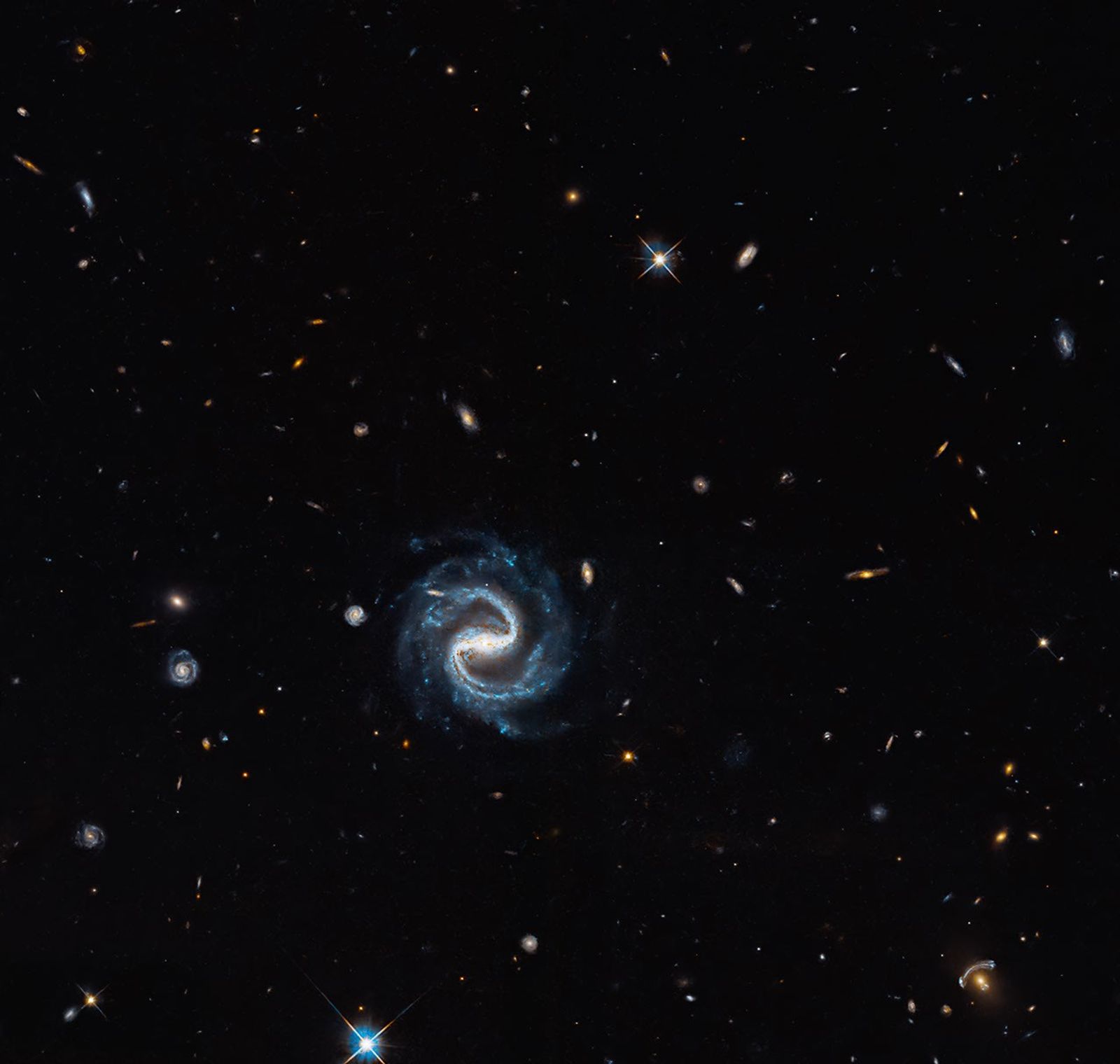
Featured image: Archival Hubble gravitational-lens field DESI J194.5345+03.5358, an example of the sky targets that motivate Roman’s surveys, not a Roman alignment image. Credit: NASA, ESA, and X. Huang (University of San Francisco); Processing: Gladys Kober (NASA/Catholic University of America).
Leave a Reply