A concentration of merging black holes near ten solar masses, followed by a relative scarcity at somewhat higher masses, may preserve a clue to how massive stars die. A study published November 10, 2026 in Physical Review D finds the distribution consistent with a distinct population formed through failed supernovae. That is a population-level inference, not a recording of a star collapsing without an explosion.
The pattern being explained
The paper’s abstract reports a strong ten-solar-mass peak using 153 observations from the GWTC-4.0 gravitational-wave catalog. Its inferred merger rate falls sharply in the roughly 12–16 solar-mass interval, then rises again above it. The authors say the conclusions persist in GWTC-5.0. The proposed explanation is especially efficient direct collapse within a narrow mass range.
That does not mean no black hole can exist between twelve and sixteen solar masses. The study concerns an inferred distribution for merging systems, with statistical uncertainties. A low estimated rate in that selected population is a narrower statement than a universal prohibition.
Evidence for an origin, not direct confirmation
Caltech’s November 10 account describes the wider analysis in terms of 257 mergers and reports that the ten-solar-mass group also has a narrower range of spins. Those two features motivate a common-origin hypothesis. The institutional account explicitly says the work did not provide direct evidence of a failed supernova.
The distinction matters because the observation and the proposed cause occur at different stages of stellar history. Gravitational waves reveal properties of black holes when they merge; the researchers then ask which formation processes could produce that pattern. A successful model must explain the excess near ten solar masses and the neighboring deficit together, rather than fitting one isolated feature.
The result makes quiet stellar collapse a testable explanation for a particular population. It does not turn every missing supernova into a confirmed black-hole birth, nor establish one pathway for all black holes. Additional observations can test whether the structure remains as catalogs grow and whether competing formation models reproduce it.
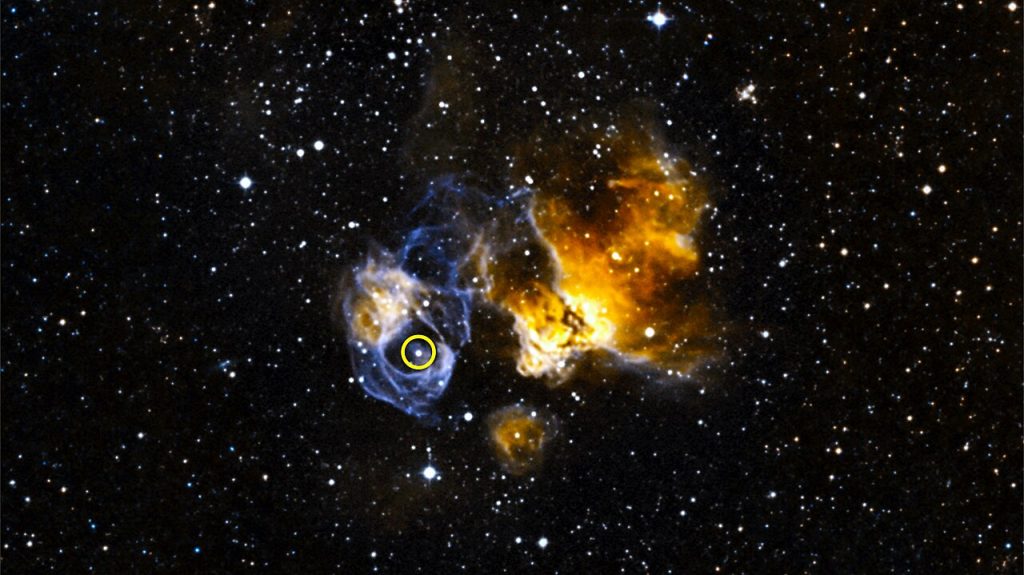
Featured image: LMC P3 marked inside the DEM L241 supernova remnant, shown as context for stellar death. It is not a failed-supernova detection or one of the merging systems analyzed here. Credit: Chandra X-ray Observatory Center/NASA’s Goddard Space Flight Center, public domain. Image source.
Leave a Reply