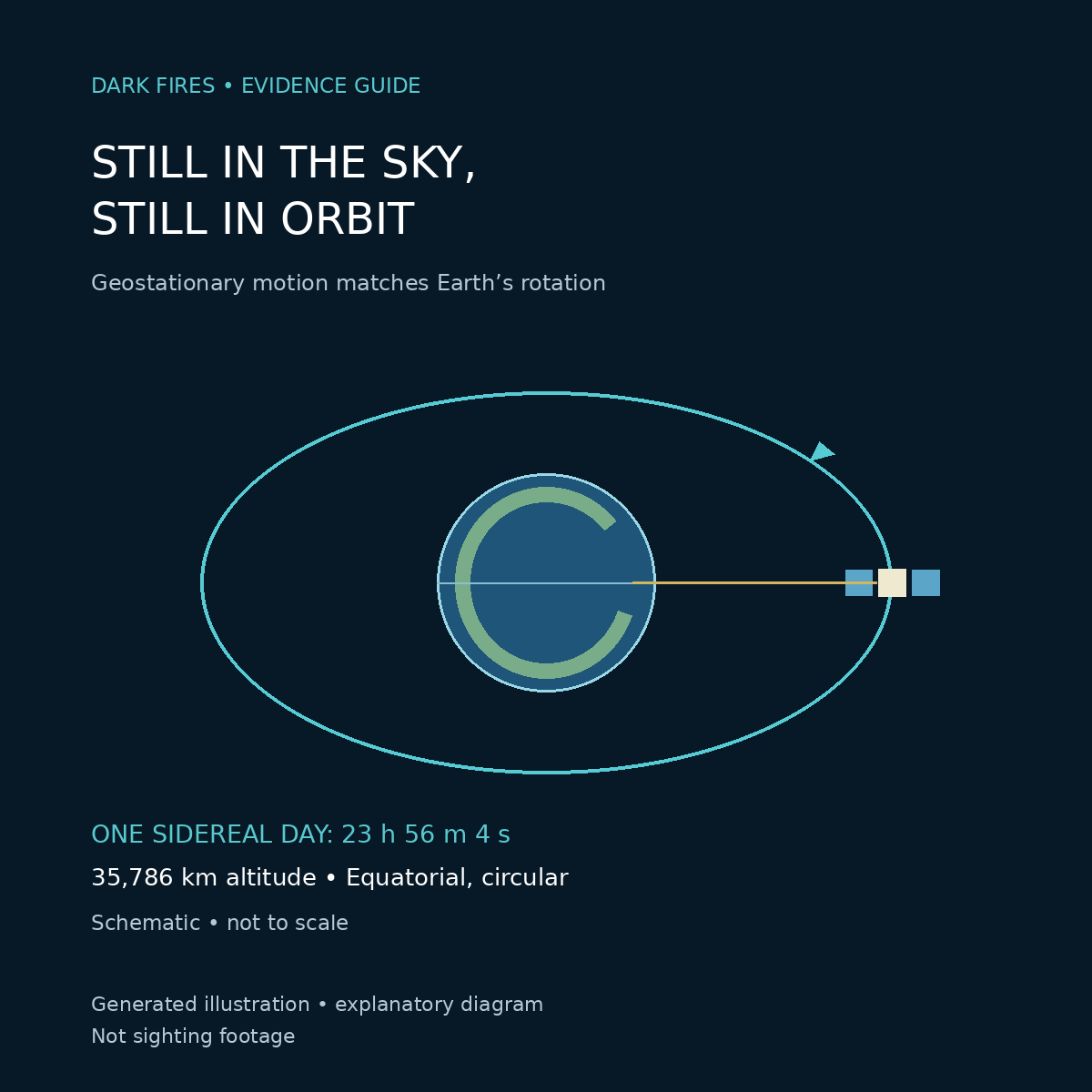
“It stayed in the same place” is an observation, not a propulsion measurement. A satellite can move rapidly around Earth while remaining almost fixed relative to an observer on the ground. That does not identify every stationary light as a satellite. It does explain why apparent hovering, by itself, cannot establish extraordinary flight.
Motion that matches the observer
ESA’s guide to orbital types describes geostationary satellites traveling west to east above the equator, completing an orbit in 23 hours, 56 minutes and 4 seconds. That is a sidereal day. At roughly 35,786 kilometers above the surface, they move at about three kilometers per second while keeping pace with Earth’s rotation.
The crucial relationship is between two motions: the spacecraft’s orbit and the observer’s rotation with Earth. A fixed-looking direction does not mean the satellite has stopped. This geometry is useful for communications antennas and weather monitoring because it provides a persistent view of the same region.
Geosynchronous is not always geostationary
NASA’s catalog of Earth satellite orbits distinguishes the broader geosynchronous family from the circular, equatorial geostationary case. Matching Earth’s rotation period alone is not enough to guarantee an unchanging apparent position. The orbit’s shape and inclination matter too. Using the two terms interchangeably can turn a useful satellite check into a misleading one.
What a sighting comparison needs
For a UAP report, the practical inference is to compare a candidate’s predicted direction with the recorded direction from the actual observing location and time. A general statement that satellites exist in that part of the sky is insufficient. Preserve landmarks, timestamp information and the camera’s field of view so that “stationary” can be measured relative to something outside the frame.
Also separate position from visibility. An orbital match alone does not establish that a particular spacecraft produced the recorded brightness or color. Nor does an object held near the center of a hand-tracked video demonstrate that it remained stationary relative to the ground. The observer may have followed it.
A good conclusion specifies what matched and what did not: direction, duration and apparent motion, followed by any unresolved visibility questions. Geostationary orbit is an ordinary explanation worth testing where the geometry fits, not a blanket label for every distant light. Without those comparisons, both “hovering craft” and “definitely a satellite” go beyond the available observation.
Featured graphic: Generated illustration. Dark Fires explanatory schematic, not to scale and not sighting footage.
Leave a Reply