A study posted November 13, 2026, and accepted for Astronomy & Astrophysics describes two planets orbiting one star in a wide binary. TOI-1699A’s stellar companion is about 348 astronomical units away in projection; the planets do not orbit around both stars together.
Two different measurements
Angelica Psaridi and colleagues combine TESS, CHEOPS, ground-based photometry and HARPS-N spectroscopy. The inner planet crosses its star every 4.55 days. Its radius is about 3.1 Earth radii and its mass about 13.9 Earth masses.
The outer companion takes roughly 108.75 days. Its gravitational effect on the star gives a minimum mass of 5.54 Jupiters, not a precise true mass: the orbital inclination remains uncertain. Dynamical modeling limits it to roughly 18 Jupiter masses, while future observations could narrow that range.
Density is not a unique recipe
The inner planet’s density rules out a bare rocky composition in the study’s models, but does not uniquely distinguish water-rich material from a smaller hydrogen-helium envelope. This system offers a test of planet formation in binary-star environments, not a resolved photograph of either world.
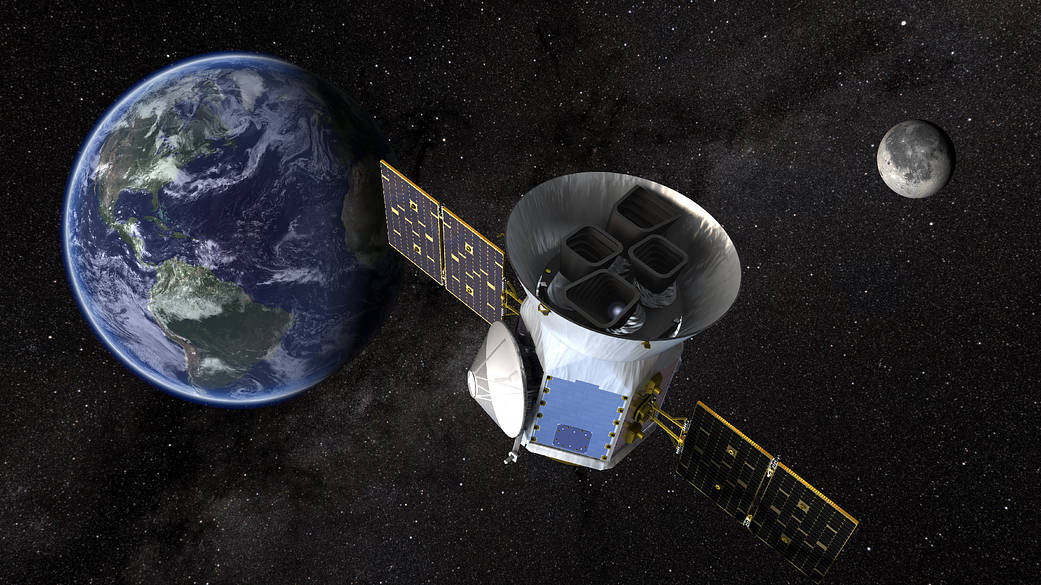
Image: Artist’s concept of TESS, one instrument contributing to the study. Credit: NASA’s Goddard Space Flight Center. Not a depiction of TOI-1699A.
Leave a Reply