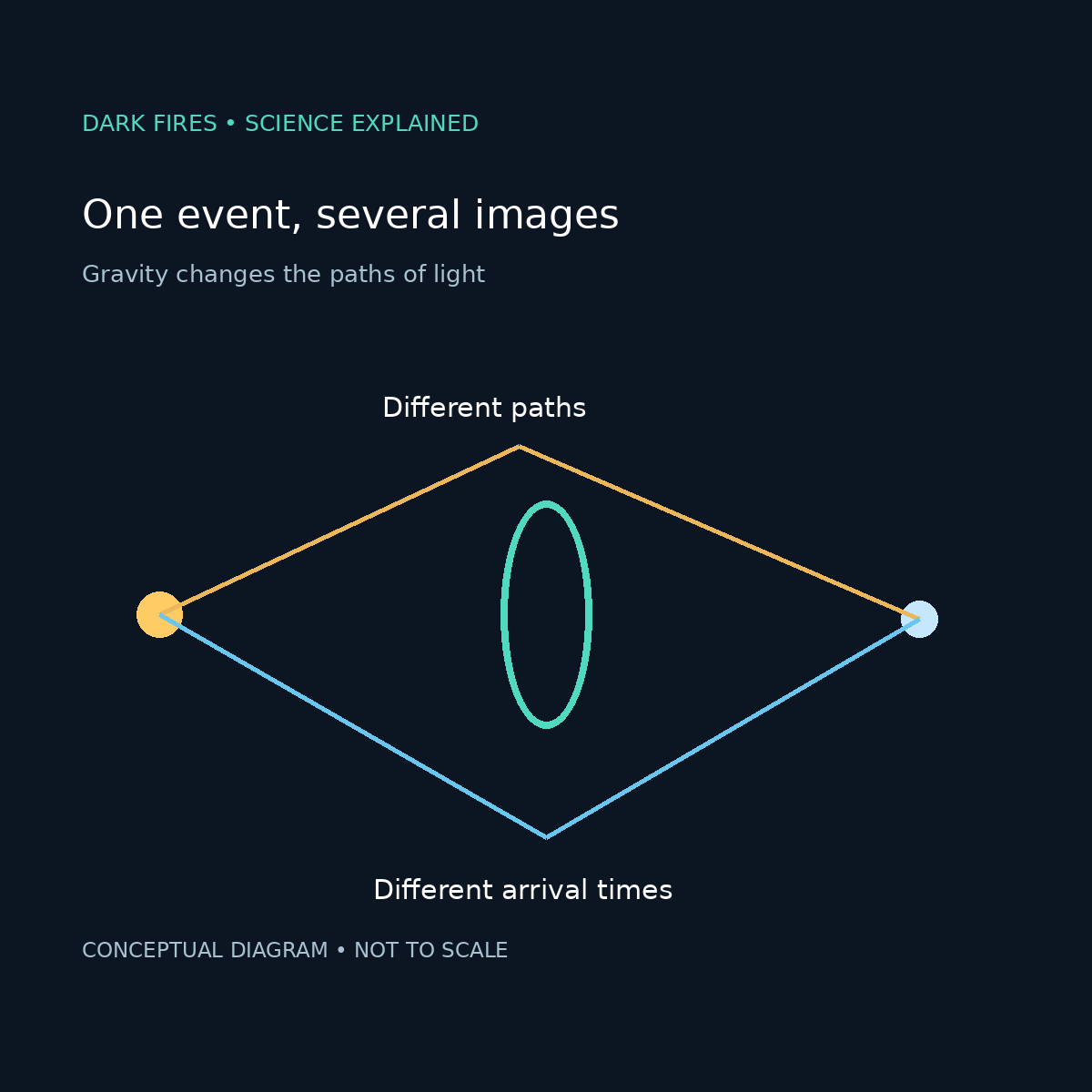
When astronomers see a supernova reappear in a gravitational lens, the star has not necessarily exploded again. Light from the same event can reach us along different routes, arriving at different times.
A massive foreground galaxy or cluster bends light from a more distant object. The geometry can produce several images rather than one. Their arrival times differ, so a brightening can appear in one image before another.
A prediction that could be checked
Supernova Refsdal provided a striking test. Hubble spotted four lensed images on November 11, 2014. Astronomers modeled the intervening cluster and predicted another appearance. It was observed on December 11, 2015, at the predicted location.
The delays are more than a visual curiosity. A research paper first submitted in May 2023 used Refsdal’s image delays to measure the universe’s expansion rate. The inference depends on the lens model as well as the observed timing; a repeated image is not, by itself, a complete cosmological measurement.
This is a historical example of a useful principle: gravity can turn a distant explosion into several views of the same event, delivered on different schedules.
Sources: NASA’s explanation and Refsdal observations; Kelly and colleagues’ 2023 research paper.
Generated illustration. Original Dark Fires conceptual diagram, not a supernova observation; not to scale.
Leave a Reply