Getting the same answer twice can be reassuring, but it matters what changed between attempts.
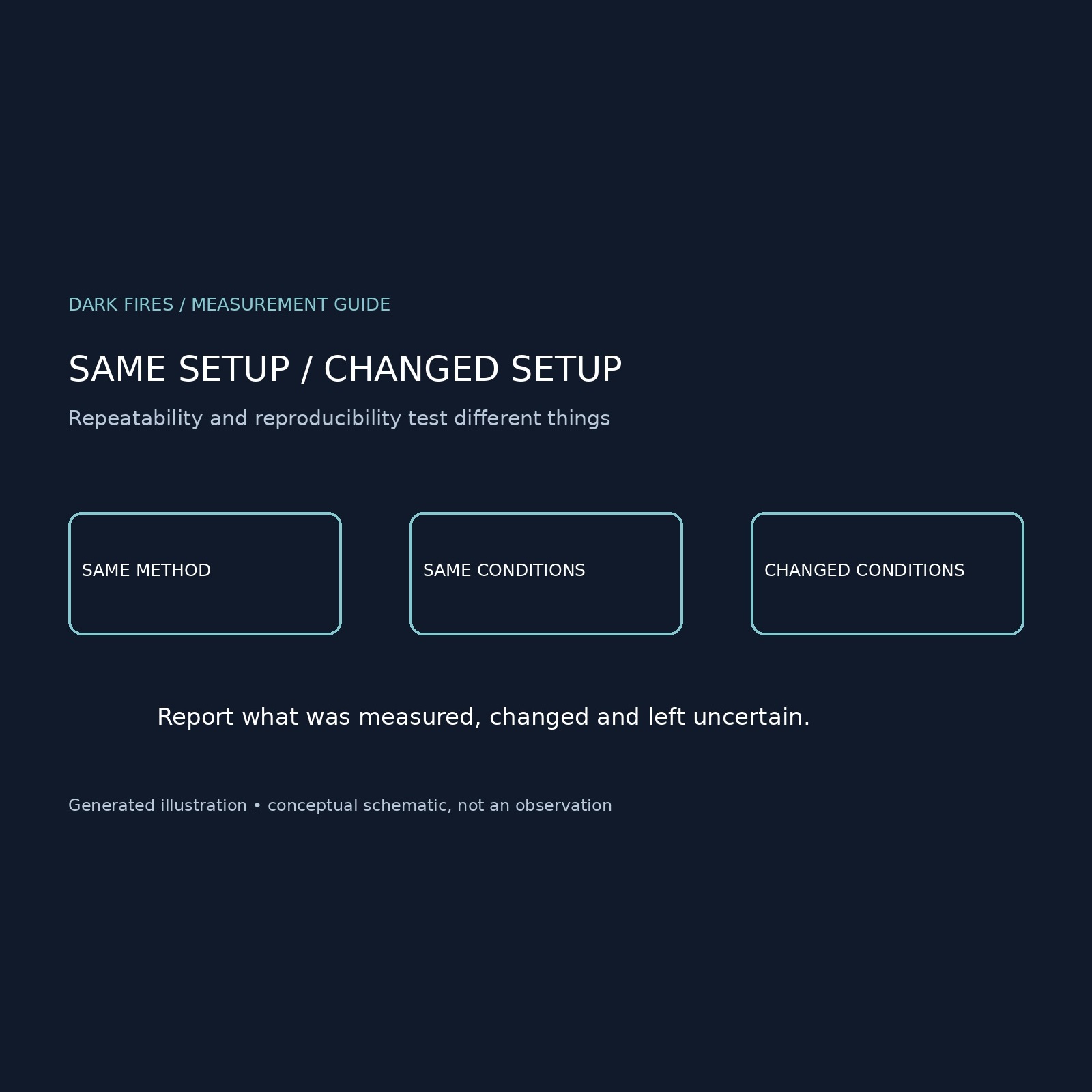
NIST’s measurement terminology distinguishes repeatability from reproducibility. Repeatability concerns successive measurements under the same conditions, including procedure, observer, instrument, location and a short time interval. Reproducibility concerns measurements under changed conditions, which must be specified. Those changes can include the instrument, observer, method, location or time.
Applied to UAP analysis, rerunning one calculation on the same video can check consistency without independently validating its assumptions. An additional sensor, another analyst or an independently measured reference can test different parts of the explanation. These are methodological applications, not conclusions about a particular sighting.
Neither test automatically eliminates error. Repeated results can share a mistaken assumption. Different instruments can also share an environmental influence. The report should say exactly what was held constant, what changed and what agreement was found.
For a fleeting event that cannot be recreated, investigators can still repeat the analysis and test proposed mechanisms in controlled conditions. The honest claim is then about the method or mechanism tested, not that the historical event itself was reproduced.
Primary source: NIST Technical Note 1297: terminology.
Featured image: Generated illustration. Conceptual schematic, not an observation.
Leave a Reply