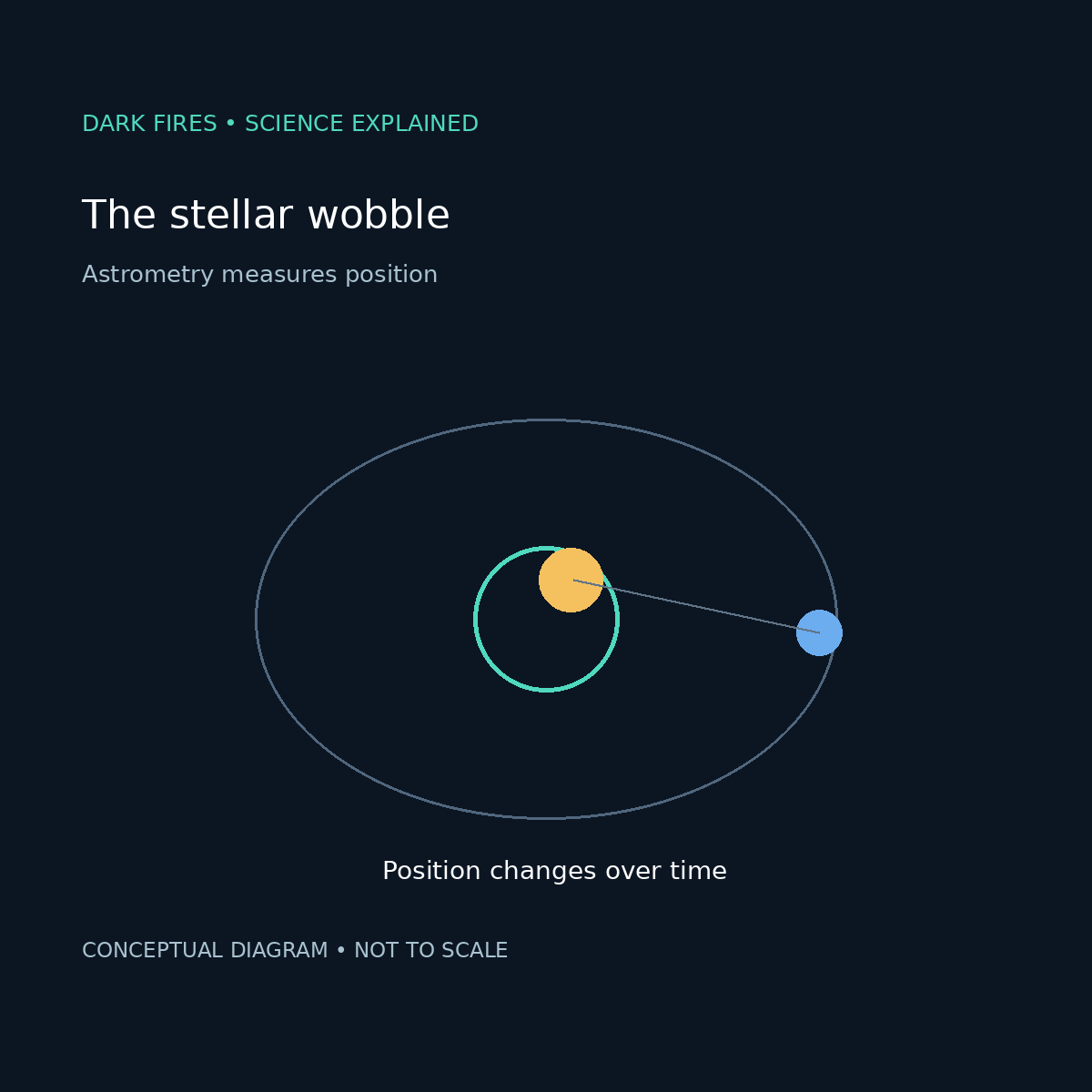
An unseen planet can announce itself through the motion of its star. Astrometry measures a star’s position on the sky over time, looking for the small wobble produced as star and companion move around their shared center of mass.
This differs from watching a planet cross the star’s face. Transit searches measure dimming; astrometry measures position. ESA explains that massive companions in wider orbits are especially favorable astrometric targets, complementing the close-orbit planets that transit surveys readily detect.
A wobble is a clue, not a verdict
A second star can also produce a wobble. That is why a candidate needs additional evidence rather than an automatic planet label.
In a February 4, 2025 report, ESA described Gaia-4b: a roughly twelve-Jupiter-mass planet with a 570-day orbit. Researchers followed Gaia’s astrometric indications with ground-based spectroscopy and radial-velocity measurements. Their work also identified Gaia-5b as a brown dwarf, not another planet.
The lesson is methodological: measuring motion can uncover companions too difficult to see directly, but interpreting the signal requires checking what kind of object could cause it. This is an evergreen explanation using a dated example, not a new discovery announcement.
Source: ESA’s Gaia-4b and Gaia-5b report, February 4, 2025.
Generated illustration. Original Dark Fires conceptual diagram, not telescope imagery; not to scale.
Leave a Reply