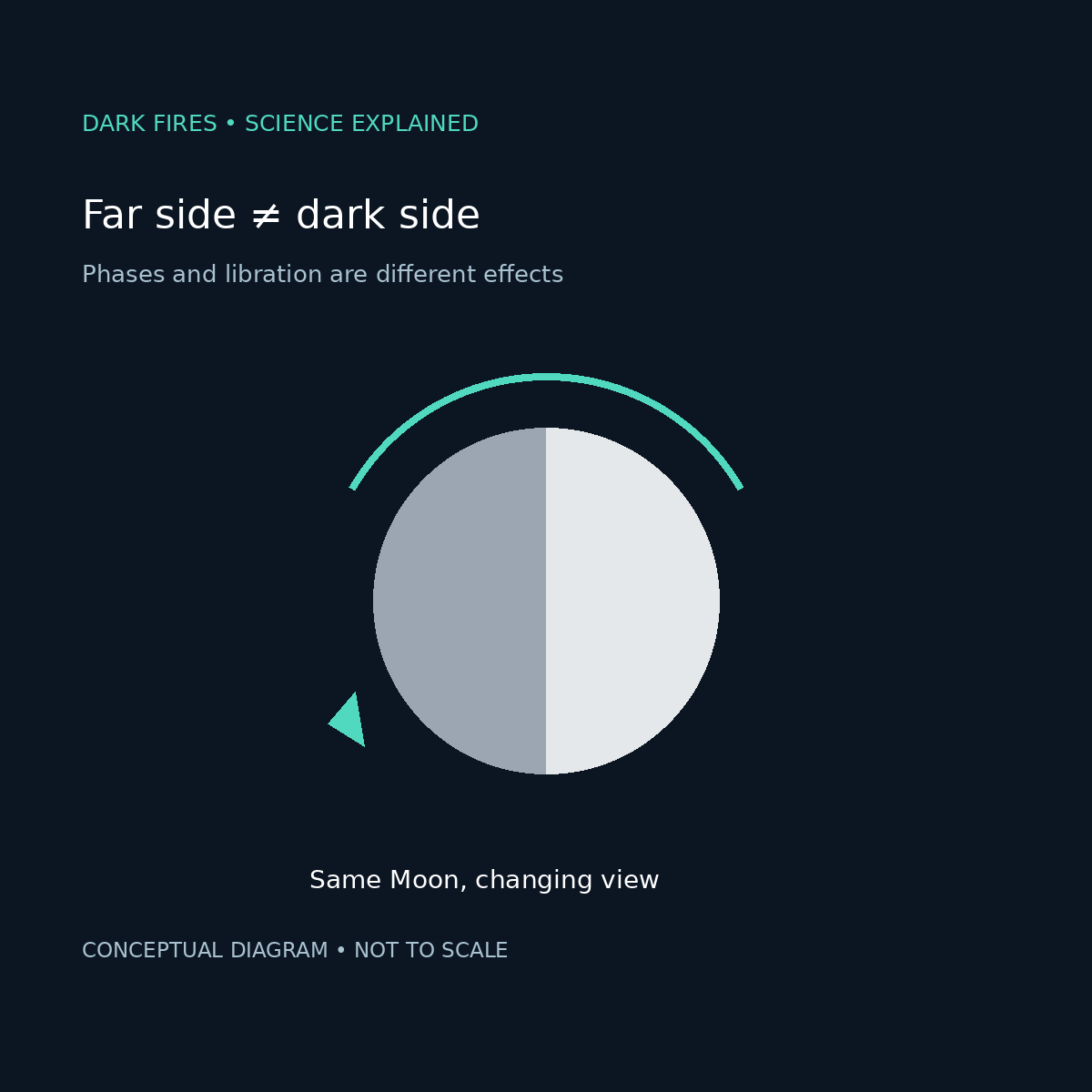
The Moon’s far side describes where it faces, not whether sunlight reaches it. The hemisphere generally turned away from Earth experiences daylight and night just as the near side does. At new Moon, the side facing us is mostly unlit while the opposite hemisphere faces the Sun.
The Moon keeps approximately the same face toward Earth because it rotates once during each orbit. That does not make our view perfectly fixed. Watch its surface over time and it appears to rock gently, revealing small portions around the edges.
A changing viewing angle
NASA calls this apparent motion libration. The Moon’s orbital speed changes along its noncircular path while its rotation is comparatively steady, allowing us to see a little farther around the eastern or western limb. The orbit’s tilt also changes our view toward its northern and southern edges.
The useful distinction is simple: phases describe how much of the sunlit hemisphere we see; libration describes changes in the angle from which we see the lunar surface. Neither requires a permanently dark hemisphere.
Source: NASA’s Moon phases and libration guide.
Generated illustration. Original Dark Fires conceptual diagram, not lunar photography; not to scale.
Leave a Reply