A distant light can remain ambiguous even when it belongs to an ordinary aircraft. The useful question is not whether one frame looks unusual, but whether a sequence supplies enough information to test an aircraft explanation. Lighting rules provide clues, not a complete identification by themselves.
Start with the navigation-light pattern
The FAA’s Airplane Flying Handbook chapter on night operations describes red at the left wingtip, green at the right wingtip, and white at the tail. These position lights help an observer judge orientation. “Left” and “right” refer to the aircraft’s own sides, not the sides of the screen.
That distinction is easy to lose in a cropped video. Before interpreting a color arrangement, establish whether the aircraft is approaching, receding, or crossing the view. If the recording cannot resolve separate light sources, do not treat a blended dot as a reliable map of the airframe.
A missing flash is not a verdict
The FAA’s Aeronautical Information Manual, section 4-3-24, explains that anti-collision systems may use red or white rotating beacons or flashing lights, with different intensities. Many aircraft have both a beacon and strobes. Pilots may turn off supplementary strobes when reflections from clouds or precipitation adversely affect vision; safety exceptions also apply to anti-collision-light use.
The same section describes the FAA’s voluntary Lights On program, encouraging landing-light use below 10,000 feet, particularly near airports and in reduced visibility. A conspicuous steady light is therefore not automatically inconsistent with an aircraft. Equally, a brief clip without a visible blink cannot establish that no blinking light was present throughout the observation.
Build a record that can be checked
Keep the original video at its original speed. Record the time with a time zone, the observing location, the viewing direction, and how long the light remained visible. Include landmarks or a wider view when possible. Those details let another person test a route or approach instead of guessing from the brightest frame.
Describe what changed: the number of distinguishable lights, their relative positions, any repeated flashes, and motion against fixed features. Separate those observations from an interpretation such as “hovering” or “turning sharply.” A camera pan can otherwise become part of the alleged flight path.
A flight-track match is strongest when its time, direction, and apparent path agree with the recording. A lighting resemblance alone is weaker. If the available record does not support a reliable match, leave the identification open rather than converting missing detail into evidence of an exotic vehicle.
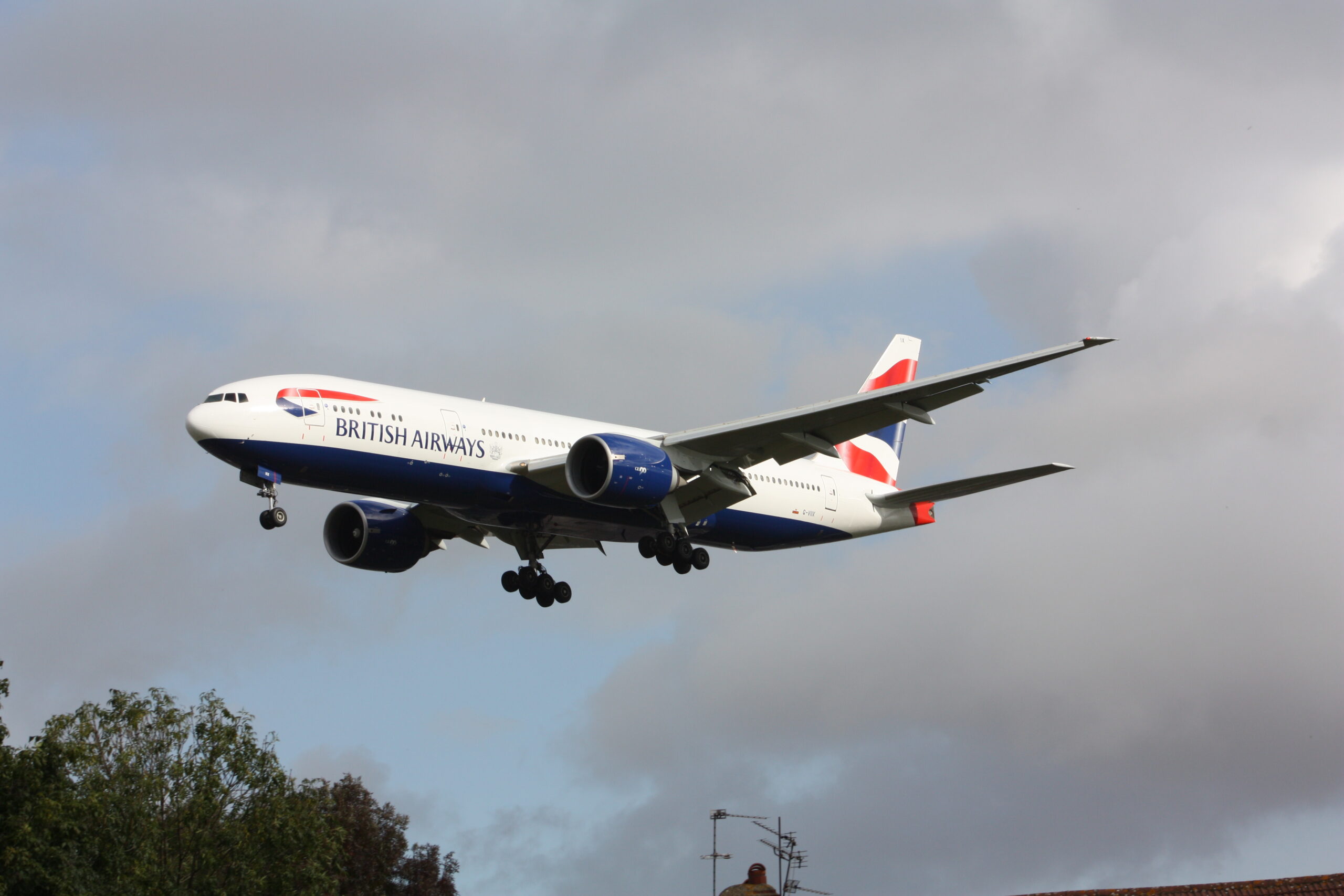
Featured image: MercerMJ / Wikimedia Commons, Boeing 777 at Heathrow, October 17, 2014, CC BY-SA 2.0. Daylight aircraft reference, not a night-sighting photograph. No changes beyond resizing and display cropping.