A vast spiral appearing among the northern lights is an arresting sight. Its symmetry can make it look designed, while its expansion can suggest something much larger than the source that produced it. Documented observations in Alaska and Hawaii show why investigators should distinguish an illuminated cloud from a solid object before interpreting its shape.
In an April 18, 2023 report, the University of Alaska Fairbanks Geophysical Institute described a spiral recorded by the Poker Flat Research Range all-sky camera. Chief scientist Don Hampton connected it to a SpaceX Falcon 9 launch whose route crossed Alaska. He considered either exhaust from a manoeuvre to bring the second stage down or excess fuel released afterward as the cloud’s source.
Hampton linked the pattern to a spinning stage releasing gas. Water vapour could become ice at altitude and reflect sunlight while the ground below was dark. His account was more specific about the physical mechanism than about which operational step produced the release. That remaining uncertainty should stay attached to the explanation.
A separate observatory recording
The Subaru Telescope’s February 1, 2023 account documents another spiral, captured over Maunakea early on January 18, Hawaii Standard Time. The Subaru-Asahi Star Camera recorded the feature in the eastern sky. The observatory associated it with a SpaceX satellite deployment and described sunlight reflection as the source of its brightness.
Subaru also noted that the camera’s sensitivity and Maunakea’s dark sky revealed the structure particularly clearly. Its suggestion that the spiral was probably visible to the unaided eye was qualified, rather than presented as a confirmed eyewitness observation. The distinction matters when comparing a sensitive camera recording with what a person might have seen.
Test the connection to a launch
These cases provide useful comparisons, but a new spiral requires its own evidence. First establish the recording’s location, time, and viewing direction. A repost’s city label may refer to the account sharing it rather than the camera’s position. Seek the original sequence before using a striking still as the basis for an identification.
Then compare the observation with a documented mission timeline and trajectory. A launch somewhere on the same continent is a starting point, not a complete match. The explanation should account for why the material appeared in that part of the observer’s sky at that time.
Preserve frames showing expansion, fading, and changing structure. Those features can help test whether the visible pattern behaves like a cloud. A luminous boundary need not mark the edge of a rigid vehicle, so an apparent diameter should not automatically become a spacecraft-size estimate.
The strongest explanation joins an observation, an appropriate launch record, and a plausible physical mechanism. Where the evidence supports the rocket connection but leaves the exact release process uncertain, report both.
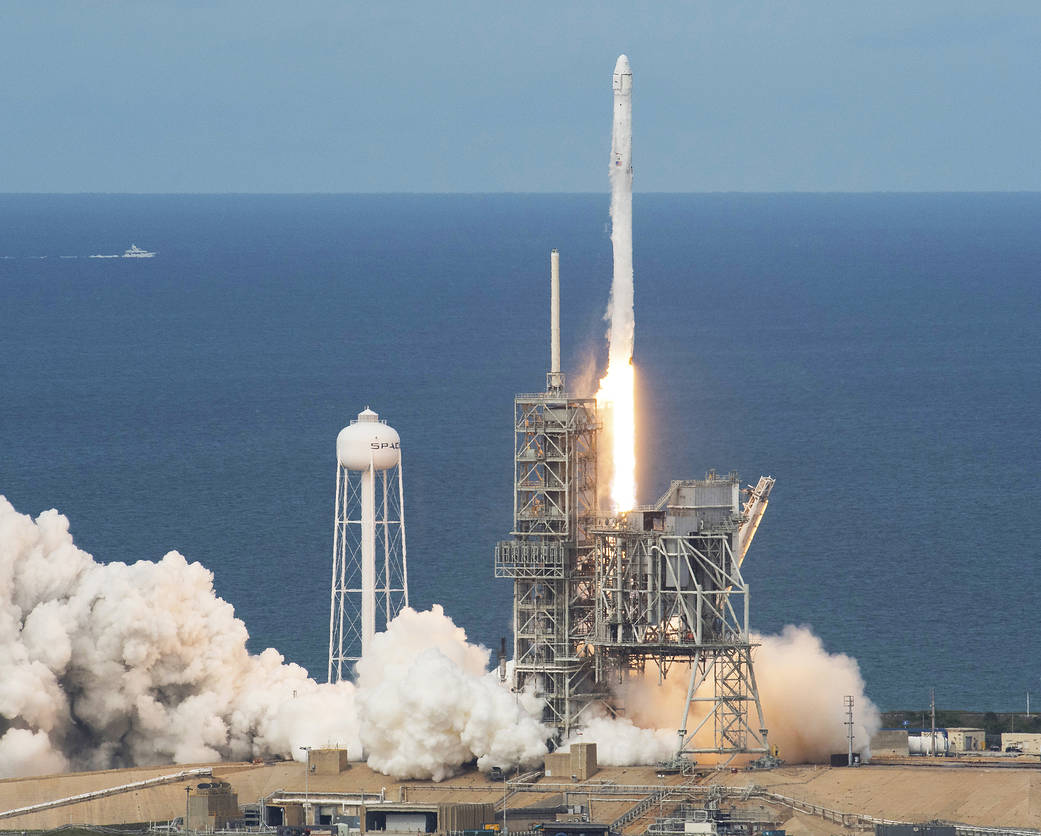
Featured image: NASA/Bill Ingalls, Falcon 9 launch on June 3, 2017. Archival vehicle photograph for context, not either 2023 launch or a photograph of a spiral.
Leave a Reply