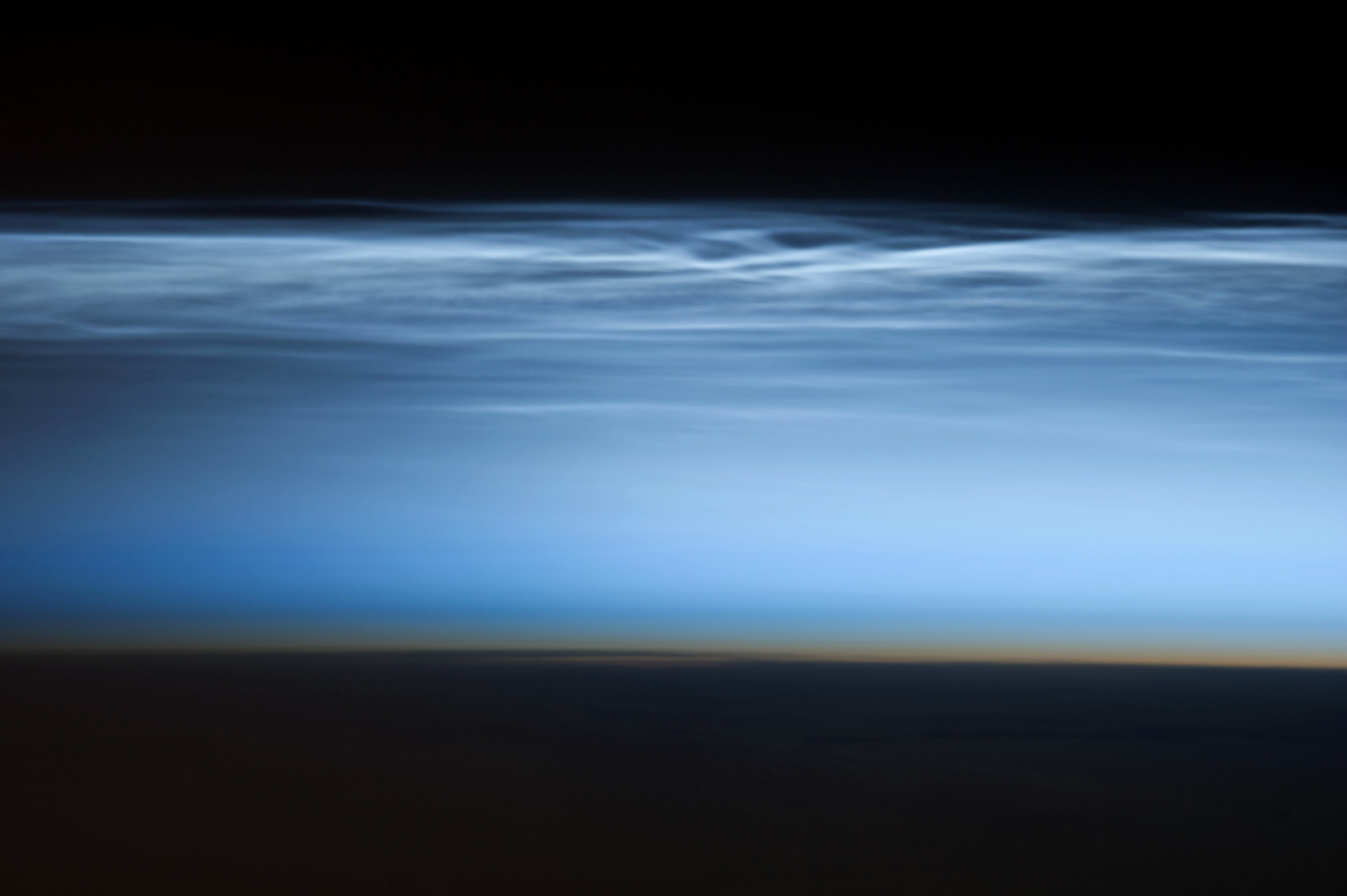
A luminous blue-white cloud above a dark landscape can create an immediate puzzle: if the Sun has set, what is lighting the sky? For noctilucent clouds, the answer involves height. The observer and the cloud do not necessarily enter Earth’s shadow at the same moment.
The World Meteorological Organization’s International Cloud Atlas places noctilucent clouds in the mesosphere, typically around 80–85 kilometres above the surface, near the mesopause. It also calls them polar mesospheric clouds and associates them with summer conditions. They occupy a very different atmospheric region from the clouds people usually watch passing overhead.
Sunlight above a darkened ground
NASA explains the illumination in its June 6, 2016 account of clouds photographed by astronaut Tim Peake. At those heights, ice clouds can remain sunlit while the ground below is dark. Their apparent glow therefore does not require the cloud to generate its own light. The published photograph was taken on May 29, 2016, rather than on the article’s publication date.
A separate NASA Earth Observatory image, acquired on January 5, 2013, shows the phenomenon from the International Space Station over the South Pacific. Its documentation identifies the camera and lens and explains that the published image was processed for presentation. Such details help readers understand both the physical scene and the version of the photograph they are viewing.
Check the setting before naming the phenomenon
For an unfamiliar luminous cloud, begin with location, date, viewing direction, and the Sun’s position. Those details can make a proposed explanation testable. A photograph that resembles a known cloud is a useful starting point, but resemblance alone does not establish the altitude or the composition of the material.
Preserve the wider sky and the horizon when possible. A close crop may remove evidence of twilight and make a diffuse cloud appear like a discrete object against blackness. A short sequence can also show whether the feature changes shape as a cloud would, although that observation should accompany the environmental checks rather than replace them.
Do not combine all unusual high clouds under one label. The WMO distinguishes noctilucent clouds from polar stratospheric clouds, including the colourful type often called nacreous or mother-of-pearl clouds. The latter occur lower in the atmosphere and under different seasonal conditions. A dramatic appearance is not enough to make those categories interchangeable.
The practical value for skywatchers is a better question: could this material still be receiving sunlight? Investigating illumination, season, and height is more productive than assuming that anything bright after sunset must be powered from within. Noctilucent clouds demonstrate how an ordinary light source can produce an extraordinary view when the geometry is unfamiliar.
Featured image: noctilucent clouds above the South Pacific, January 5, 2013. Credit: NASA/JSC, Expedition 34, ISS034-E-24622. NASA cropped the image, enhanced contrast, and removed lens artifacts. Image source.
Leave a Reply