A planet can already be present in a telescope’s observations and still remain invisible in the processed image. A new computational technique offers astronomers a better way to recover that faint signal by reconstructing, then subtracting, the glare of the planet’s star.
The method, called Physics-based Learning for Imaging Planets, or FLIP, was described in a Nature paper published November 4. Tests using the James Webb Space Telescope’s Near-Infrared Camera produced sensitivity improvements ranging from two to 15 times compared with standard processing methods.
Modeling the telescope’s imperfections
According to Caltech’s account of the research, the team built a digital model of NIRCam and adjusted its physical parameters to reproduce the unwanted starlight. Small optical imperfections and changes in an instrument affect the pattern that reaches its detector. Modeling those effects more accurately makes it possible to remove more of the glare without simply treating every bright feature as a planet.
The researchers recovered the known giant planet 51 Eridani b in Webb observations where the previous analysis had not detected it. That distinction matters: the result is a new detection within a particular dataset, not the discovery of a previously unknown planet.
Lead author Rodrigo Ferrer-Chavez and colleagues are exploring how the approach could be extended beyond Webb. The immediate opportunity is to make better use of observations already collected, including archival images in which planets may have escaped detection.
Why the glare is so difficult
Nature Portfolio’s November 5 summary notes that even bright young giant planets can be roughly 100,000 times fainter than their stars. Removing the star’s light therefore requires much more than making the whole image darker.
Webb already uses hardware to help with this problem. Its NIRCam and MIRI instruments contain coronagraphs that block starlight, as explained in ESA/Webb’s background on direct planetary imaging. Image processing then deals with light that remains. FLIP addresses that latter stage by making the simulated stellar pattern more faithful to the observation.
A useful advance, with further tests ahead
The reported improvement varies across the tests; it should not be read as a guaranteed fifteenfold gain for every Webb image. Nature’s summary identifies computational cost and testing on larger collections of observations as priorities for further work.
Colder, older, or lower-mass giant planets could be among the beneficiaries. Applying related methods to future observatories might eventually support the imaging of Earth-like worlds. For now, the demonstrated achievement is more specific and still valuable: recovering planetary light that existing observations contained but conventional analysis could not reliably reveal.
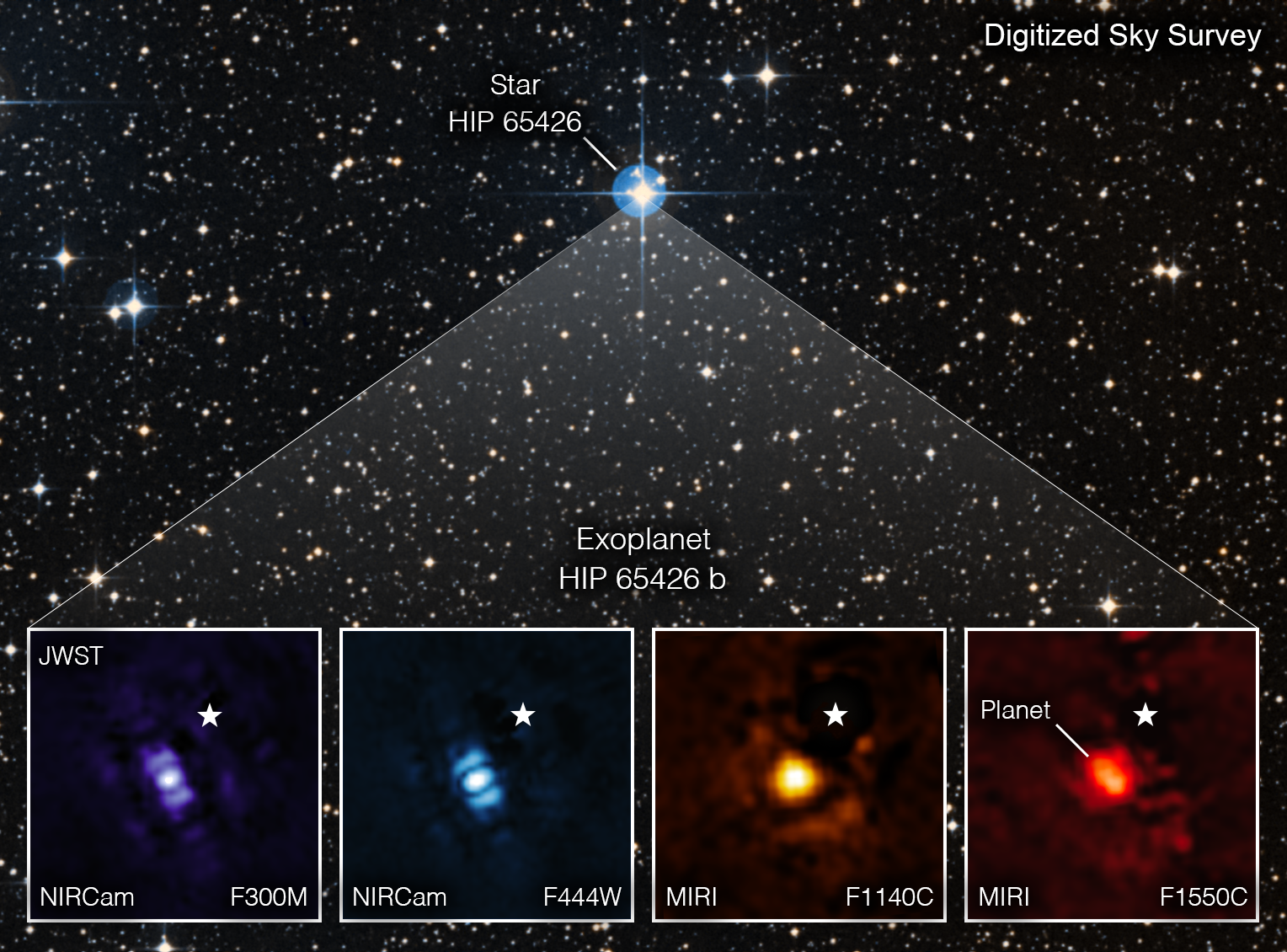
Featured image: Webb’s 2022 observations of HIP 65426 b, shown in different infrared filters. Archival context, not the new FLIP result for 51 Eridani b. Credit: NASA/ESA/CSA, A Carter (UCSC), the ERS 1386 team, and A. Pagan (STScI). CC BY 4.0.
Leave a Reply