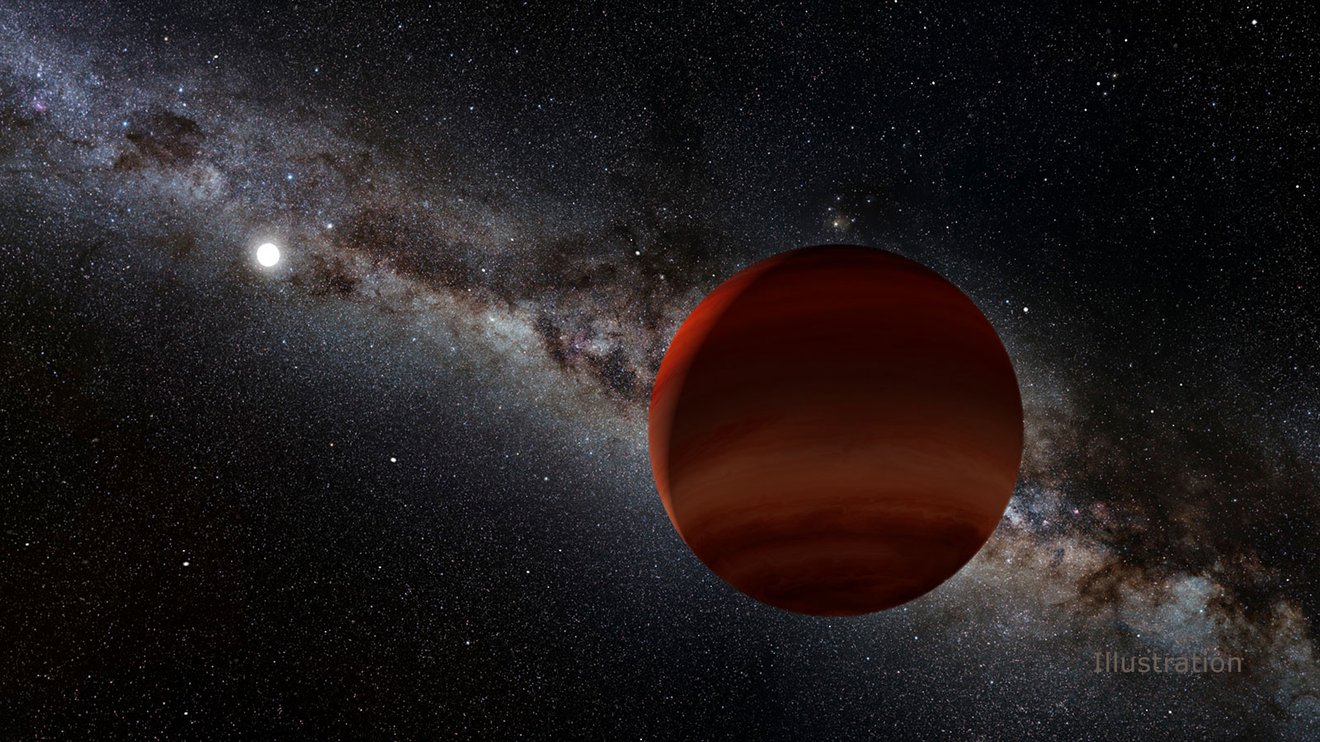
Featured image: Artist’s illustration of a white dwarf–brown dwarf pair, used for context; it does not depict the J0404+1112 system studied here. Credit: NOIRLab/NSF/AURA/P. Marenfeld; acknowledgement: William Pendrill. CC BY 4.0.
A brown dwarf circling the white dwarf J0404+1112 every 2.93 hours offers astronomers an unusually clear view of an atmosphere under intense irradiation. An October 16 AAS Nova highlight describes follow-up work that revises the system’s physical properties after its initial discovery in 2025.
The white dwarf is now estimated to contain about 60 percent of the Sun’s mass, with a temperature near 28,000 kelvin. Its companion weighs roughly 40 Jupiters, rather than the approximately 25-Jupiter estimate from the preliminary analysis. Additional observations from the Gran Telescopio Canarias and United Kingdom Infra-Red Telescope helped resolve ambiguities in the earlier interpretation.
The nearly edge-on orbit provides the crucial advantage. The brown dwarf completely covers the much smaller white dwarf during an eclipse, temporarily removing the brighter object’s light. That allows the companion’s nightside emission to be isolated, giving an estimated temperature around 1,750 kelvin. Its irradiated face should be substantially hotter, but that prediction still needs better observational constraints.
An eclipse as an atmospheric experiment
The research paper by Julien de Wit and colleagues, published in The Astrophysical Journal Letters, combines spectra, rapid brightness measurements and Gaia distance information. The revised dimensions put the white dwarf’s radius at about 0.015 times the Sun’s, while the brown dwarf is approximately 0.9 times Jupiter’s radius.
These proportions explain why an object far less massive than the star can nevertheless hide it entirely. They also make the system a promising target for measurements throughout an orbit, potentially tracking how energy moves between the brown dwarf’s illuminated and darker hemispheres.
The comparison with ultra-hot giant exoplanets is useful but imperfect. A hot white dwarf supplies a different radiation spectrum, including a stronger ultraviolet component, than a normal star heating a close-orbiting planet. Studying both environments could help separate the effects of heat from the effects of high-energy light on atmospheric chemistry.
This is a refined portrait of a known binary, not a newly discovered planet. Its value lies in the unusually clean experiment its geometry makes possible.
Reporting checked October 20, 2026 (UTC). Catch-up coverage of the October 16 research highlight.
Leave a Reply