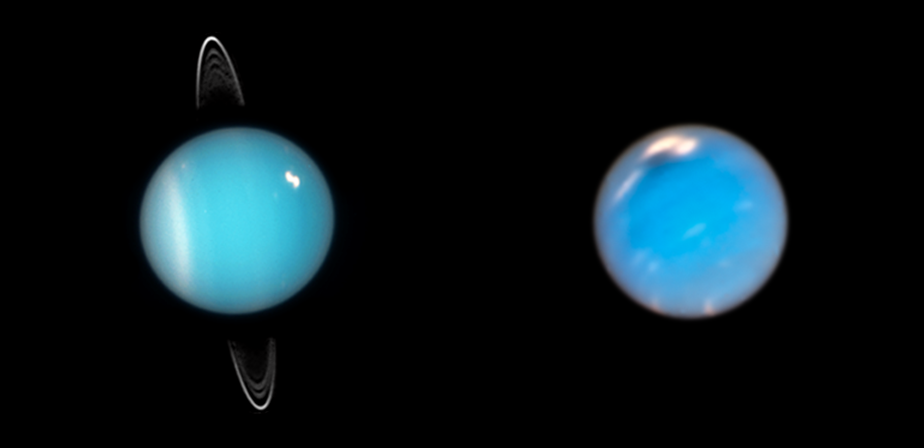
Featured image: Archival, color-composite Hubble views of Uranus (left, 2005) and Neptune (right, 2018), shown for context rather than as images of their formation. Credit: NASA, ESA, Mark Showalter (SETI Institute), Amy Simon (NASA-GSFC), Michael Wong (UC Berkeley), Andrew Hsu (UC Berkeley). Image source and details.
Uranus and Neptune look like close relatives, but their chemical histories may be less alike than their sizes suggest. In an October 19 announcement, Southwest Research Institute highlighted research indicating that Neptune’s deep atmosphere is considerably more oxygen-rich than Uranus’s.
The study, published in the September issue of Astronomy & Astrophysics, does not directly sample either planet’s deep interior. Instead, it combines atmospheric chemistry models with observations of carbon monoxide, including ALMA measurements, to infer conditions beneath the visible clouds.
Researchers then compare the inferred carbon-to-oxygen ratios with models of the disk from which the Solar System formed. Different compounds condensed into solids in different regions of that disk, creating chemically distinct reservoirs. One interpretation is that some of Neptune’s building materials originated closer to the young Sun and traveled outward before being incorporated into the planet.
The atmosphere is a clue, not a core sample
The paper led by Tom Briand examines variations with latitude as well as uncertainty in chemical reactions. Its largest sensitivity comes from vertical mixing: how efficiently material is transported through the atmosphere changes the deep oxygen abundance needed to reproduce the carbon monoxide measurements.
When that mixing is varied, the modeled oxygen-to-hydrogen enrichment spans roughly 62–177 times the protosolar value for Uranus and 222–342 times for Neptune. Those numbers describe inferred elemental ratios relative to the early Sun’s composition, not the percentage of either planet made of oxygen.
The ranges support a chemical contrast within the tested models, while also showing why a single abundance estimate would conceal important uncertainty. Different formation or evolutionary histories remain interpretations to investigate, not a uniquely established reconstruction of where each planet grew.
The broader lesson is that resemblance in size need not imply identical ingredients. Until deeper measurements are available, chemistry offers an indirect route into these distant worlds, but the route depends on understanding both the reactions and the circulation that carry their signatures upward.
Reporting checked October 20, 2026 (UTC). Catch-up coverage of the October 19 announcement.
Leave a Reply