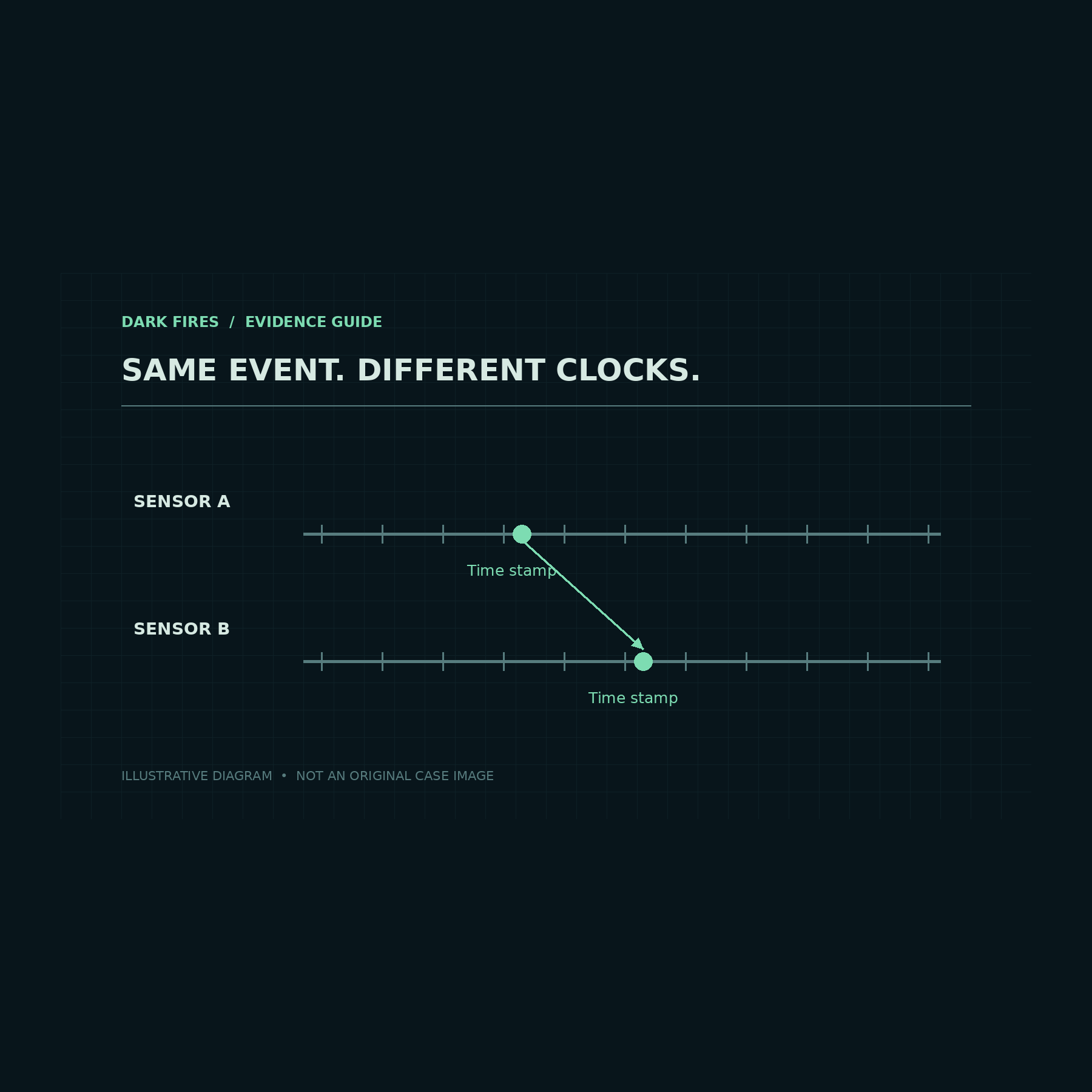
Two instruments recording something unusual can provide stronger evidence than one. First, however, investigators must establish that their records concern the same event at the same time. A timestamp that looks precise on screen does not, by itself, establish that two sensors were synchronized.
Three times can hide inside one record
There is the time light reached a camera, the time its software attached a timestamp, and the time a receiving computer saved the data. Delays between those stages matter when comparing a moving target across instruments. A NIST-hosted presentation on data quality and synchronization recommends timestamps that reflect when measurements were taken, with transmission and application delays identified and accounted for.
Applied to UAP analysis, the practical question is therefore specific: what physical or software event does this timestamp label? An upload time, file-modification time or edited video counter is not interchangeable with a documented exposure time. More decimal places cannot repair an unknown delay.
Matching clocks does not always match exposures
Camera researchers have demonstrated this distinction directly. In Wireless Software Synchronization of Multiple Distributed Cameras, first submitted in December 2018 and revised in June 2019, Sameer Ansari and colleagues describe a two-stage method. They synchronize device clocks, then align the timing of the image streams. Their smartphone-camera implementation achieved synchronization accuracy below 250 microseconds in their tests.
That result is evidence for a tested engineering method, not a specification that can be assigned to unrelated UAP recordings. Its broader lesson is that a shared clock and simultaneous image capture are separate properties. An investigation needs evidence for whichever property its calculations require.
A small timing error can become a spatial error
Consider an illustrative target moving at a known, constant 100 meters per second. If two records are offset by one tenth of a second, they describe positions 10 meters apart. That follows simply from speed multiplied by elapsed time. It is not an estimate for any reported UAP.
The example explains why an apparent mismatch between sensors might not indicate two objects, and why a visually neat match might be misleading if someone shifted clips until they agreed. Timing corrections should be derived from independent information or a documented method, then reported. Selecting the shift that makes a preferred explanation look best reverses that order.
The 2017 Cyber-Physical Systems Timing Annex, published by NIST for its public working group, treats clock error, synchronization and latency as distinct engineering concerns. For a UAP observing network, that suggests keeping synchronization logs and uncertainty estimates alongside the images rather than treating timing as administrative metadata.
A defensible comparison should say how the clocks were checked, what each timestamp represents, whether dropped frames or processing delays were investigated, and how large the remaining offset could be. Independent sensors become most valuable when those uncertainties are explicit. Without that work, “recorded by two systems” may be a promising lead rather than a completed correlation.
Featured image: Generated illustration. Original Dark Fires explanatory diagram, not sighting imagery.
Leave a Reply