NASA’s twin TRACERS satellites have delivered an early answer to a deceptively difficult question: when the magnetic connection between the Sun and Earth changes, is the spacecraft crossing a spatial pattern, or observing a process change with time? The initial results favor spatial variability, while also finding temporal changes within many events.
NASA highlighted the findings on October 29, 2026. The distinction matters because one spacecraft alone can have trouble separating movement through an environment from changes in that environment. A second satellite following behind supplies a comparison rather than just another isolated measurement. NASA’s results announcement describes the work as an initial step, not a completed account of space weather.
A natural particle funnel
TRACERS launched on July 23, 2025, to investigate magnetic reconnection: the rearrangement of magnetic fields that transfers energy and accelerates charged particles. Earth’s magnetic environment does not form an impenetrable shell. Near the poles, funnel-shaped regions called cusps allow researchers to sample particles connected to processes occurring much farther away at the magnetopause.
The mission uses two spacecraft in low Earth orbit to examine these particle signatures in succession. Its observations complement NASA’s Magnetospheric Multiscale mission, which studies reconnection farther out in space. These are different vantage points on a connected system, rather than competing pictures of the same location. NASA’s mission overview explains how the paired measurements help distinguish evolving structures from repeated encounters with similar ones.
What the first sample says
The research paper analyzes 207 tandem cusp encounters collected from November 2025 through February 2026. Encounters classified as spatially dominated outnumbered temporally dominated encounters by at least two to one across the solar-wind categories examined. However, nearly all encounters assigned to the spatial category also contained some temporal variability.
That qualification prevents a misleading either-or reading. “Spatially dominated” does not mean completely unchanging: similar structures can persist at similar locations while some features appear or disappear between passes. The value of the paired satellites is their ability to constrain which contribution is larger in the sampled encounters.
Why more passes matter
The researchers emphasize that the available sample is smaller than originally planned. Operational constraints reduced the number of usable tandem encounters, and additional measurements are needed to establish how robust the early pattern remains. The result therefore should not be presented as a universal rule for every reconnection event.
NASA reports that the spacecraft now routinely observe the southern cusp and that a September mission extension supports observations into spring 2027. More data will test whether the first pattern persists across a broader range of conditions. For now, the achievement is methodological as well as physical: two moving observers are beginning to disentangle where a magnetic process happens from how rapidly it changes.
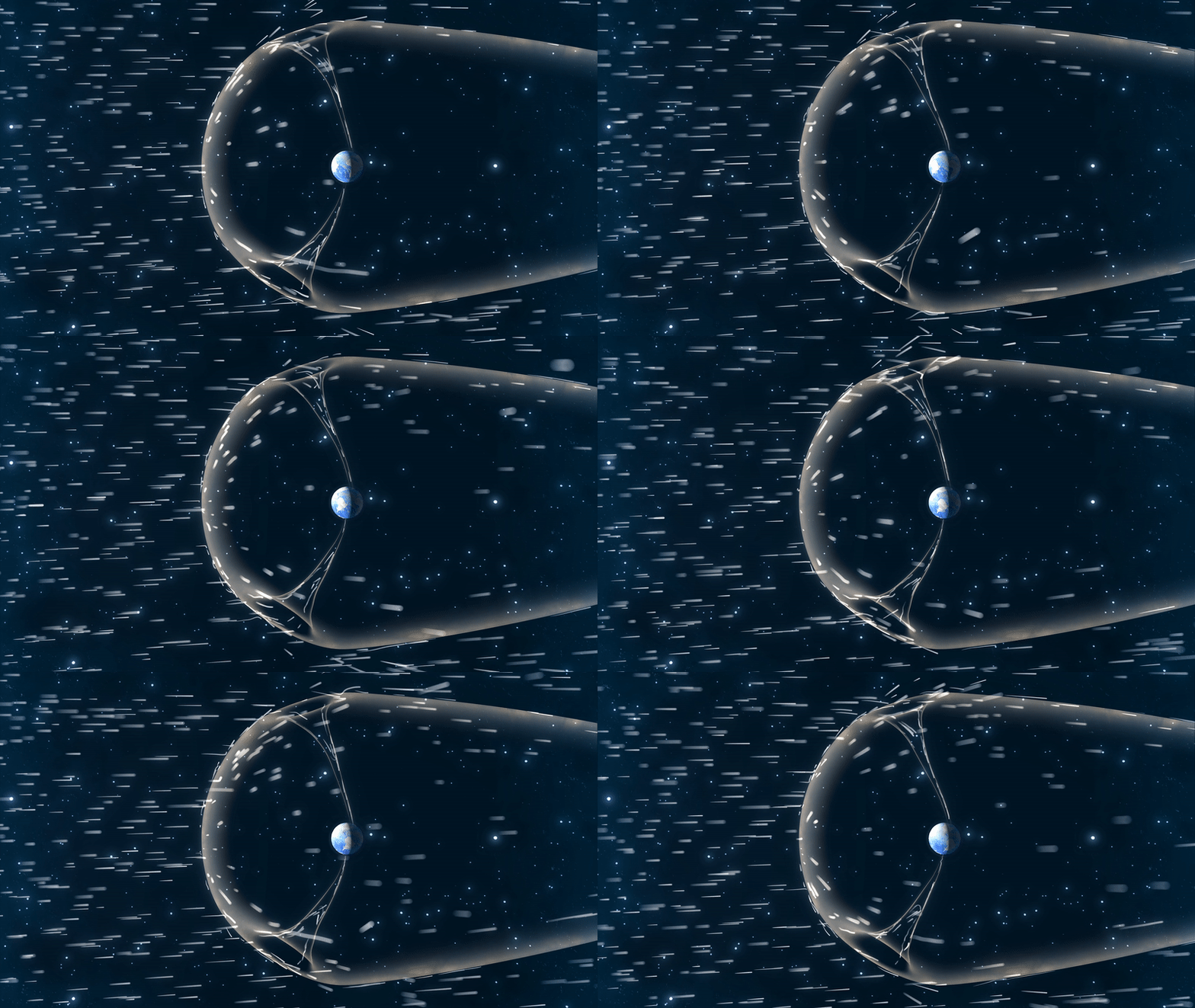
Featured image: Illustration of solar wind interacting with Earth’s magnetic environment; not a photograph of visible magnetic field lines. Credit: NASA/CILab/Josh Masters.

Leave a Reply