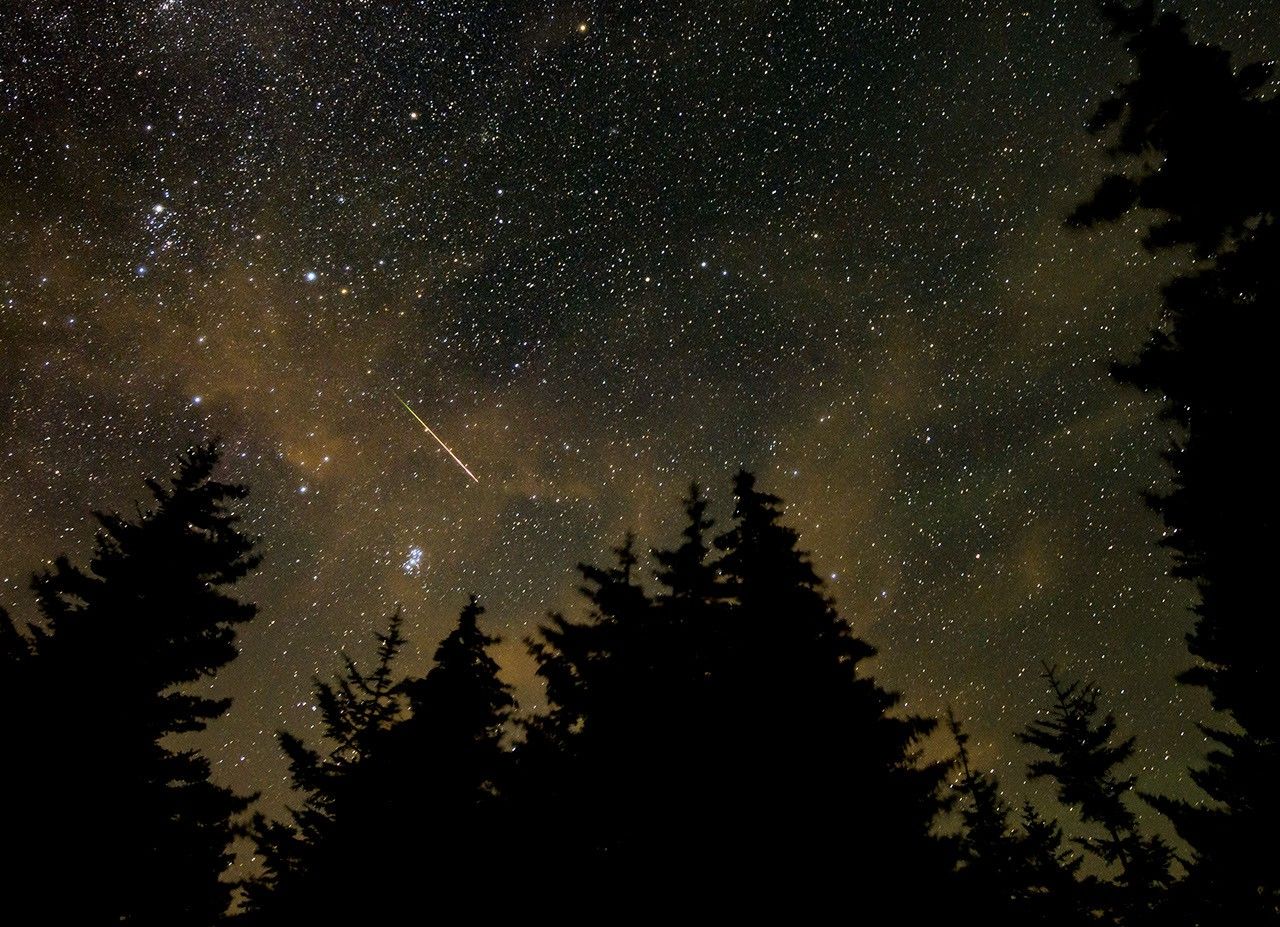
Context photograph: a Perseid meteor over West Virginia in August 2021, photographed by NASA’s Bill Ingalls. This is not the November 5, 2026 Tennessee event.
A bright meteor reported over southern Tennessee on November 5, 2026, was recorded by four NASA all-sky cameras. The agency’s analysis identifies a small asteroid fragment and explicitly rules out membership in the active Taurid meteor shower.
NASA’s event record places the observation at 7:45 p.m. Eastern Standard Time, or 6:45 p.m. Central. Its precise timestamp is November 6 at 00:45:21 UTC. The different calendar dates describe the same event, an important detail when matching recordings and witness accounts.
A measured path above two states
The object first appeared above Robbinsville, North Carolina, moving slightly south of west. NASA says it disintegrated above East Ridge, Tennessee, southeast of Chattanooga. The event table gives a camera-observed altitude range of 86.3 to 40.5 kilometers, and a speed of 21.2 kilometers per second, approximately 47,500 miles per hour.
The agency estimates the incoming fragment was about two inches across and weighed six ounces. These are estimates of the small body responsible for the luminous event, not measurements of a recovered rock. The record does not announce a meteorite recovery.
Why the shower label matters
A meteor appearing during a shower’s active period does not automatically belong to that shower. Here the classification comes from NASA’s event analysis, which directly states that this fireball was not a Taurid. Calendar proximity should not replace that finding in descriptions of the footage.
NASA’s background explanation of fireballs describes how atmospheric entry converts part of a meteoroid’s kinetic energy into visible light. A striking flash therefore does not require an object comparable in size to the bright area seen in a camera frame. The light records an energetic interaction with the atmosphere.
This case also illustrates the difference between a widely shared clip and a documented event. A useful comparison begins with time, observing location and viewing direction, then asks whether a recording matches the measured passage. A dramatic appearance alone cannot establish that two videos show the same object.
The photograph accompanying this article is an older NASA image of a Perseid meteor in West Virginia, used only for context. It is not a photograph of the Tennessee fireball and should not be circulated as evidence of this event.
Featured image: NASA/Bill Ingalls. Perseid meteor photographed in West Virginia on August 11, 2021; contextual photograph, NOT the November 5, 2026 Tennessee fireball. Public domain. Image source.
Leave a Reply