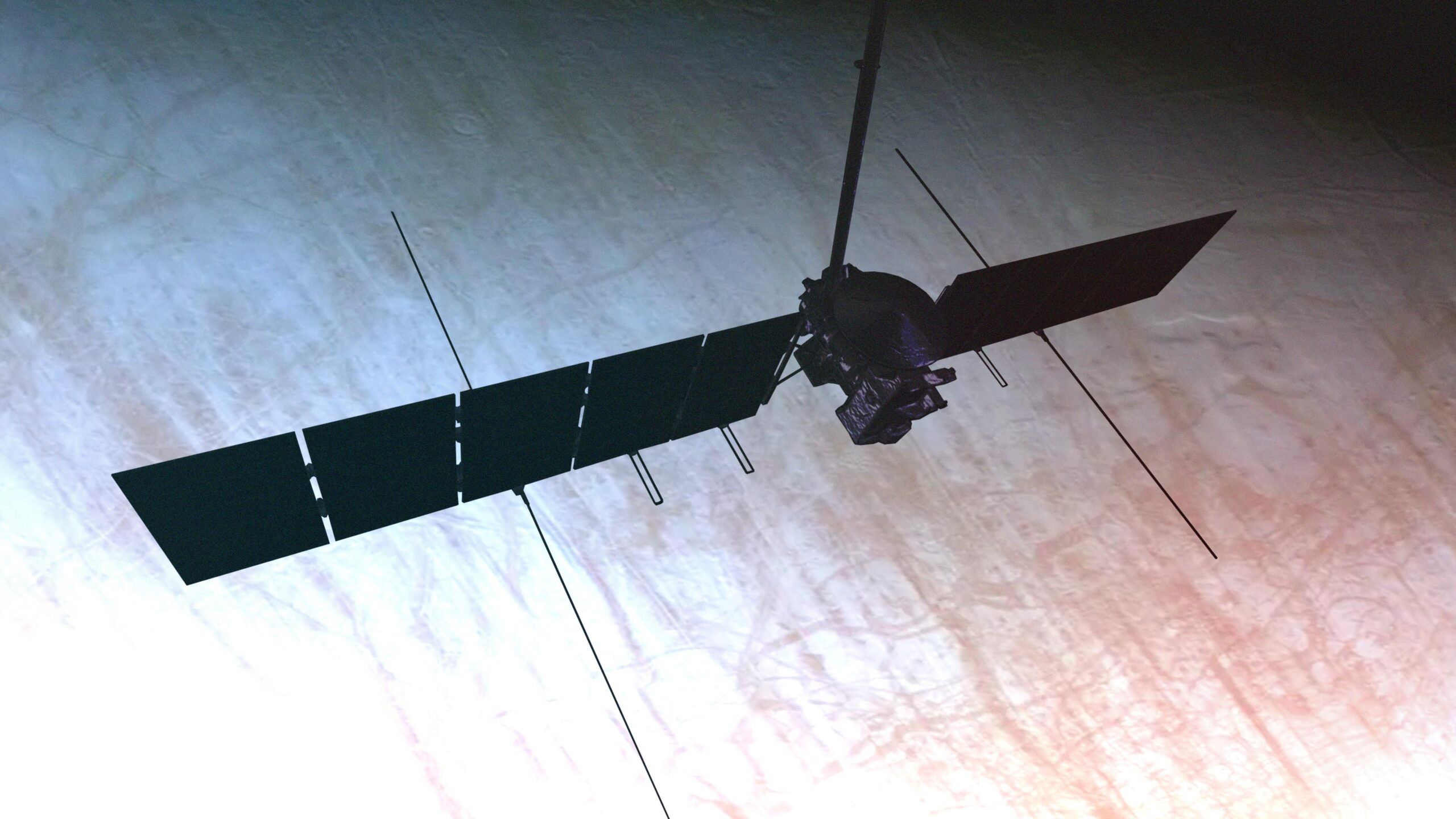
Artist’s concept of Europa Clipper passing above Europa’s icy surface. Illustration: NASA/JPL-Caltech. Image source.
A spacecraft headed for Jupiter has one more appointment close to home. In December 2026, Europa Clipper is due to swing past Earth, more than two years after its launch. The encounter will give it the extra energy needed for the long outward journey to the Jupiter system.
That return is part of the route planned from the beginning. Europa Clipper launched on October 14, 2024, and passed Mars on March 1, 2025. Earth is the second stop in a carefully timed sequence of planetary flybys. The destination remains Jupiter, with arrival planned for April 2030 on NASA’s mission timeline.
Why take the long way around?
Launching a spacecraft into deep space means giving it enough energy to climb outward through the Sun’s gravitational field. More propellant adds mass, and carrying that extra mass creates further demands on the launch and propulsion systems. A useful planetary encounter can do some of the work.
Clipper’s Mars flyby reshaped its orbit around the Sun and set up the coming Earth encounter. In fact, the spacecraft left Mars travelling more slowly relative to the Sun than it had approached. That makes the mission a good example of something the familiar “slingshot” description can hide: a gravity assist can reduce speed as well as increase it. What matters is the orbit the spacecraft needs next. NASA’s account of the Mars manoeuvre explains how the two encounters work together.
Borrowing a little momentum
Earth is moving around the Sun while Clipper approaches. During the flyby, Earth’s gravity bends the spacecraft’s path. With the right approach direction, that turn increases the spacecraft’s speed relative to the Sun and sends it onto a more energetic orbit.
The energy comes from a tiny exchange with the planet’s orbital motion. Earth’s change is negligible; for a spacecraft, the gain can be substantial. The geometry and timing have to be right, which is why mission planners design these encounters years ahead. NASA’s gravity-assist primer describes the same principle behind earlier journeys by Voyager, Galileo and Cassini.
The work waiting at Jupiter
Reaching Jupiter is another major navigation challenge. Clipper is expected to brake into orbit with an engine burn lasting roughly six hours. Its first close encounter with Europa is planned for spring 2031, after further adjustments to its orbit.
The spacecraft will orbit Jupiter and make 49 close flybys of Europa. Its nine science instruments will examine the moon from complementary angles, gathering information about the ice, surface materials and surrounding environment.
Scientists have strong evidence that a saltwater ocean lies beneath Europa’s frozen exterior. Clipper’s science programme will investigate the thickness of the ice shell, the ocean’s properties and the ways material might move between them. Radar, cameras and measurements of magnetic fields can help turn that hidden world into something scientists can test and compare.
The central question is whether Europa has conditions that could support life. Finding a potentially habitable environment would be important in its own right, but would not establish that anything lives there. The December flyby is one practical step toward answering that much larger question.
Leave a Reply