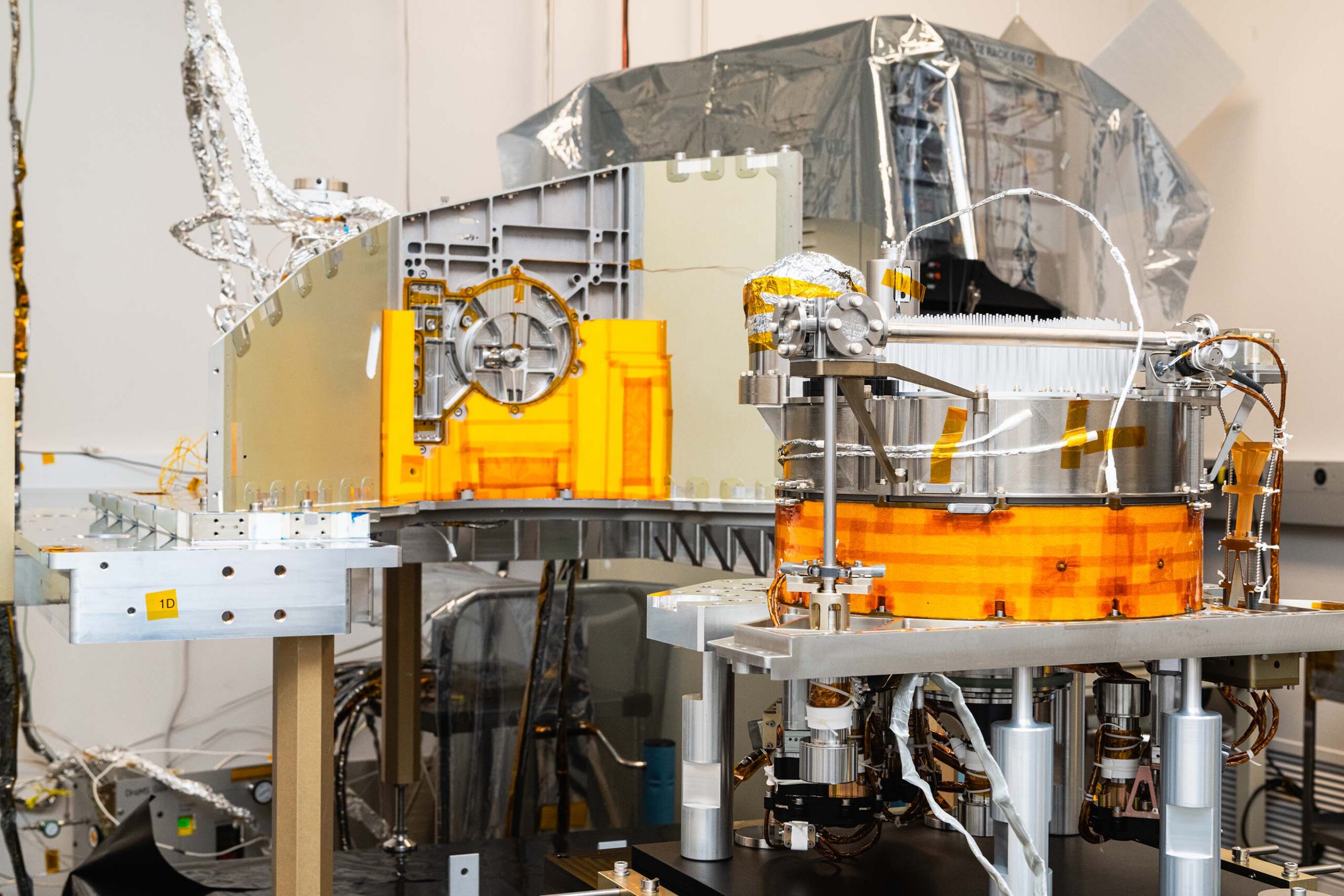
Dragonfly’s mass spectrometer, left, and sample-delivery carousel, right, before integration at NASA’s Goddard Space Flight Center in March 2026. Photo: NASA/Mike Guinto. Image source.
On Saturn’s largest moon, the atmosphere that hides the landscape also offers a way to explore it. NASA’s Dragonfly mission will use eight rotors to travel between scientific targets on Titan, carrying its laboratory from one landing site to the next.
The mission is still being built. As of October 2026, NASA’s published schedule calls for launch no earlier than July 2028 and arrival in late 2034. The planned surface mission lasts about 3.3 years, giving Dragonfly time to investigate several kinds of terrain and compare their chemistry.
Why flying makes sense on Titan
Titan combines a dense atmosphere with weak gravity. Those conditions help a rotorcraft generate lift and make flight a practical way to cross terrain that could be difficult for wheels. Sand and rough ground still matter when choosing a landing site, but they do not have to block the entire route.
Dragonfly will fly autonomously between locations. Its mobility is central to the science: a single patch of ground can tell only part of a moon’s story. Visiting different sites lets researchers compare what formed in different settings. The Johns Hopkins Applied Physics Laboratory’s mission overview describes a vehicle equipped to photograph its surroundings, examine surface material and measure local conditions.
The pace will be deliberate. NASA expects a flight roughly every one or two Titan days, with each of those days lasting about 16 Earth days. There will be substantial time on the ground between journeys.
A laboratory that can change its address
Drills will collect surface material for the onboard Dragonfly Mass Spectrometer, known as DraMS. This instrument is designed to identify chemical compounds in the samples. Other instruments will investigate elemental composition, weather and possible seismic activity, while cameras provide both broad landscape views and close-up detail.
The hardware is already taking shape on Earth. In March 2026, the mission’s sample-delivery carousel was integrated with DraMS at NASA’s Goddard Space Flight Center. Photographs of that work show the machinery that will move samples into the instrument for analysis.
Power is another reason the spacecraft needs a specialised design. Sunlight at Titan is limited, so Dragonfly will carry a radioisotope thermoelectric generator and a battery. Its spacecraft design also includes a heat shield and parachutes for arrival. After descending through the atmosphere, the rotorcraft is intended to separate from its protective shell and fly down to the surface.
Looking at chemistry before biology
Titan is particularly interesting because of its abundant carbon-containing chemistry. “Organic” molecules can form without life, and finding them is only the beginning of the investigation. Dragonfly will examine how far that chemistry has developed and what the results reveal about potentially habitable environments.
One important destination is Selk Crater. The impact that created it may have allowed liquid water and organic material to mix, leaving a frozen record of reactions worth studying. NASA’s science plan identifies the crater as a place to investigate processes that could help explain the chemical steps preceding life.
Those questions give Dragonfly a clear purpose without promising a discovery of living organisms. Its contribution will come from detailed measurements, comparisons between sites and the ability to follow interesting terrain beyond a single landing spot. On Titan, the next useful sample may be a flight away.
Leave a Reply