Argonne National Laboratory has completed two cosmological simulations containing 13.4 trillion dark-matter particles apiece. Announced on October 19, 2026, the Aurora supercomputer runs follow structure across regions 28.6 billion light-years wide, providing test data for surveys including DESI and NASA’s SPHEREx.
These gravity-only calculations omit gas and star-formation physics. Their particles represent the underlying dark-matter distribution rather than individual, experimentally detected dark-matter particles.
The pair shares the same cosmology and an imposed primordial signal, but reverses the starting phases. Combining the runs reduces random variation. Researchers testing analysis methods will not know the injected signal’s strength in advance, allowing a blinded check of whether their pipelines recover it. This is a test environment, not a detection of new physics.
Why build such an enormous rehearsal? The SPHEREx science team explains that inflation, the proposed burst of expansion near the universe’s beginning, should leave statistical traces in the later distribution of matter. Different physical mechanisms can produce different patterns. One target is primordial non-Gaussianity: departures from a simple bell-curve description of the original fluctuations. Measuring those departures could help distinguish models involving one driving field from models involving several.
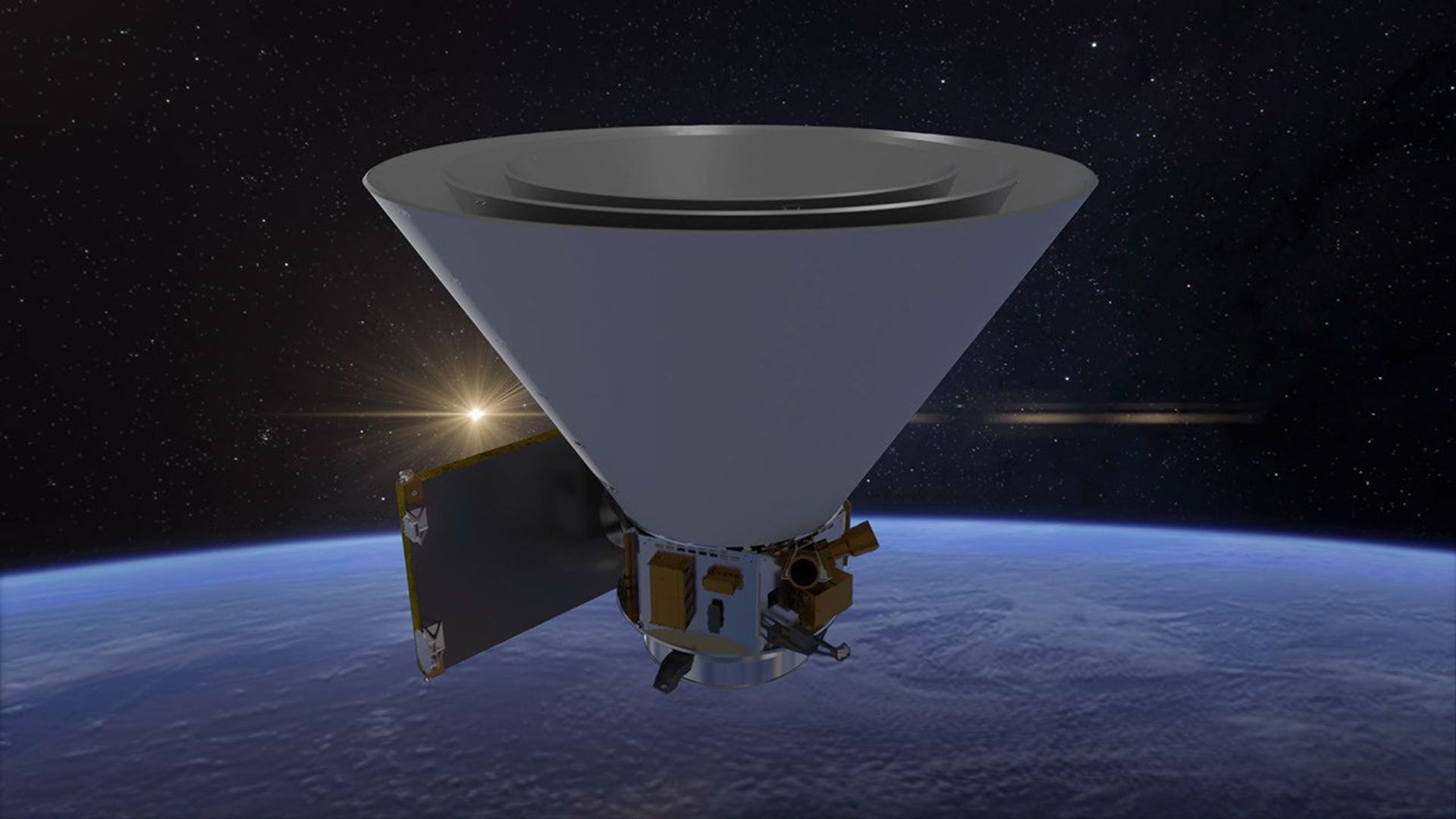
SPHEREx approaches that problem by measuring galaxy spectra and estimating redshifts, allowing their positions to be mapped in three dimensions. NASA’s mission overview describes a planned two-year survey of more than 450 million galaxies. The experiment links a vast present-day observational catalogue to questions about the universe’s earliest fractions of a second.
DESI takes a complementary ground-based approach, obtaining optical spectra on the Mayall telescope at Kitt Peak. Its original five-year survey finished in April 2026 after observing more than 47 million galaxies and quasars; observations are continuing to expand the map.
Synthetic skies expose biases by letting researchers compare recovered answers with constructed inputs. Precision alone is not enough; the analysis must be trustworthy.
Image: Artist’s concept of NASA’s SPHEREx observatory, one of the surveys the new simulations are intended to support. This is mission artwork, not an output of the Aurora simulations. Credit: NASA/JPL-Caltech. Image source. Usage policy.
Leave a Reply