Powerful stellar explosions may not always clear a path for the radiation that transformed the young universe. A study highlighted by the University of Michigan on October 21, 2026 instead suggests that some supernova-driven galactic winds can make it harder for ionizing light to escape its birthplace.
The wider question concerns reionization, when energetic radiation stripped electrons from hydrogen spread through the universe. Young galaxies are important candidates for supplying that radiation. But producing photons is only part of the problem: they must also get through the gas and dust surrounding the stars. The university’s account explains that supernova explosions have often been invoked as a way to open those escape routes.
The paper, published in Nature Astronomy on October 15, examined six otherwise similar local star-forming galaxies spanning different stages of a starburst. Hubble ultraviolet spectra allowed the team to compare escaping Lyman-continuum radiation, which can ionize hydrogen, with the properties of outflowing gas.
Escape was strongest in the youngest systems, less than about three million years into the burst. These showed intense radiation and stellar winds, but not fast galactic-scale outflows. Older systems had faster galactic winds alongside stronger absorption and more dust. The authors argue that launching winds and loading them with material after supernovae begin can suppress photon escape during roughly the first ten million years.
This is spectroscopy rather than a photograph of a cleared channel. NASA’s Cosmic Origins Spectrograph guide explains that the instrument separates ultraviolet light into its component wavelengths. Those spectra can reveal material’s composition, density and motion. Installed on Hubble in 2009, COS was designed to study faint ultraviolet sources that would otherwise be difficult to investigate.
The sample is small, and nearby starbursts are proxies, not direct observations of reionization-era galaxies. The result does not establish that every supernova wind blocks radiation. It challenges a simple assumption about when escape should be easiest.
Michigan’s researchers instead point toward feedback from very young stars as a promising mechanism to test further. If that timing holds in larger samples, models will need to capture what happens before the first explosions, not merely what the explosions sweep away.
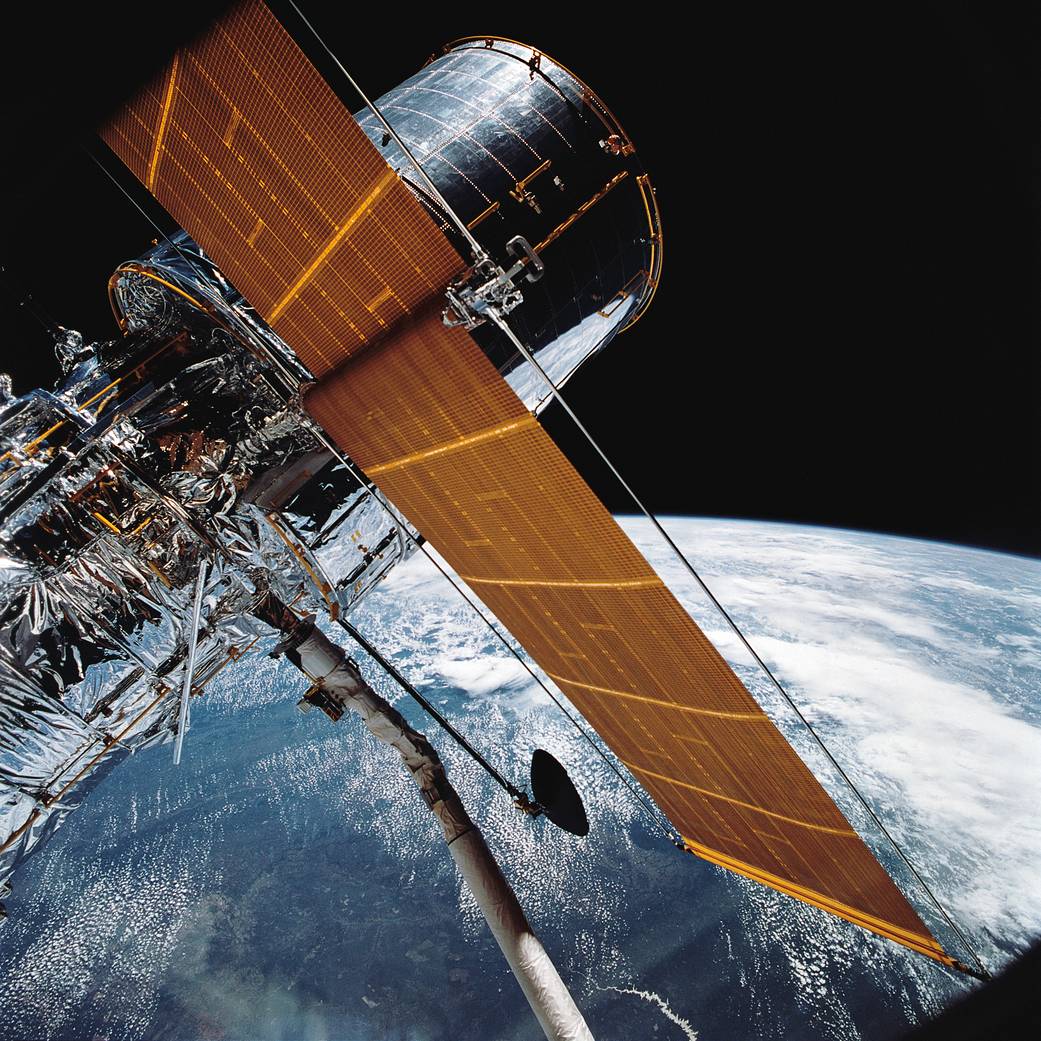
Image: Hubble during deployment from Discovery on April 25, 1990. This archival photograph shows the observatory, not the galaxies in the new study. Credit: NASA. Image source. Usage policy.
Leave a Reply