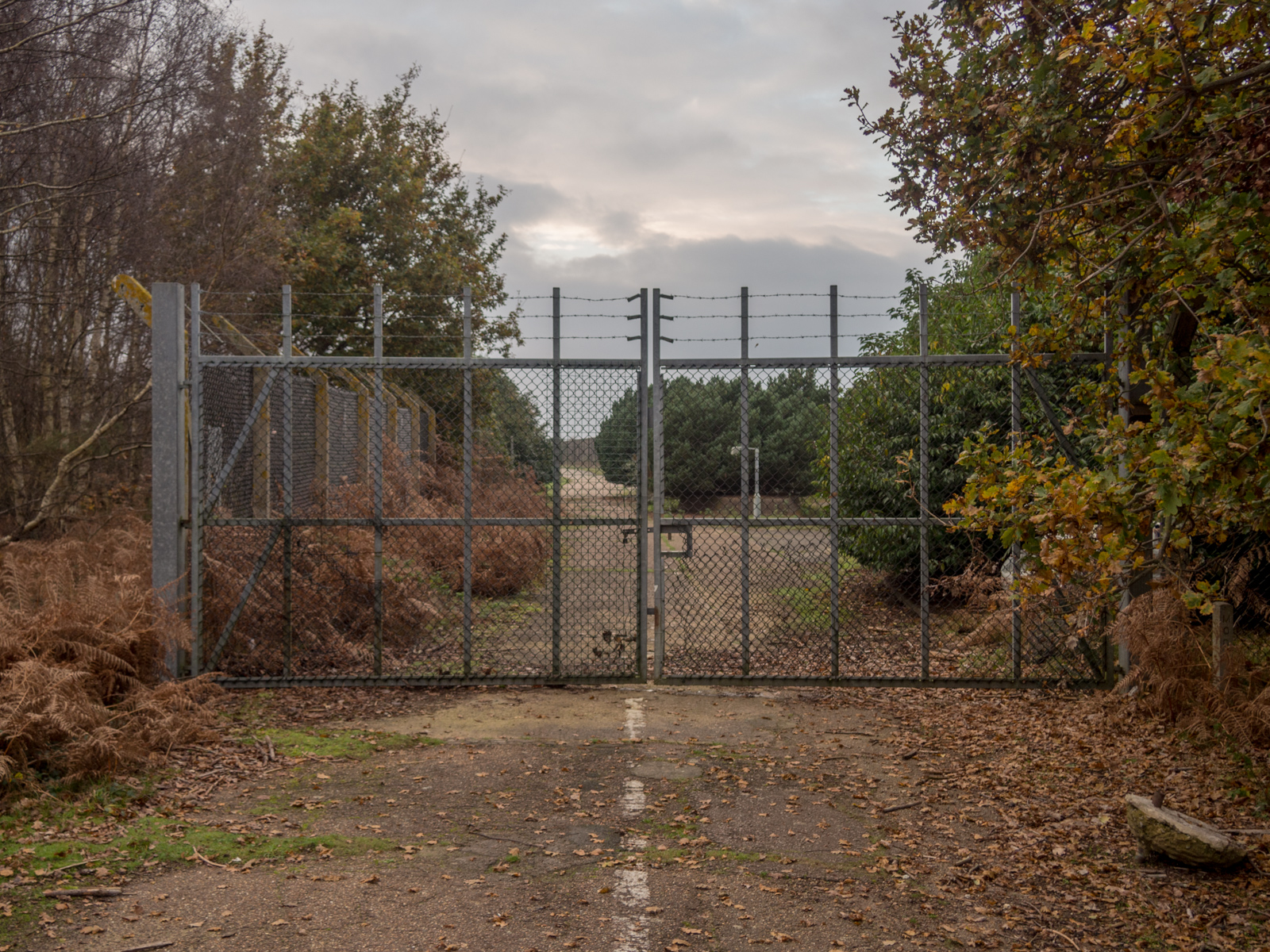
RAF Woodbridge’s East Gate, November 2014. A later view of the location, not a photograph of the 1980 sightings. Photo: Taras Young / Wikimedia Commons, CC BY-SA 4.0. Resized for display; thumbnail previews may be cropped.

Lieutenant Colonel Charles I. Halt’s January 1981 memo runs to a single page. Under the subject “Unexplained Lights,” it records strange events reported near RAF Woodbridge in Suffolk.
That short memo is a useful starting point for the Rendlesham Forest case. It preserves a dated military account against which later versions of the story can be compared. It also contains an important distinction that is easily lost when the whole incident is retold as one continuous encounter.
Whose observation was it?
The first paragraph of the memo, dated 13 January 1981, relates what security personnel reported. Lights outside the base prompted concern about a downed aircraft. Three patrolmen investigated, reporting a glowing, apparently metallic triangular object with coloured lights that moved through the trees and disappeared.
The remaining paragraphs describe ground depressions, radiation readings and later lights seen through the trees and in the sky. At the end, Halt explicitly says that he and other people witnessed the activities described in paragraphs two and three. His signature therefore does not make him an eyewitness to every detail of the patrolmen’s earlier encounter.
A report with limits
The distinction matters when weighing the document. A description of an object’s appearance, a measurement written into a memo and an independently established explanation are different kinds of evidence. The memo gives reported radiation figures but does not supply a full measurement protocol or a laboratory analysis tying them to an unusual source. Its account of depressions likewise leaves their cause unestablished.
There is more to the contemporary record than the letter alone. The National Archives’ UFO research guide describes Halt taking a team into the forest after further lights were reported and making a live audio recording during the investigation. For research purposes, that recording and the later written summary deserve to be considered separately, with attention to when each was made and what each can actually establish.
What the Ministry of Defence decided
The British government’s response focused on defence significance. In a 1996 parliamentary answer, defence minister Nicholas Soames said the report had been assessed by staff responsible for air defence. Their judgement that it contained nothing of defence significance led to no further action.
In January 2001, the Ministry reiterated that position, saying no additional information had emerged to overturn the original assessment. This tells us how officials handled the report. It does not provide a detailed physical explanation for each observation in Halt’s account.
Following the paper trail
The National Archives identifies the memo and follow-up inquiries in file DEFE 24/1512. A later dedicated file, DEFE 24/1948/1, opened to the public in August 2009, contains the memo alongside parliamentary briefing material and years of correspondence. Those later papers trace the dispute’s long afterlife as much as the events in the forest.
Rendlesham rewards a patient approach. Begin with the dated records, keep witnesses’ individual claims separate, and ask what would be needed to test each explanation. The memo gives us a firm place to begin that work. The identity of the reported lights requires a different standard of proof.
Leave a Reply