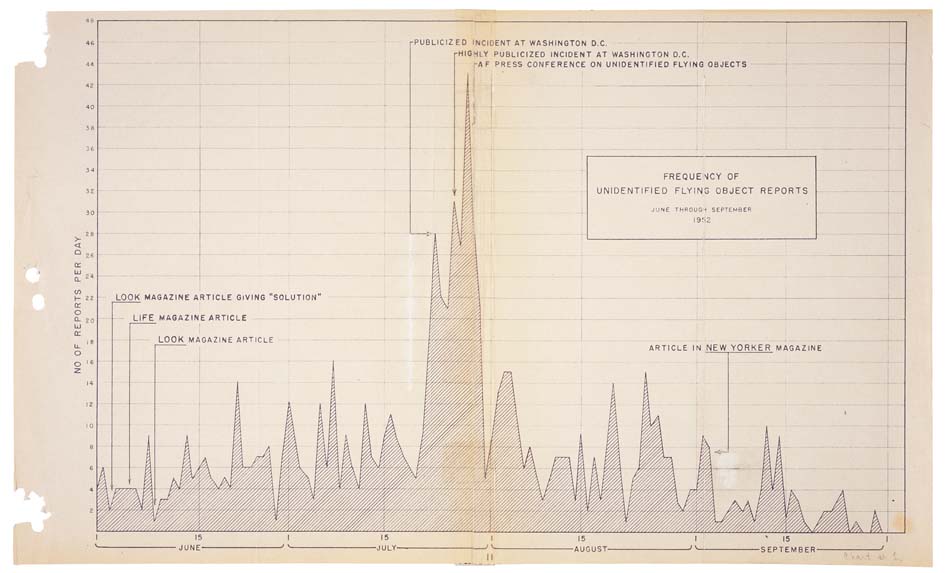
Air Force chart tracking UFO report frequency from June through September 1952. U.S. National Archives, NAID 595542; public domain.
Open a Project Blue Book file and the first thing you are likely to encounter is paperwork: a witness description, a questionnaire, a map, a photograph, an investigator’s conclusion. That ordinary administrative record is what makes the collection worth reading. It lets us follow how a strange sight in the sky became a military case, and how the Air Force decided what to make of it.
One name, several investigations
Blue Book began in March 1952, following the Air Force’s earlier Projects Sign and Grudge. Its headquarters were at Wright-Patterson Air Force Base in Ohio. The often-quoted span of 1947–1969 refers to the wider body of reports inherited by the programme, rather than twenty-two years under the Blue Book name. The National Archives’ historical overview makes that chronology clear.
The practical questions were rooted in defence. Could a reported object threaten American security? Could investigating it reveal technology useful to research and development? In a 1966 Air Force interview preserved by the National Archives, project leader Hector Quintanilla described those two goals. Watching the official films also reveals another part of the programme’s work: explaining its findings to an anxious and curious public.
What survived in the files
The case files contain observers’ accounts, correspondence, press cuttings and analyses of photographs or other evidence. Questionnaires recorded the time and place of a sighting and what the observer said they saw. A control sheet summarised the report and the Air Force’s explanation. Reading those layers together is more useful than lifting a dramatic sentence out of a witness statement.
The collection also preserves a revealing chart of reports from June through September 1952. Its annotations mark magazine articles, publicity surrounding sightings over Washington and an Air Force press conference. It invites a question about how publicity and reporting interacted. The graph alone cannot establish what caused any individual sighting.
The 701 unidentified reports
A January 1985 Air Force fact sheet, reproduced on the National Archives’ Blue Book reference page, gives the familiar total: 12,618 reports across 1947–1969, with 701 classified as unidentified. That surviving category records an unresolved identification. Treating every entry in it as evidence of the same extraordinary cause would require information the number itself cannot supply.
The Air Force’s stated conclusions were that the reports it evaluated had demonstrated no national-security threat, no technology beyond contemporary scientific knowledge, and no evidence that the unidentified sightings were extraterrestrial vehicles. Its decision to end the investigation drew on the University of Colorado study, the National Academy of Sciences review and its own investigative experience. Termination was announced on 17 December 1969.
Read the record with its date attached
Blue Book remains valuable because both the observations and the official judgements can be examined. A careful reading asks who witnessed an event, what was recorded at the time, what investigators checked, and how strongly their explanation follows from the available evidence.
The 1985 fact sheet is itself a historical document. Its remarks about future Air Force policy or where witnesses should send reports belong to that period. Keeping dates, testimony and conclusions distinct is the simplest way to make this enormous UFO archive more useful, and considerably harder to misread.
Leave a Reply